PONTE VEDRA BEACH, Fla. — Early Wednesday morning, outgoing PGA Tour commissioner Jay Monahan quietly stepped out on the back lawn behind the TPC Sawgrass clubhouse, holding a few blue Tiffany boxes.
As is tradition, Monahan shuffled around from player to player, handing each of the 14 newly minted PGA Tour members a box of silver cuff links before engaging in a short conversation. A camera trailed him until he had given out all the gifts before he shuffled away without much fanfare.
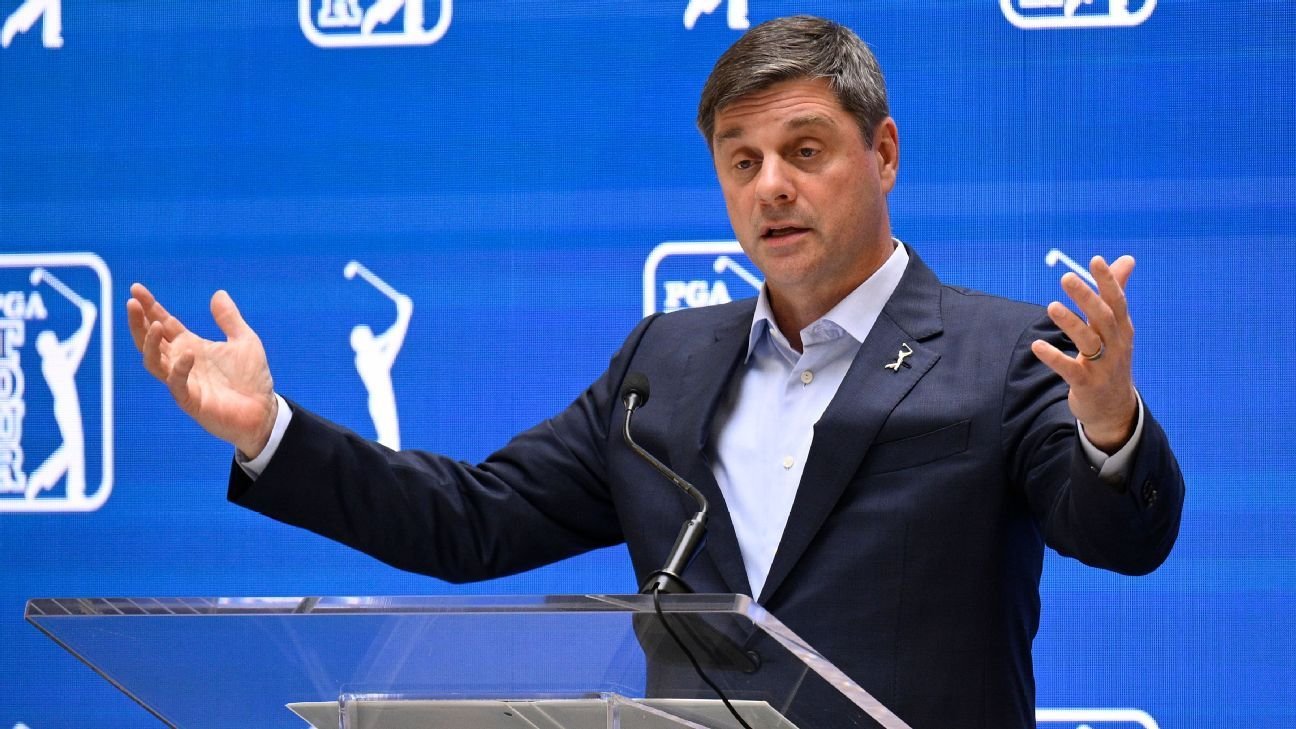
In any of the previous nine years, Monahan would be scheduled to deliver an address to the assembled media in the press room the same day. Instead, just a few hours later, Monahan was sitting in the front row as new PGA Tour CEO Brian Rolapp took the stage — not inside the media center but front and center inside the PGA Tour’s Global Home headquarters, where 1,100 people waited to hear him speak.
If the optics weren’t loud enough to signal a changing of the guard, Rolapp’s words only reinforced what was already evident: The PGA Tour has entered a new era, and it’s attempting to give itself a giant makeover. Rolapp himself went as far as to refer to it as a “blank sheet of paper.”
“We went into this project with a very clear objective,” Rolapp said of the Future Competition Committee that was announced last August. “To build the best version of the PGA Tour.”
What does that look like? It depends on who you ask, but Wednesday, Rolapp delivered his six-step plan, one that he couched multiple times as not being formally decided in any form, but also one that clearly had a purpose for being said out loud.
The headliner was the institution of a promotion-relegation system, effectively splitting the PGA Tour into two separate tiers — one for the best in the world which will feature 21 to 26 signature-style, 120-player events a year (with a cut) and a separate schedule of events for those trying to, as Rolapp put it, “ladder up” to the top tier.
A cursory reading between the lines yields a clear philosophy: the tour is taking more control of what its fields look like, and it’s going to try to ensure that anyone playing a top-tier track event has earned their way there.
“You already have a split in the PGA Tour in a sense,” Andrew Novak told ESPN, referring to the way signature events differ from regular PGA Tour events. “I think it is a good step toward trying to make it a more even playing field for everybody. Right now, for the rookies, they are in a weird spot where it’s like, ‘Yeah, you’re getting a tour card, but you’re not getting a fair shot either.’ You’re playing for less points, and they’ve got these signature events that you’re not in, so you’re already behind in that. I think it’ll hopefully be a better environment for some of the young talent to show up because hopefully it’ll be a little bit more even playing field in some of those events.”
The revamped schedule and the promotion-relegation format is the fountain from which every other aspect of Rolapp’s plan flows. With a contained number of events, the field sizes can be consistent, the points system (as well as the way players move between tiers) can be simplified, while the best players in the world will be incentivized (by way of points and purses) to play in as many top tier events as possible. Major media markets can be scouted and added to the schedule (Rolapp called out Boston, New York, Chicago, San Francisco, Philadelphia and Washington, specifically) and perhaps most importantly, there can also be more flexibility regarding where the Tour plays and when as well as what formats it implements.
“That consistency matters. It helps fans know who they will see and showcases who they want to see, the most competitive players,” Rolapp said. “It helps partners know what they’re investing in, and it helps players better understand the competitive landscape in their schedules, all while embracing meritocracy.”
“I don’t necessarily want to play less, but I also think that golf is a little bit oversaturated,” Jake Knapp said, noting that the amount of events and the cadence is something the players seem to be split on. “I don’t think anybody necessarily wants to play less, but also, we don’t want it more condensed, because we don’t want to play six weeks in a row, half a week off, and all that. So I think, in a perfect world, I think everybody’s good with playing, like, three weeks in a row and having a week off.”
The “perfect world” is a phrase Rolapp uttered multiple times during his news conference. And while the approach might have come off as idealistic, there is something to be said for the fact that Rolapp was not shy about throwing out buzzwords that have been hot topics of discussion in the golf world. A big season-opening event at an iconic, West Coast venue that will finish in prime time on national TV? Rolapp said it’s what they want. The potential for a match-play component to the PGA Tour playoffs? Rolapp said they’re exploring it.
“We have heard from our fans and our partners — they want more drama,” Rolapp said.
While it might be difficult to guarantee drama in every event, there are ways that the tour can attempt to engineer it. Match play is one of those ways while the golf courses it chooses to hold its events on is another.
“What we have this weekend [at the Players] is a standard. That is the standard we’re chasing,” Rolapp said. “Now that is, some may say, an absurd standard, but I would submit that standards are meant to be absurd and aspirational. We know all of the elements that makes this a great event include the fields, but it also includes the course. It also includes the fan experience. So we’re chasing all of that.”
Rolapp’s ambitions and the decision to essentially try to speak them into existence at this time served multiple purposes. It was an informed wish list that has clearly gone through some player input, an announcement that they’re open for business (see: major markets and sponsors) but also a receipt. Now that this is out in the open, the Tour has created a hypothetical concept for what it could look like, whether that’s in 2027 or 2028. That creates an inevitable expectation that at least most of what Rolapp outlined Wednesday will come to fruition.
“This remains a work in progress, and it is by no means a baked cake,” Rolapp said. “These are simply areas where we are starting to see a meaningful consensus.”
Finding true consensus among a host of parties that includes more than 100 players, several sponsors and broadcast partners is not easy. One rank-and-file player said Wednesday that he would be in favor of a smaller, slower-paced schedule, given that there’s a lot of uncertainty with its current format, but also added that he felt like the process of finding out what it’s going to look like next season or beyond has been frustrating.
“It’s a lot of questions and no clear answers yet,” the player said.
Others are attempting to see the longer-term vision and how these changes, whenever they go into effect, could unlock a better version of the tour, not just for players but fans, too.
“I think a lot of the things that they’re trying to address are things that I’ve heard fans say or friends of mine that follow golf say,” Novak said. “There are some flaws with following the FedEx Cup standings and playoffs. The points are hard to understand. Understanding who’s in what tournaments is tough. This [could] make it easier for new fans to get into it because they’ll understand it better. And then, hopefully, the quality of it and how it plays out for our die-hard fans is also still something that they’ll want to engage in.”
The details might shift and evolve until Rolapp addresses the media again at the Travelers Championship in late June. Obstacles may arise and players as well as other stakeholders maybe prove to be bigger speed bumps, but for now the goal is clear: to turn the PGA Tour into a more competitive, compelling and creative entity. That’s easier said than done, of course, but saying it is the first step. On Wednesday, Rolapp did not hesitate.
ESPN.com’s Mark Schlabach contributed to this report.

