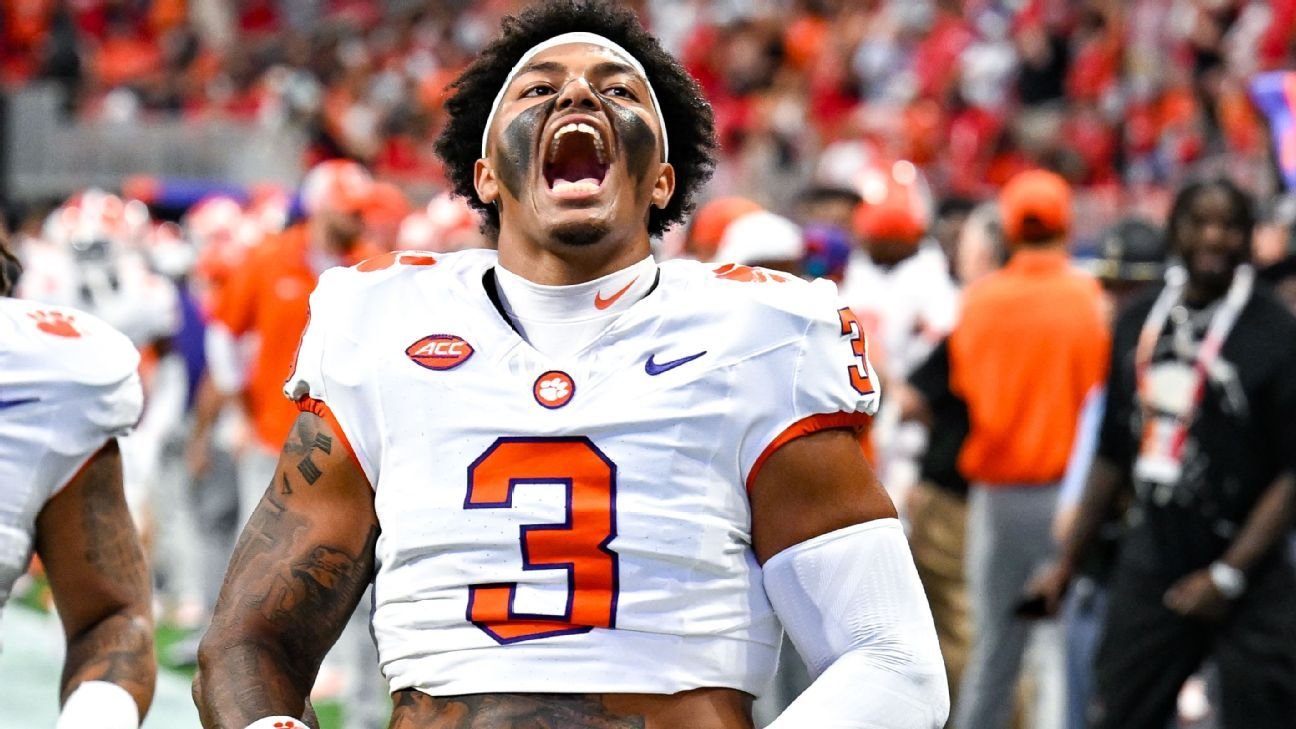
BUFFALO — The 2026 NFL draft wrapped up on Saturday after three days in Pittsburgh.
The Buffalo Bills traded out of Round 1 and picked T.J. Parker at No. 35 in the second round.
Here’s a look at the Bills’ selections and what you need to know about them:

Round 2, No. 35 overall: T.J. Parker, OLB, Clemson
My take: The Bills traded out of the first round but still came away with an edge rusher who can contribute right away with the third pick of the second round. Parker fills one of the team’s bigger holes coming into the draft, as a pass rusher who can help get after the passer and help against the run. Parker can develop under new defensive coordinator Jim Leonhard, learning behind Greg Rousseau and Bradley Chubb.
Key Stat: Parker had 39 career tackles for loss, the second most in FBS since 2023. He also is the only FBS player since 2024 with at least five forced fumbles and five fumble recoveries. Those are the kind of impact plays the Bills will be looking for from Parker in the years to come.
My take: The Bills moved up four spots, giving up a sixth-round pick in the process, to add another outside cornerback. The move shows a team trend, investing in draft picks on the defensive side of the ball. In the past six drafts, 13 of the 19 picks the Bills have made in the first four rounds have been defensive players (including six straight).
An area to watch for Igbinosun is penalties. In 2024, he was the most-penalized defender in the FBS, getting flagged 16 times in coverage. He did improve in 2025, however, only being penalized five times in coverage.
Will he start as a rookie? That is not the plan. GM Brandon Beane said that Christian Benford, the team’s clear No. 1 corner, and last year’s first-round pick Maxwell Hairston are the “penciled in starters.” Igbinosun slots in as the team’s third cornerback. Beane noted how he brings a different skillset and depth to a position the team highly values. The 6-foot-2, 189-pound cornerback will still, however, have the opportunity to play, in certain situations and it is a spot the Bills have dealt with injuries, which was a part of adding depth to the position.
Round 4, No. 102: Jude Bowry, OT, Boston College
My take: Bowry gives the Bills some depth at both tackle positions. He started 21 games at left tackle in college and two at right tackle — but he very well may have an opportunity to play guard for Buffalo. The only open position on the starting line is left guard.
He adds depth and the Bills hope to develop him over time. He also provides value as someone that could potentially back up multiple positions with the team also losing restricted free agent swing tackle Ryan Van Demark this offseason.
Round 4, No. 125: Skyler Bell, WR, UConn
My take: The Bills addressed the wide receiver room with Bell, who was the only FBS player to finish in the top five in receptions, receiving yards and touchdown catches last season. His yards after catch ability (833 yards after the catch in 2025, second most in FBS) and experience with high volume makes him a fit for what the Bills look for.
He also has ability in the slot and outside and adds a playmaking ability. He has similar qualities to Khalil Shakir, but bringing in Bell will help Joe Brady move players around the field.
My take: The Bills addressed a major position of need with Elarms-Orr, adding to an inside linebacker room that had yet to be addressed this offseason.
He’ll bring significant speed, an important part of coordinator Jim Leonhard’s defense. He ran a 4.47-second 40-yard dash at the combine, second-fastest among linebackers and had 130 total tackles in 2025, most in the Big 12. He also has experience playing special teams, but he very well could compete for a starting role and be a valuable part of this defense for now and the future.
Round 5, No. 167: Jalon Kilgore, DB, South Carolina
My take: Kilgore brings versatility and a logical fit into the defense and the current depth on the roster. While the team added to the safety and nickel positions in free agency, a young player who has experience playing all over the field brings important qualities to this defense and that is something Beane values.
He’ll give the team depth in the secondary, and if he develops well, he could compete for a starting job in future seasons. He also will have opportunities to contribute on gamedays this season with him being able to play safety and nickel.
Round 5, No. 181: Zane Durant, DT, Penn State
My take: Durant brings depth to the line and will compete for a role as a backup. While a bigger nose tackle was seen by many as a need for Buffalo, Durant instead brings speed — he led all DTs with a 4.75 40-yard dash — and a smaller size (6-foot-1, 290-pounds).
He has experience lining up as a 3-technique. He is also just the latest part of the defensive rebuilding through the draft, with the Bills using five of seven picks in the first five rounds on that side of the ball.
Round 7, No. 220: Toriano Pride Jr., CB, Missouri
My take: Pride brings depth to the defensive backfield, primarily playing outside cornerback during his college career. He’s smaller (5-foot-10, 185 pounds) but brings speed — he ran a 4.32 40-yard dash at the combine.
Pride is a strong and willing tackler, something the Bills have valued in their cornerbacks. He will ultimately have an uphill battle to make a competitive 53-man roster.
Round 7, No. 239: Tommy Doman, P, Florida
My take: Doman will have a very real opportunity to win the Bills’ punting job and earn the role as the long-term answer at the position after the Bills went through significant turnover at punter last year.
He will compete with veteran Mitch Wishnowsky, who returned to the team on a one-year contract after joining the Bills midseason in 2025. But this will likely be Doman’s job to lose.
My take: Guard was a position in need of some additional depth coming into the draft. Reed-Adams will have to fight for an opportunity and has the size (6-foot-6, 314 pounds) to do so. He gives the team another presence in the interior of the offensive line

