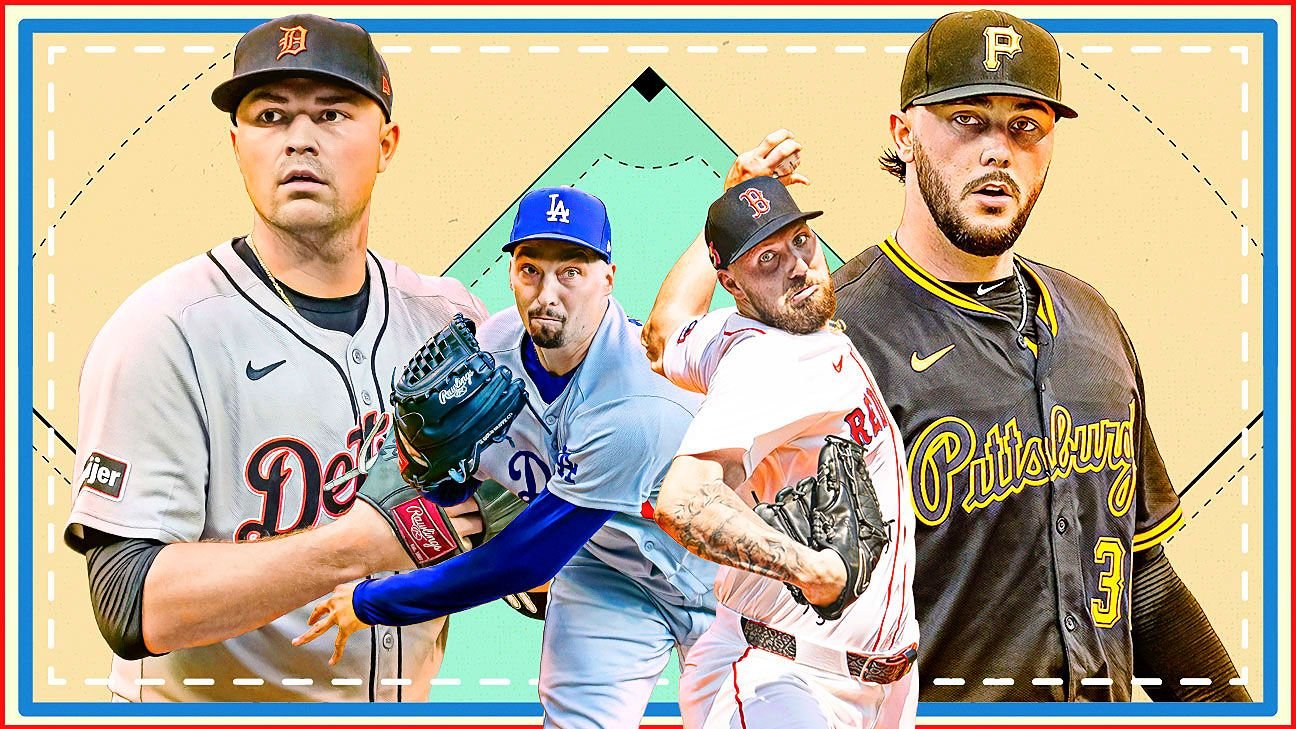
Spring training camps are underway, which means it is time to look at the state of baseball. As part of our 2026 MLB season preview, ESPN’s Buster Olney surveyed those around the industry to help him rank the top 10 players at every position as part of his annual positional ranking series.
The objective of this exercise is to identify the best players for the 2026 season, not who might be best in five years or over their career. We will roll out a position per day over the next two weeks. With starting pitchers up first, here’s the rest of the schedule: relievers (Tuesday), catchers (Wednesday), first basemen (Thursday), second basemen (Friday), third basemen (Feb. 23), shortstops (Feb. 24), corner outfielders (Feb. 25), center fielders (Feb. 26), designated hitters (Feb. 27).
Who are the best players today? Check out who makes the list at every position.
The question is simple: Who is the best pitcher on the planet, Tarik Skubal or Paul Skenes?
But the initial responses of Major League Baseball industry evaluators suggest overwhelming brain fry.
“Oh, wow …”
“C’mon …”
“You’re asking me?”
“Are you f—ing kidding me with that?”
Within our annual top-10 lists of players at each position, there are some really good — and fun — debates. Would you prefer Juan Soto or Aaron Judge in right field? Where should Mookie Betts be on the list of shortstops, after his surprisingly excellent defensive play last year? Is Patrick Bailey, generally considered to be the best defensive catcher, among the top three at the position? Has Nick Kurtz already surpassed perennial stars such as Bryce Harper and Freddie Freeman among first basemen?
But picking between Skubal and Skenes for the best starting pitcher in baseball has confounded evaluators more than any other discussion, leaving them to dig deep to separate the two generational stars.
You could look at ERA+: Skenes finished last year at 217, with Skubal at 187. If you prefer strikeout rate to assess pure dominance, Skubal would be the guy, after whiffing 32.2% of the batters he faced last year; Skenes struck out 29.5% of batters.
If you focus on command, Skubal’s walk percentage was a microscopic 4.4% — but Skenes was in the same neighborhood at 5.7%. One evaluator opined that maybe Skenes was the better choice because he commands the running game better — and yes, Skubal was on the mound when Josh Naylor stole a base in a pivotal moment in Game 5 of the American League Division Series. But over the past two regular seasons, Skubal has allowed only six steals in 13 attempts, while Skenes allowed only 10 steals in 13 attempts, shockingly low for a tall, right-handed pitcher.
One AL coach whose team has faced both pitchers said that when hitters return to the dugout after facing Skenes or Skubal, there is no bravado, feigned or real; they are just quiet, maybe because they felt overmatched in the batter’s box.
“You can get something to swing at against a lot of the other guys,” the coach said of the other pitchers on the top-10 list. “They might challenge you with a fastball, or hang a secondary pitch. But with [Skubal and Skenes], it’s just different.”
That’s why they are at the top of this list. But which ace takes the No. 1 spot?
Top 10 starting pitchers

1. Tarik Skubal, Detroit Tigers
If you think Skenes should be here, there are a lot of folks in the big leagues who would agree with you. But Skubal is here for a couple of reasons.
First, he’s left-handed, with one manager saying, “All things being equal, you prefer the left-hander.”
Second, Skubal has been at the top of the mountain longer than Skenes, who made his major league debut early in the 2024 season. Skubal also has back-to-back Cy Young awards, something that hadn’t been accomplished by an American League pitcher in about a quarter century. Greg Maddux (1993-95) and Randy Johnson (1999-2002) are the only pitchers to win at least three consecutive Cy Young awards, something Skubal will try to do this season before he enters free agency after the 2026 season.
Skubal’s fastball is so good, said one staffer, that even when hitters can anticipate the pitch, they will swing through it — and of course, that fastball is complemented by Skubal’s extraordinary changeup.

2. Paul Skenes, Pittsburgh Pirates
Some evaluators who preferred Skenes at No. 1 on this list believe he has been hit hard in fewer of his starts. Last season, he allowed three earned runs or more in only six of his 32 starts, and he allowed five earned runs only once — against the St. Louis Cardinals on April 8.
But Skubal also fared well when measured by this standard — he allowed three earned runs or more in 10 of his 31 starts, and, similar to Skenes, had only one start in which he allowed as many as five earned runs, against the Boston Red Sox on May 14.
Skenes’s slash line is slightly better than Skubal’s: Hitters mustered just .199/.250/.307 against Skenes in 2025, while Skubal was at .199/.240/.319.

3. Yoshinobu Yamamoto, Los Angeles Dodgers
There’s a more than reasonable statistical argument for Yamamoto being at or near the top of this list, given how great he was in the playoffs and World Series. And he compares favorably with Skenes and Skubal in how hitters fared against him: Opponents batted only .183 against Yamamoto, with a .283 slugging percentage.
To put that last number into perspective, among 154 hitters who had enough at-bats to qualify for the batting title last year, Ke’Bryan Hayes had the lowest slugging percentage, at .306. All hitters were collectively worse against Yamamoto than the worst slugging hitter in the big leagues.
But Yamamoto threw markedly fewer innings in the regular season than Skenes or Skubal because of the Dodgers’ philosophy of trying to keep their pitchers as fresh as possible for the postseason. Whereas the No. 5 pitcher on this list generated 8.0 WAR in the regular season, Yamamoto finished at 5.0 WAR, ninth best among qualified starting pitchers. It’s hard to imagine the Dodgers allowing Yamamoto to shoulder a heavy regular-season workload in the way that someone such as Logan Webb does for the San Francisco Giants.

4. Garrett Crochet, Boston Red Sox
Boston got everything it hoped for from the left-hander after making a blockbuster deal with the Chicago White Sox and signing Crochet to a six-year, $170 million contract. Crochet led the AL in innings (205⅓) and batters faced (814), and led the majors in strikeouts (255). He had a strikeout rate of 31.3% and a ground ball ratio of 48.3%; there wasn’t much for hitters to swing at.

5. Cristopher Sanchez, Philadelphia Phillies
Early in spring training last March, then-Orioles manager Brandon Hyde began a conversation with some visiting reporters by mentioning Sanchez. “Have you seen him this spring?” Hyde said, before detailing Sanchez’s jump in fastball velocity.
Hyde’s read was prophetic; Sanchez was the majors’ breakout pitching star of 2025, mixing his disappearing changeup with that fastball and striking out 212 in 202 innings. He’s 29 years old, and the Phillies have him under contractual control through 2030, with two option years in 2029 and 2030, as part of a four-year, $22.5 million deal he signed in the middle of the 2024 season.

6. Hunter Brown, Houston Astros
Last season, the Astros’ right-hander posted an ERA+ of 172, while holding opponents to a .201 average.

7. Max Fried, New York Yankees
Fried’s career ERA+ is 141, 19th all time. He’s tied with Chris Sale in that category and ahead of Roy Halladay, Whitey Ford and his childhood hero, Sandy Koufax.

8. Logan Webb, San Francisco Giants
Webb is the sort of workhorse starter who is becoming increasingly rare in MLB. At a time when few pitchers reach 200 innings, Webb cares about that milestone, about taking the ball — and keeping it — into the late innings. He has compiled 627⅔ innings over the past three seasons and led the majors in starts each of the past two years.

9. Chris Sale, Atlanta Braves
Sale followed his Cy Young Award season of 2024 with a 2.58 ERA in 21 appearances before he got hurt in 2025. His Hall of Fame case will look very similar to that of Jacob deGrom‘s, in the end, with dominant seasons wrapped around an extensive period of injuries.

10. Jacob deGrom, Texas Rangers
DeGrom held hitters to a .196 average in 30 starts last season, his best performance in years. His eventual election into the Hall of Fame now seems to be a lock, considering the recent trend in which voters reward candidates for peak performance. His career ERA+ is at 151, sixth all time, behind Clayton Kershaw and Pedro Martinez, who are tied at 154.
Honorable mentions
Blake Snell, Dodgers: There are stretches in each season in which he can be the most dominant pitcher in the big leagues; in his last eight starts of 2025, he had a 2.09 ERA. But he has been unavailable for months at a time — he has 31 starts over the past two seasons, and last year, he contributed just 61⅓ innings.
Zack Wheeler, Phillies, and Gerrit Cole, Yankees: The Phillies say that Wheeler’s recovery from thoracic outlet syndrome is going well and believe he’ll be back relatively early in the season. The Yankees hope that Cole could be back on the mound in the first half of the season. And once both of those things happen, there’s every reason to believe the pair will move back into the top 10 of this list.
Freddy Peralta, New York Mets: He finished fifth in the National League Cy Young voting last season, after posting a 2.70 ERA in 33 starts.
Bryan Woo, Seattle Mariners: He became the de facto ace of the Seattle rotation last season.
Dylan Cease, Toronto Blue Jays: Toronto signed him to a seven-year, $210 million deal this past winter because of his power stuff — he has 1,106 strikeouts over the past five seasons.
Andrew Abbott, Cincinnati Reds: He produced 5.6 bWAR for Cincinnati last year, with a 2.87 ERA in 29 starts. His teammate Hunter Greene also has the potential to break into the top 10 given his overpowering stuff; however, he’s been limited to 370 innings over the last three seasons.
Carlos Rodon, Yankees: He allowed just 132 hits in 195⅓ innings last season.
Kevin Gausman, Blue Jays: Incredibly consistent over the past five seasons.
Cole Ragans, Kansas City Royals: Kansas City’s swap with the Rangers for Ragans — for impending free agent Aroldis Chapman — is one of the best trades of the past decade.

