Come Saturday, all eyes will be on New Zealander Cam Jones (Scott), the defending Unbound 200 champion, who smashed the competition in last year’s race with a 150-mile breakaway effort alongside French rider Simon Pellaud (Tudor Pro).
Not only will we be watching to see if he can out-power the competition again, but also what he’ll be riding.
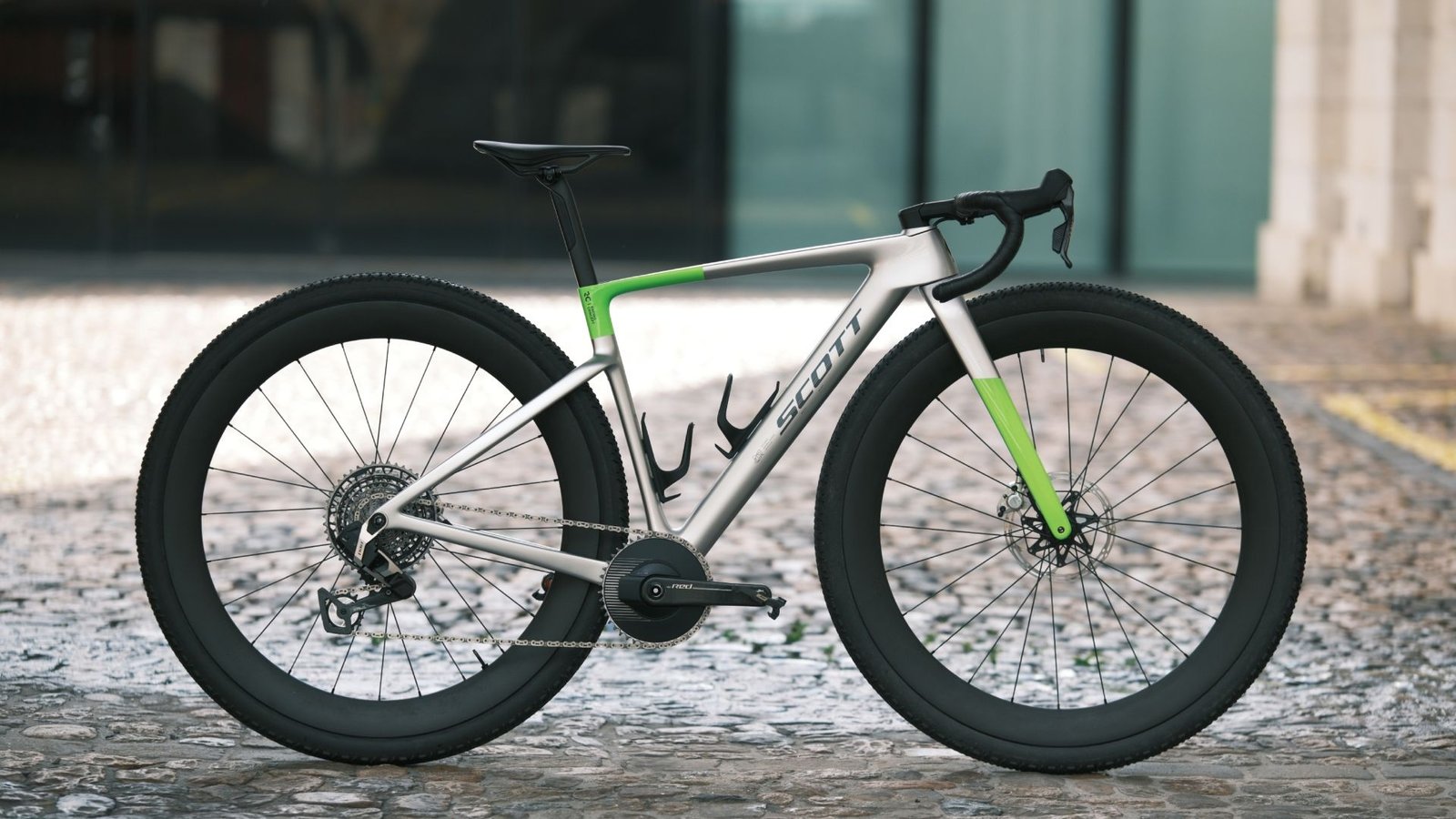
Scott today announced that Jones, as well as Swiss ultra-cyclist Robin Gemperle, will tackle the unforgiving terrain of the Kansas Flint Hills aboard a prototype bike built around 32″ wheels. And one that, Scott emphasised, “will never be released on the market.”

While cycling’s governing body, the UCI, dictates that all equipment used by its pro riders must be made commercially available within 12 months of it appearing in competition, gravel racing largely exists outside UCI governance. This means there are far fewer restrictions on equipment and much more freedom for manufacturers to experiment.
For years now, Unbound and its notoriously unforgiving terrain have served as both testing ground and launching pad for the latest gravel tech.
“Our athletes don’t just race; they test, challenge, and refine,” says Scott. “Cameron Jones and Robin Gemperle have been riding a 32” prototype gravel race bike since last year. What began as a theoretical concept — a ‘what if’ — was quickly brought to life by Scott’s R&D team.”
Thirty-two-inch wheels have become one of the industry’s biggest talking points this season, with nearly every tyre manufacturer showcasing products in the size at April’s Sea Otter Classic. Proponents of the new platform argue that a bigger wheel has greater momentum and therefore carries more speed. And, as we’ve learned with the emergence of the 29ers in mountain biking, larger wheels can roll over obstacles more easily. And then there are the tyres that go on them: more tyre means more contact patch, which translates into more grip, while a larger tyre also enables riders to run lower pressures without sacrificing traction.
But while tyre manufacturers appear fully committed to the format, we haven’t yet seen too many bike manufacturers roll out bikes in this new size aside from a handful of smaller custom builders. Scott is therefore among the first major brands to publicly back the concept.
According to the brand, it took just one test ride for Jones and Gemperle to be convinced that this would be their bike of choice for Unbound Gravel.
“This bike makes you feel like you’re levitating over the surface. I’ll be experiencing a road race while everybody else is racing gravel,” said Jones about his Scott RC Gravel 32″ bike.
“The driving traction and cornering grip is revolutionary. I’m genuinely scared how fast I’ll be able to corner once on a course with proper descents.”
Gemperle, who won the 2025 Tour Divide and Silkroad Mountain Race, said that the 32″ wheel platform is just what gravel racing has been waiting for.
“We started by riding an unfinished bike, with crucial parts still developing. But ever since, I’ve known that even if there wouldn’t be a single additional test ride, I’d immediately take it to racing once granted permission,” he said. “There were plenty of additional rides, and the project found its final shape, which cemented the feeling that this big boy is the actual size gravel racing and especially Unbound Gravel was waiting for.”
Cam Jones’ Scott RC Gravel 32″ Bike Prototype
Image 1 of 4


- Frame: Scott RC Gravel 32″ Bike Prototype
- Handlebar: Syncros ST-R100-AL Stem 110mm, ENVE Aero Road bars 370mm
- Groupset: Shimano XTR with Dura Ace shifters and GRX Cranks
- Crankset: Shimano GRX with 4iiii Power meter and 160mm Crankset
- Wheelset: I9 Wheels (Custom Wheels Prototype)
- Tyres: 32“ Schwalbe RX 50mm
Robin Gemperle’s Scott RC Gravel 32″ Bike Prototype
Image 1 of 3


- Frame: Scott RC Gravel 32″ Bike Prototype
- Handlebar: Syncros HB-R 100 Alloy Handlebar 80/360mm
- Groupset: RED AXS XPLR 13 Speed Electric group set
- Crankset: SRAM RED XPLR Power Meter Crankset, 46T
- Wheelset: 32“ Prototype Wheels
- Tyres: 32“ Schwalbe RX 50mm
Explore More

