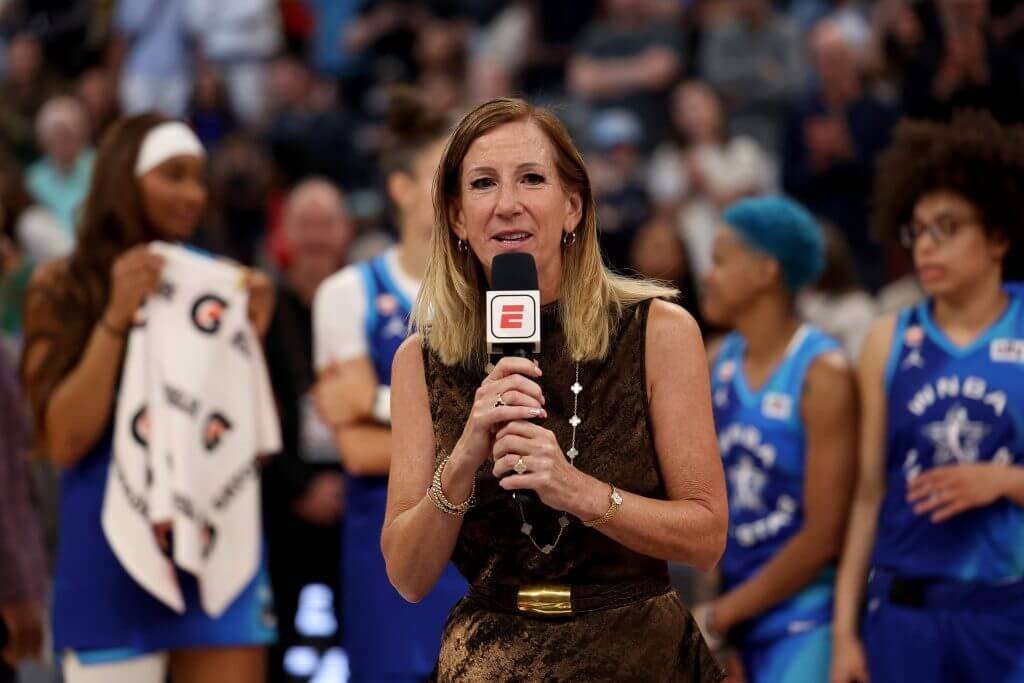
Cathy Engelbert doesn’t communicate well with the players of the WNBA. She doesn’t text the current women in the workforce on their birthdays, nor acknowledge the O.G.s on their retirements. Mostly, she doesn’t reach out when they feel under attack from the cretins crawling about social media. Some of the WNBA’s biggest stars say they have no relationship with Engelbert. To put it succinctly, she’s not a good hang.
When she does open up, though, Engelbert can come across as dodgy. When asked straight-to-the-point, no-fluff questions, she breaks out her best Neo, dodging those kinds of direct inquiries from reporters as though they’re bullets from Agent Smith. In a nutshell, her interpersonal skills suck.
Advertisement
Yet for all that Engelbert lacks in warmth, she seems to be doing the one thing that she’s paid to do well. And that’s to be the commissioner of a major, growing and prosperous professional sports league. It’s time to stop adding new and superfluous job requirements to the job description for “WNBA commissioner.” Neither Engelbert nor anyone who might replace her can live up to the touchy-feely standards some people have placed upon this position.
Put another way:
The league doesn’t need a change at the top. However, players, stakeholders and fans of the W need to change their expectations.
Engelbert might never master how to effectively dap and tuck it in like NBA commissioner Adam Silver expertly knows how to greet his players. Instead, she does expertly provide cover to a group of team owners — you know, her employers — who largely remain out of the crosshairs of criticism. (Shouldn’t team owner Mat Ishbia have received questions about the support he provided Phoenix Mercury players when they faced online attacks?)
Advertisement
Engelbert might never bear-hug a draft pick the way NFL commissioner Roger Goodell does so affectionately every April. However, she did help corral a media rights deal that has soared past $3 billion, money generated from several broadcast partners such as Disney, USA Sports and NBC Universal. (Such has been the growth of the league that the 16 percent stake sale she made in 2022, when the league needed an infusion of cash, now looks like a raw deal.)
Don’t ever, ever expect her to invite an enemy — I mean, a reporter — over to her personal residence, the way NWSL commissioner Jessica Berman has. Engelbert, however, oversaw the approval of a new collective bargaining agreement and a revenue share — the first of its kind in women’s professional sport — that is projected to provide upwards of $1 billion in player salaries and benefits over the next seven years.
Engelbert might never be considered as chill, down for the cause, or the kind of boss the players would want to sit down with and sip a “Stud Bud” cocktail. But last we checked, the WNBA is booming. The average WNBA salary has risen 450 percent under her watch, from roughly $130,000 in 2020 to $600,000 now. If money is the marker for progress — and yes, in professional sports, money is always the main thing — then she’s doing her job. As much as it pains me to admit.
I’ve rolled my eyes at the many missteps of Engelbert. Why couldn’t she just condemn the racism leveled at Angel Reese and other players during that 2024 CNBC interview, rather than praise the television ratings? Why did she, according to Napheesa Collier, act defensive about the blatantly poor officiating by calling players who complain “losers”? Why’d she have to insult her audience at the start of this season by bringing up her gender when asked a fair question about her job performance? Ugh.
Messaging is part of her job description, and she’s not exceptionally good at that. This tracks with one of the biggest complaints against Engelbert. She doesn’t talk enough with players.
Advertisement
Recently, The Athletic’s Annie Costabile wrote a fascinating, well-reported piece about how Engelbert is viewed around the league. One telling anecdote: Former player Candace Parker said she receives a gift from Silver, the NBA commissioner, every Christmas, and that he reached out to congratulate her following her retirement.
However, Parker never heard from Engelbert.
New York Liberty star Sabrina Ionescu also said she talks to Silver more than Engelbert. Las Vegas Aces forward A’ja Wilson, the league’s best player and four-time MVP, said she only speaks to Engelbert when the commissioner’s in town to present her a trophy.
These women of the W aren’t the only professional athletes to point out their icy relationship with their commissioner. In 2020, many men of Major League Baseball didn’t like Rob Manfred, in part, because he had described their game’s championship trophy as a “piece of metal.”
Advertisement
No offense to these elite athletes, but a commissioner was never meant to be a camp counselor. The businesswomen and men who run sports leagues come from backgrounds in the legal field or Fortune 500 companies. Their personalities aren’t exactly warm and cuddly. Sure, it’s great that Silver, a lawyer adept at dapping, is generally liked by players, but that relationship equity can disappear the moment he makes a controversial ruling, such as the 65-game minimum rule.
The job of a commissioner, at the core, is to protect the interests of the owners and raise capital for the league. Engelbert has done that. And surely, Parker might appreciate the $100,000 bonus she’s entitled to as a retired player, following the ratification of the CBA, more than any Christmas card she gets from Silver.
Still, the widespread belief that Engelbert hasn’t done enough to protect players might be her downfall.
More than any other sports league, the WNBA is fraught with land mines that are ready to explode whenever a Black woman — like, Alyssa Thomas — commits a hard foul on, say, the league’s most visible star, Caitlin Clark. Or when a culturally conservative player/podcaster, Sophie Cunningham, voices her opinion on trans athletes. Or when some man behaving like a degenerate gambler plods into Chelsea Gray’s DMs with a disgusting slur.
Advertisement
No commissioner can police, or be held responsible for, online behavior. However, the truth is, for any modern-day pro player under attack, help isn’t merely available; it’s plentiful. Billionaire owners, the team’s front office, coaches, agents and managers — their job descriptions are to protect their people. Since when did it become the duty of a league commissioner to serve as support staff?
The rank stench of racism, homophobia and misogyny still perfumes our world, on social media and in society at large. It isn’t going away. And no one leader can magically make wayward “fans” behave. Not even one who regularly texts “hey girl!” to players. No commissioner — not Silver, not Goodell, not anyone — could have stopped the ugly blowback directed at Thomas following her flagrant foul against Clark.
WNBA players are unhappy with Engelbert’s lack of outreach, behind the scenes, when that sort of ugliness happens. Point taken. But for the now-flourishing WNBA, the question remains: Can the league be about business, without expecting its commissioner to be the players’ bestie?
This article originally appeared in The Athletic.
Advertisement
Minnesota Lynx, New York Liberty, Seattle Storm, Los Angeles Sparks, Washington Mystics, Atlanta Dream, Chicago Sky, Connecticut Sun, Indiana Fever, Dallas Wings, Las Vegas Aces, Phoenix Mercury, Golden State Valkyries, Portland Fire, Toronto Tempo, WNBA, WNBA Highlights
2026 The Athletic Media Company

