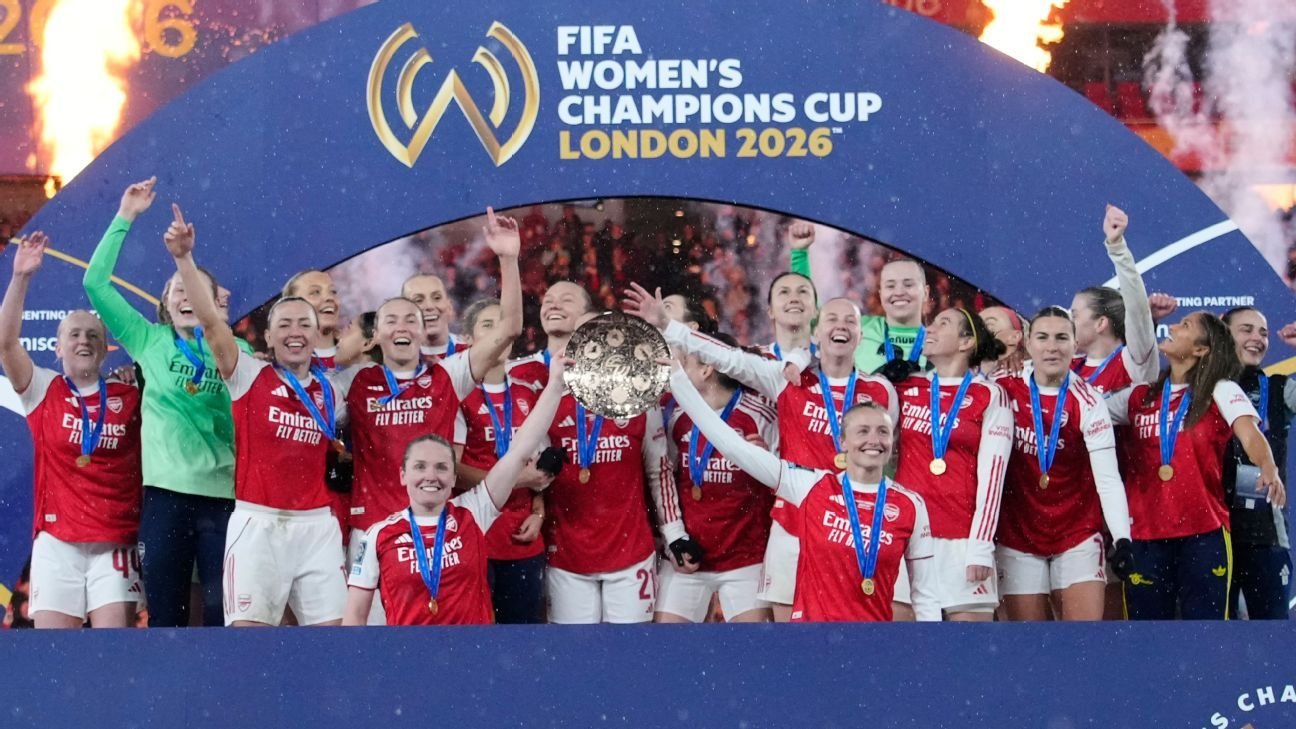
LONDON, England — Arsenal made history as the first winners of the FIFA Women’s Champions Cup on Sunday, beating out Copa Libertadores winners Corinthians, 3-2 and, as a result, they claim the title as the best club in the world. But the inaugural edition of the six-team competition turned out to be anything but a fair judgement of who claims the bragging rights as the cream of the crop of world football.
The competition was tipped as the battle between the best club in the world from each of the six confederations — though only four made it to the semifinals in London. The Champions Cup, implemented after a new Women’s Club World Cup was postponed to 2028, is supposed to provide an adequate way to assess where the continental Champions League winners fair regarding one another and a way to compare leagues across the globe.
But there will never be a completely fair way to judge the best club in the world — not when various leagues run at different times of the year and there is no one location that would not benefit at least one club. Even so, the Champions Cup fell short of what it could’ve been by not giving every team an equal shot at winning the title.
For the inaugural edition, two teams were in season, two teams were out of season, one club was playing in their backyard, two clubs travelled over six hours and there have been reports of disparity in facility access. Arsenal had the upper hand before a ball was even kicked — but it almost did not matter.
The Gunners were made to work for victory over Corinthians, twice squandering leads to allow the relentless never-say-die mentality of the South American champions back into the game, eventually sealing victory after extra time. A defensive error from Corinthians, failing to clear the ball away from Stina Blackstenius allowed her shot to be parried into the path of Olivia Smith whose powerful volley took a deflection to end up in the back of the net.
The lead was short-lived as a scramble in Arsenal’s box allowed 40-year-old skipper Gabi Zanotti, the crown jewel who netted the only goal to see the South American side into the final, head the ball over the line.
It was an Arsenal header from centre back Lotte Wubben-Moy lurking in the box that gave Arsenal the lead again, but a contentious penalty call on Gisela Robledo by Katie McCabe in the box gifted Corinthians a last-ditch effort to salvage a chance and sent the game to extra time.
Corinthians were dispossessed on the halfway line by a tenacious Frida Maanum who set up Caitlin Foord to strike low past the keeper, ultimately securing another trophy in the cabinet, possibly the only one the club may see this season.
Truthfully, the pendulum of the competition was always set to swing in the favour of reigning UEFA Champions League title-holders Arsenal. From the location, to the facilities, to the timing of the tournament and lack of travel, it made the comparison and judgement of the four clubs and in turn the leagues and confederations of which they belong to, redundant.
The competition was relocated from the west coast of the United States to London, mainly upon request of Arsenal. The club was unwilling to add several hours of travel and jet lag to their quick turnaround in between two vital title race games — they beat Chelsea 2-0 and face league leaders Manchester City next weekend — so the competition was moved closer to home. Well, to their home stadium, to be exact.
Host venues were only confirmed in December, one month prior to the competition starting. Due to the poor timing and planning, there were little options available as the semifinal clashed with men’s Champions League games and the final fell on a weekend with plenty of London clubs playing at home in the Premier League and Women’s Super League (WSL). Brentford hosted the two rather empty semifinals and Arsenal’s home stadium, the Emirates, became the host for the final, home advantage and all.
Arsenal were able to train at their own facilities, a state of the art training complex in Hertfordshire while the three other teams were dotted around the city with disparity in the access to facilities than what Arsenal have at their disposal in their daily environment.
Arsenal are in season, another factor in their favour, while New York-based Gotham FC and Corinthians are in the middle of their preseason, yet to start the 2026 season. Though this does directly impact their season and adds two extra games than their top three rivals, the side are inform, something that cannot be said for Gotham who, despite a month long preparation in Europe, looked vastly off the mark in the 1-0 loss to Corinthians on Wednesday.
Brazilian fans, a loud, hefty contingent who matched the home fans for passion at both the semifinals and final with their chanting and dancing, viewed this as the most important game in Corinthians history, a chance for the domestically dominant side to challenge themselves against the best in the world and prove where they compare on the world stage.
And though it was not the fairest of contests or the result they would’ve wanted, Corinthians, the underdogs, proved critics wrong, beating out Gotham 1-0 and showcasing just what South American football is all about: grit, resilience and the ability to push teams to the very limit in pursuit of silverware.
Though the Champions Cup victory would suggest that Arsenal are currently the best team in the world, beating out the confederation winners of the five other continents, the 13 point gap with WSL leaders Manchester City — albeit with a game in hand –and failure to qualify for the Champions League knockouts directly, would suggest otherwise.
Perhaps the Club World Cup in 2028 will provide a more accurate way to determine who really is the best club in the world.

