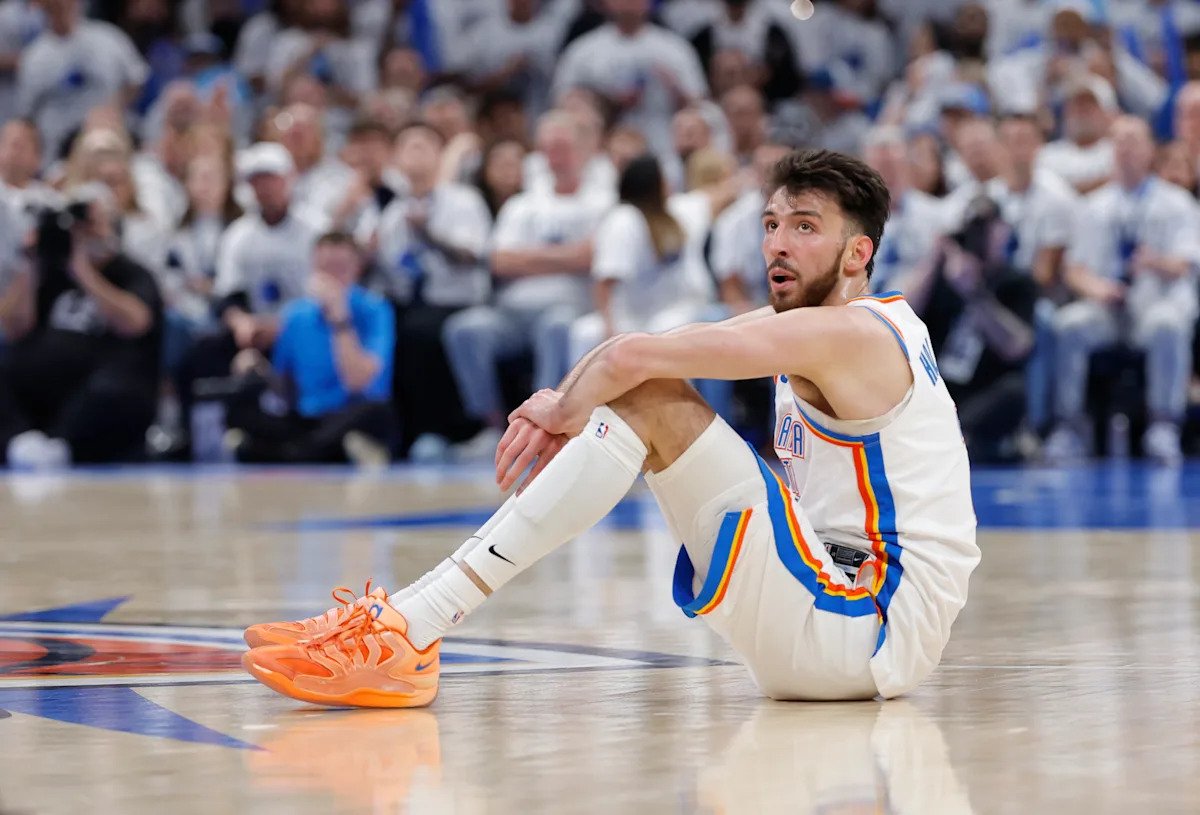
Chet Holmgren took two shots in Game 7 of the Western Conference finals. And he didn’t attempt a third after Victor Wembanyama rose up and detonated on him for one of the most violent dunks of these playoffs:
(Christian Petersen via Getty Images)
The poster was so emphatic it seemed to physically eliminate Holmgren. He just sort of stopped existing. Bobbled passes. Tripped over his own feet. Drifted into the corners and stayed there. Holmgren was so horrible that a debate was sparked on social media regarding his future in Oklahoma City.
Advertisement
It’s a worthy conversation. Even if Wemby wasn’t lurking, Holmgren looked incapable of scoring against other San Antonio defenders. It was illuminating how bad he was.
It’s also not the first time Holmgren has been a shrinking violet on offense:
-
In 2022, Holmgren averaged 12.8 points on 13% shooting from 3 in five conference tournament and NCAA tournament games for Gonzaga.
-
In 2024, Holmgren shot 22% from 3 in Oklahoma City’s 2024 second-round series loss against Dallas.
-
In 2025, Holmgren was terrible offensively in the NBA Finals against Indiana. He averaged only 12.3 points on 47% from 2-point range and 16% from 3.
Chet is now 30% from 3 in 48 career playoff games. Down from 37% for the regular season. His shooting isn’t translating to the playoffs and he has shown no signs of being a shot creator. Now his five-year, $240 million max is about to kick in.
So, trade Chet? I don’t think the answer is a definitive yes, to be clear. Chet was voted second for Defensive Player of the Year for a reason. He might’ve got dunked on, but he still made some competitive plays for the Thunder on that end throughout the series. And he’s only 24 years old, so there’s room for growth on offense.
Advertisement
But it is completely reasonable to question whether Chet should be part of Oklahoma City’s future. He has struggled offensively in the playoffs. He’s about to get paid big money. Durability is a concern too. He missed his entire rookie season with a Lisfranc injury to his right foot, and missed 50 regular-season games last year with a hip bone fracture. Those types of injuries piling up for a 7-footer is pretty scary.
On top of all that, there’s a harsh financial reality facing the Thunder. With Holmgren and Jalen Williams both becoming max contract players next season, the franchise currently projects to have $260 million on the books for 2026-27. That puts them about $40 million above the second apron, which would lead to $500 million in salary and luxury tax penalties on top of all the penalties that come with being a second apron team. Those penalties are debilitating:
-
Can’t send out cash in deals
-
Can’t use traded player exceptions
-
Can’t combine contracts in trades
-
Can’t take back more salary than they send out
-
Can’t sign players on the buyout market
-
Can’t complete sign-and-trades
-
Can’t use a portion of the midlevel exception
-
Can’t trade your first-rounder seven years into the future
-
Can’t keep your homegrown core together
OK, just kidding about that last one. That’s actually not written in the collective bargaining agreement. But look at the other eight and tell me it isn’t the spirit of the thing.
Last summer we saw the Celtics, Suns, and Timberwolves all make cost-cutting moves to get under the apron. Boston traded away two starters (Jrue Holiday and Kristaps Porziņģis) and let two free agent veterans walk (Al Horford and Luke Kornet). Phoenix waived Bradley Beal. Minnesota let go of Nickeil Alexander-Walker, who went on to win Most Improved Player this year in Atlanta.
Roster turnover is coming for Oklahoma City no matter what. The only open question is timing. This summer alone, the Thunder have to make team-option calls on Isaiah Hartenstein ($28.5M), Lu Dort ($18.2M), and Kenrich Williams ($7.2M). Picking up all three would launch them clear past the second apron. A year after that, Cason Wallace hits restricted free agency and Isaiah Joe’s deal can run out. So, the roster that just lost Game 7 is not the roster that gets the next crack at San Antonio. It can’t be.
Advertisement
The Thunder can work to get under the tax in less explosive ways: Get rid of Dort, Joe, and Aaron Wiggins, and replace them with cheaper players. (Ajay Mitchell, Jared McCain, and Nikola Topić all have two more years on their rookie contracts, so they could take on even bigger roles.) They could deny Hartenstein’s option and re-sign him at a lower number. Or let Hartenstein walk and bet on a healthy Thomas Sorber, the rookie center they drafted last year before a torn ACL erased his season. There are sensible paths here that stop short of blowing up the team.
And the core might not need blowing up anyway. The Thunder pushed the Spurs to a Game 7 without JDub and Mitchell — two of their three best ball-handlers — with Shai Gilgeous-Alexander leaning on McCain and Alex Caruso (and not Chet) just to create shots. They still came a win short of a second straight Finals.
The Thunder also hold the 12th and 17th picks in a loaded draft, and there have been rumblings for weeks that they want to package them and move up — some have reported Oklahoma City is targeting Duke power forward Cam Boozer. But Boozer projects to go in the top three, which means leaping from 12 to the front of the lottery. A more realistic target might be 7-foot-3 Michigan center Aday Mara. Or maybe they keep one pick and flip the other for a future first to keep the assets coming.
But Presti rarely settles. The Thunder are sitting on a mountain of future picks and approaching a major financial crossroads. Some consolidation is going to be necessary. League sources widely expect the Clippers to listen to trade-down offers for the fifth pick. So maybe there’s a deal to put together with 12, 17, and a player to get there. And then from the fifth pick, can OKC build an overwhelming offer to get up into the top three? Could that deal include a 24-year-old All-NBA player?
Advertisement
Presti is the same person who traded away James Harden months after Oklahoma City made the 2012 NBA Finals when Harden’s big contract extension was due. The collective bargaining agreement at that time introduced a repeater tax designed to heavily penalize teams that spent above the threshold in consecutive years. The Thunder wanted to avoid that. They could have amnestied Kendrick Perkins, but that would have set them on a complicated financial path to fill out rosters annually around Harden, Russell Westbrook, and Kevin Durant. So the Thunder instead dealt Harden to Houston for Kevin Martin, Jeremy Lamb, and two future firsts (Steven Adams and Mitch McGary). The deal quite obviously was a mistake by Oklahoma City. But Harden, at the time, had already flashed the potential to become an elite scorer.
Holmgren has shown no offensive upside. His handle has not improved since college. He shows every symptom of a playoff choker. He plays like he’s terrified of The Alien. Presti has traded a homegrown talent on the verge of a max for a lot less. A nightmare Game 7 and the second apron just revived the same debate.

