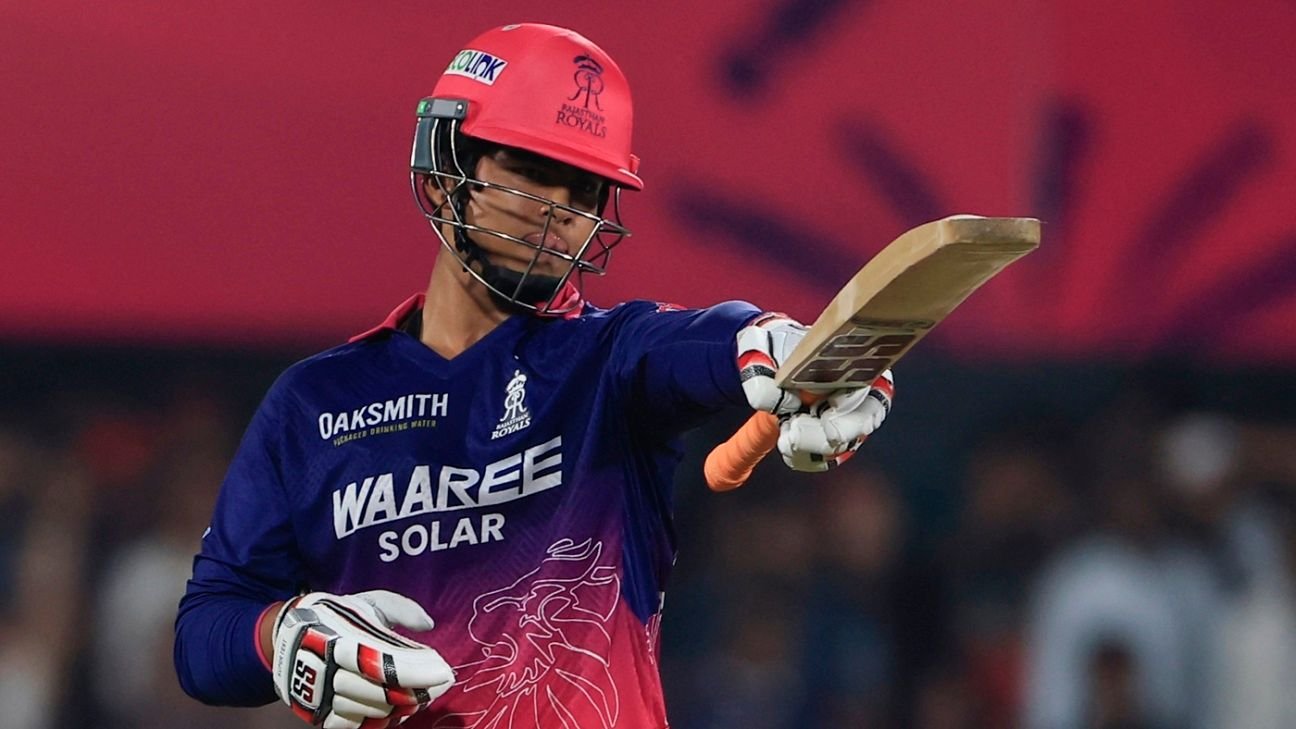
Yes, sure, he hit a six off the very first ball he faced from Jasprit Bumrah, but listen, hear me out, wasn’t that a bit of a hit-me ball?
When someone as absurdly young as Vaibhav Sooryavanshi does things that would astonish you even if they came from someone within the accepted age range for elite sportspersons, it is an entirely understandable and human reaction to explain it away as something other than an outlier-among-the-outliers level of genius.
He’s a kid, you know? It has a psychological effect on bowlers. Try as they might, something prevents them from delivering their best ball when their foot lands on the crease. These are the sorts of things we tell ourselves, to feel slightly better about our entirely non-outlier, non-genius selves.
Two days after that first meeting with Bumrah, Rajasthan Royals (RR) were up against Royal Challengers Bengaluru (RCB), the IPL’s defending champions, and Sooryavanshi was on strike for the first time to Josh Hazlewood.
Hazlewood, coming back from a long injury layoff, had already bowled one over, and it wasn’t his best over. He had missed that exacting length and line he’s known for twice in that over, and Yashasvi Jaiswal had carved and pulled him for a pair of sixes.
The other four balls, however, had been classic Hazlewood; angling across the left-hand batter, climbing awkwardly, finishing over the top of off stump, never allowing Jaiswal to free his arms. The one time Jaiswal tried to do that, he nicked off to the keeper. Three dots and a wicket.
When he ran in and bowled to Sooryavanshi for the first time in his life in his next over, Hazlewood bowled the same sort of ball. It was even better, perhaps, than those four he had bowled to Jaiswal, because this one straightened substantially off the deck, cramping the batter even more.
This would have been an excellent ball to any left-hand batter, and more so, you’d have thought, to Sooryavanshi. This is the guy with the exaggeratedly high backlift with the exaggerated cocking of the wrist, and the exaggeratedly free flow of the bat. This is a technique made for six-hitting, and not necessarily, you’d have thought, for late adjustments.
You’d have thought. Until you saw what Sooryavanshi did to this ball.
At the high, wide apex of his backswing, Sooryavanshi seemed to be shaping for something like a square cut; then his body moulded itself to the new reality that this ball presented him. His front foot slid to the leg side, ever so slightly. His hip opened up, ever so slightly.
Then his hands took over: a twist of the top hand, right at the top of the handle; a loosening of the bottom hand, letting go at impact. All this to bring the bat down more or less vertical, with a slightly open face, and meet the ball right next to his body and almost behind it.
Hazlewood had a short third and a deep point. The ball bisected them and ran away for four.
You’ve watched Kane Williamson do this many, many times, in his own minimalist fashion, a delayed dead-batting to send the ball scuttling away fine. You’ve watched enough of Sooryavanshi by now to not be surprised by anything, but you didn’t expect this. This masterful late adjustment, this expert manipulation of hands and bat face and bat speed.
In the next over, Dhruv Jurel played a lovely little back-cut off Abhinandan Singh. This wasn’t a difficult shot, unlike Sooryavanshi’s, because Abhinandan had offered him width, but there was a similar deftness to Jurel’s use of his hands. On TV, the two batters punched gloves mid-pitch, and Sooryavanshi said one word: “Shot.”
To Jurel, a decade older than Sooryavanshi and a Test cricketer already, batting alongside the boy genius and hearing terse words of encouragement must feel utterly disconcerting.
“When you watch him, you just can’t understand,” Jurel said after the match. “Seriously, you can’t believe your eyes. How can he hit the ball like that? Even I’m batting on the same wicket; why isn’t it happening for me? He’s a great talent.”
All this while Sooryavanshi is still very much a creature of his age off the pitch.
“Everyone loves him, loves having him around,” RR captain Riyan Parag said. “He likes eating stuff, he likes going out and stuff like that, so we make sure we make that available for him.
“He’s a 16-year-old kid, 15-year-old, whatever it is. [He likes doing] kiddish things, and he’s happy with that. He likes a lot of batting [at the nets], so we make sure that that is presented to him, and if he keeps on batting like that, I think [he can do] whatever he wants.”
Sooryavanshi is 11 matches old in the IPL, and every new innings has unpeeled a new layer. Watching him has felt like watching a young Lionel Messi at Barcelona. You’d heard about Messi’s brilliant close control and dribbling, and then you watched him and realised how much more there was to his game. You realised that this teen sensation did not play football like your typical teen sensation. He didn’t just try and beat players one-on-one in a bullish, head-down way; he had an innate understanding of space on a football pitch and how to manipulate it with movement and ball circulation. He made everyone around him play better.
And on this Saturday night in Guwahati, Sooryavanshi did something like that to his RR team-mates. When he was in the middle, tonking, carving, and manipulating his way to 78 off 26 balls, a target of 202 looked like (sorry, but who can resist?) child’s play. After he was out, 73 in 71 balls began to look like a challenge.
And none of this felt odd or unexpected. We have watched enough for this to already seem like the established order. Many more new layers await their unpeeling, but Sooryavanshi’s genius is a given, a known and cherished part of the fabric of our lives.

