College Football Playoff committee’s bracket for 2025 became a just ending for a contrived controversy originally appeared on The Sporting News. Add The Sporting News as a Preferred Source by clicking here.
Perhaps it was all about getting us to turn on the television Sunday at noon, and to tune not to one of the NFL pregame shows or some real-estate infomercial but the selection show for the College Football Playoff.
Advertisement
Because the committee that arranges the bracket for the CFP presents an official ranking of the contenders to make the field on a weekly basis starting in early November, and ESPN turns it into a popular bit of programming. And for all five weeks in advance of the much-more-official presentation of the tournament field, the committee presented Notre Dame as a higher-positioned team than the Miami Hurricanes.
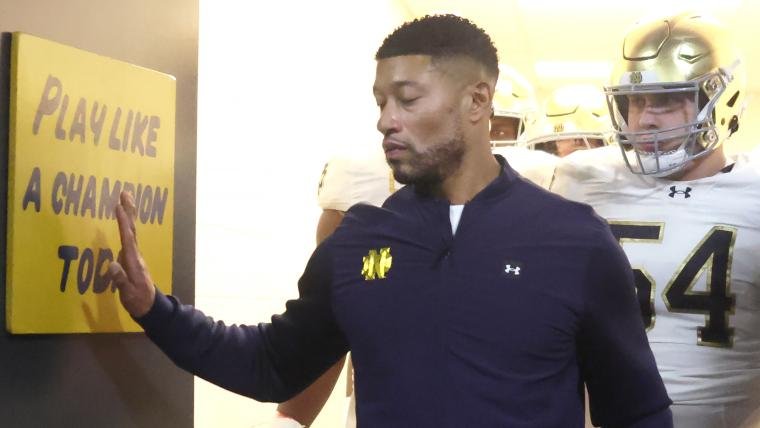
When it counted, though, early Sunday afternoon, the committee threw in a record-scratching plot twist, ranking Miami seventh among at-large candidates and Notre Dame eighth, and thus the Canes were granted the playoff berth that long had been supposed would belong to the Fighting Irish.
There will be plenty of hysterical reactions to this, about the need to eliminate automatic berths, or the auto berth reserved for at least one champion from the mid-major conferences known as the “Group of 5”, but that’s just as misbegotten as the initial Irish > Canes assertion.
Advertisement
What we saw Sunday was the presentation of a reasonable championship tournament for the sport of college football. There isn’t much about the bracket that warrants change, in terms of the teams selected or the order in which they were arranged.
The only legitimate controversy was of the committee’s own creation, and it does lead to suspicion the Notre Dame-Miami debate was contrived to generate interest.
The manufactured outrage we observed in advance of the draw resembled one of those hideous Mel Gibson movies, like “The Patriot”, in which the script called for just enough annihilation of the Gibson character’s family to get him really, really angry and justify the carnage he would inflict.
One figure in college sports presented a ridiculous anonymous statement to ace On3 college football reporter Brett McMurphy in advance of the draw: “No matter what, today could be the day the CFB collapses. If they hose Notre Dame or Alabama or an entire P4 league, then they let two G5 teams in and only one from the Big 12 and ACC? I’m praying this ends committees.”
Advertisement
Boy, that person covered so much ground, they should be starting in the secondary for the Ohio State Buckeyes. There was no way the committee could avoid at least one of these “forbidden” scenarios, and possibly multiple.
MORE COLLEGE FOOTBALL PLAYOFF NEWS:
The idea a computer could do this better than a committee is a fantasy, at least for now. It only would do it differently. ESPN’s Bill Connolly posted what a particular computer formula would have produced, which would delight fans of Miami and Vanderbilt and infuriate those who adore Alabama and Oklahoma.
The best part about the computer solution is it provides no target for the aggrieved. One is left either to yell at a machine or at the person behind the keyboard, and whomever that is would not be showing up on your television every Tuesday evening making lame excuses for the work.
Advertisement
The worst part is computer rankings in college football are mostly mid, not because the formulas are flawed but because the data is limited. So long as there is little competition between members of the powerful conferences, it’s difficult to tell which are the strongest conferences. The ACC is supposed to be the worst of the Power 4 conferences, and the SEC supposedly the best. They played 10 games this season. The SEC went 6-4. That’s not much of a sample size, but neither is it much to indicate dominance.
College Football Playoff schedule 2025
|
Date |
Round |
Matchup |
Time (ET) |
TV Channel |
|
Dec. 19 |
First Round |
Alabama at Oklahoma |
8 p.m. |
ABC/ESPN |
|
Dec. 20 |
First Round |
Miami at Texas A&M |
Noon |
ABC/ESPN |
|
Dec. 20 |
First Round |
Tulane at Ole Miss |
3:30 p.m. |
TNT/truTV |
|
Dec. 20 |
First Round |
James Madison at Oregon |
7:30 p.m. |
TNT/truTV |
|
Dec. 31 |
Quarterfinals |
Ohio State vs. TBD |
7:30 p.m. |
ESPN |
|
Jan. 1 |
Quarterfinals |
Texas Tech vs. TBD |
12 p.m. |
ESPN |
|
Jan. 1 |
Quarterfinals |
Indiana vs. TBD |
4 p.m. |
ESPN |
|
Jan. 1 |
Quarterfinals |
Georgia vs. TBD |
8 p.m. |
ESPN |
|
Jan. 8 |
Semifinals |
TBD vs. TBD |
7:30 p.m. |
ESPN |
|
Jan. 9 |
Semifinals |
TBD vs. TBD |
7:30 p.m. |
ESPN |
|
Jan. 19 |
National Championship |
TBD vs. TBD |
7:30 p.m. |
ESPN |
This could be mitigated to a degree next season, when the ACC and SEC are planning to guarantee each of their members plays at least one P4 opponent. That will deepen the data pool, and the computer rankings will be of greater assistance to the committee in their deliberations. But it’s doubtful those numbers would be trustworthy enough to make the final decisions.
Those who are appealing for the end of automatic bids entirely, or for the Group of 5 conferences in particular, are invested not in the legitimacy of the competition but simply the appeal of the television show.
Advertisement
This isn’t “The Voice” or “The Traitors”. This an actual sporting competition. If Division I FBS football includes 136 programs, there’s no logical justification for excluding 67 – almost exactly half – of them. One single guaranteed position for them is the least the sport can do, and it assures such programs as 2017 UCF and 2016 Western Michigan are granted the opportunity they merit to compete for the championship.
It also guarantees there are moments such as the one that arrived when the James Madison Dukes realized they had been acknowledged as the last automatic qualifier in the field, ahead of actual Duke, who lost five games but managed to tie-break their way into the ACC Championship and to defeat first-place Virginia in overtime. The JMU players literally were standing on tables to celebrate their impending trip to Oregon to face the Ducks in a legit playoff game rather to some nondescript bowl that will fill out ESPN’s live programming schedule during the holiday season.
As I’ve said before, increased parity inside the sport has complicated the committee’s job of filling out the at-large field. It’s why an expansion to a 16-team field is not only preferable, but necessary. There’s simply not enough obvious difference between 10-2 Vanderbilt, 10-2 Miami and 10-2 Notre Dame, let alone those three and 10-3 Alabama, whose resume was complicated by its presence in the SEC Championship game against a Georgia team the Tide previously defeated.

Some of this is, presumably, not Notre Dame’s fault. The butchery of the ACC tie-breaking process shoved Miami to the side and placed Duke and its five overall defeats into the title game. If Virginia had won the title over the Blue Devils, we can’t be certain the committee would not have considered the Cavaliers’ inevitable inclusion in the 12-team field as sufficient acknowledgment of their league.
Advertisement
“It had absolutely no impact,” committee chair Hunter Yurachek told ESPN. This may be true.
MORE: ESPN’s Rece Davis grills CFP chairman Hunter Yurachek
It is Notre Dame’s fault they played only two high-end opponents and lost to them both, and that it insists on remaining independent and thus entirely dependent on grabbing one of the at-large berths. The Fighting Irish case for reaching the field was beating a solid USC team at home – the committee ranked the Trojans at No. 16 — and also rolling through seven other P4 opponents with a combined record of 34-50.
Miami’s case included rolling through a lot of similar teams, including seven P4 victims with a combined record of 34-45, but that victory over the Irish demanded to be acknowledged.
Advertisement
Why it took until the very end for the committee to recognize it is impossible to say, and we know this because Yurachek’s explanation for the late switch is torturously convoluted.
“We felt like the way BYU performed in their championship game, a second loss to Texas Tech in a similar fashion, was worthy of Miami moving ahead of them in the rankings,” Yurachek told ESPN. “And once we moved Miami ahead of BYU, then we had that side-by-side comparison that everybody had been hungry for with Notre Dame and Miami.
“And you look at those two teams on paper, and they’re almost equal in their schedule strength, their common opponents, their results against their common opponents, but the one metric we had to fall back on again was the head-to-head.”
That game was played Sept. 1. It should not have taken three months, or one month of weekly meetings, for the committee members to acknowledge it. This will be a buzzer-beating defeat that will linger with Irish fans longer than Danny Ainge’s coast-to-coast drive to knock ND out of the 1981 NCAA Tournament. Football is a bigger deal at Notre Dame, as you surely know.

