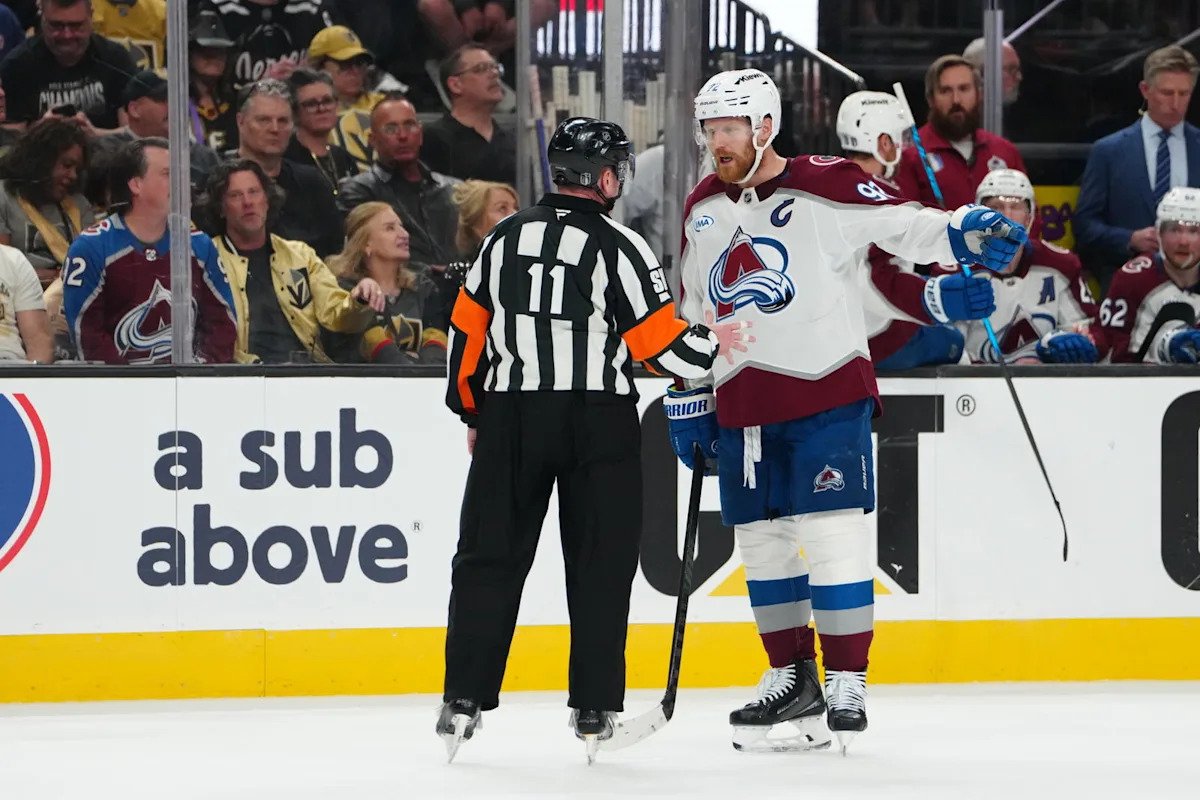
The frustration is understandable.
Spend five minutes scrolling through social media or reading the comments, and you’ll find plenty of Avalanche fans asking the same questions.
Where was the big move? Who replaced Valeri Nichushkin? Is this really the roster Colorado is bringing back after getting swept out of the Western Conference Final?
Advertisement
Those concerns are completely understandable. But they also ignore something Avalanche fans probably don’t want to hear.
Colorado already made its biggest bet.
Last season wasn’t supposed to be another step toward contention or another year of waiting for the right opportunity. The Avalanche had reached the point where anything short of a Stanley Cup was going to be viewed as a disappointment.
Colorado won the Presidents’ Trophy, and Joe Sakic and then-general manager Chris MacFarland pushed even more chips into the middle of the table, acquiring Nazem Kadri before the trade deadline and making the move for Nicolas Roy to strengthen the roster for a playoff run. Those additions came with a cost, including another significant contract commitment, but they sent one unmistakable message.
Advertisement
The message was obvious: this was a team built to win immediately.
Anything less than a Stanley Cup was going to be viewed as a failure.
Instead, the Avalanche became another victim of the Presidents’ Trophy curse.
The Vegas Golden Knights bullied the Avalanche for four straight games, took away their speed, dictated the physical play and exposed cracks that had existed throughout the season. For months, those flaws were masked by an explosive offense capable of overwhelming opponents before they could take advantage.
But once Vegas took away Colorado’s greatest weapon, the Avalanche had no answer.
Advertisement
It was similar to what happened when Tyson Fury took away Deontay Wilder’s greatest weapon in their rematch, ironically in Las Vegas, in 2020. Wilder had built his career around one of the most dangerous punches in boxing, but once Fury removed that threat, Wilder never found a consistent answer. Against Vegas, Colorado faced a similar problem. Once the Golden Knights eliminated what made the Avalanche so dangerous, there wasn’t another solution waiting.
It wasn’t just a playoff exit.
It was an epic bust in 4K.
When a team goes all-in and comes up empty, the following offseason almost never delivers another round of blockbuster additions. That’s the reality Avalanche fans are wrestling with today.
Advertisement
They don’t have to like it.
But expecting another summer filled with splashy moves was never realistic.
Instead, Colorado pivoted.
The goal was to create enough flexibility to improve the roster when the opportunity presents itself during the season.
If there was one consistent theme throughout the offseason, it was creating financial breathing room. That meant moving on from players who helped Colorado win games but whose contracts became increasingly difficult to justify.
Ross Colton was coming off his worst season in the NHL and had become a likely cap casualty. Jack Drury was a phenomenal fourth-line center for the Avalanche, a player Jared Bednar trusted in important situations, but Colorado ultimately determined the money could be better allocated elsewhere.
Advertisement
And honestly, it’s hard to blame Chris MacFarland for wanting a new challenge.
MacFarland’s departure to become general manager and president of hockey operations of the Nashville Predators wasn’t simply another front-office change. It marked the exit of one of the league’s more aggressive roster builders.
The Avalanche reportedly tried to keep MacFarland from leaving, but it’s easy to understand why Nashville appealed to him.
Colorado had become a difficult place for someone like MacFarland to operate.
MacFarland has never been the type of executive who’s content sitting on his hands. Throughout his tenure, he consistently looked for opportunities to reshape the roster, whether that meant pulling off blockbuster trades, using draft picks as trade currency or finding creative ways to squeeze more talent onto an already loaded team.
Advertisement
But by this summer, many of those opportunities had disappeared.
Colorado had already spent years sacrificing draft capital in pursuit of another Stanley Cup. The prospect pool had been thinned by those same win-now decisions, leaving few blue-chip assets capable of landing another impact player.
The salary cap offered little flexibility, the core of the roster was largely established and there simply weren’t many levers left to pull.
Compare that to what awaited him in Nashville.
The Predators entered the offseason with cap space, premium draft picks, promising young talent and the freedom to reshape the organization however they wanted. Unsurprisingly, MacFarland has been one of the NHL’s busiest executives this summer.
Advertisement
Will those moves eventually deliver the first Stanley Cup in franchise history?
Only time will tell.
But MacFarland’s departure also reinforces an important point.
This wasn’t an offseason where Colorado was positioned to reinvent itself.
It was an offseason where preserving flexibility may have been the smartest move available.
No move has generated more criticism than trading Valeri Nichushkin.
And that’s understandable.
Regardless of how frustrating his injuries became or how disappointing his postseason was, Nichushkin was one of Colorado’s most complete forwards, capable of playing in every situation, defending elite players, killing penalties and producing offense at a top-six pace.
Advertisement
Players with that combination of size, defensive responsibility and scoring ability simply don’t become available very often.
The Avalanche didn’t ignore that reality.
They just couldn’t solve it.
Without meaningful cap space, there wasn’t another player available who could replicate everything Nichushkin brought to the lineup. Instead, Colorado accepted a short-term downgrade in exchange for long-term flexibility by drafting Egor Shilov with the 43rd overall pick.
Whether fans agree with that strategy or not, it was rooted more in financial reality than a lack of ambition.
The trade sending Jack Drury to Nashville was a difficult one for Avalanche fans.
Advertisement
But it was the right move.
Drury had become one of Jared Bednar’s most trusted players. He won faceoffs, killed penalties and routinely elevated his game in the postseason — the type of player every coach wants in the lineup.
Colorado is betting that Fedor Svechkov and Zachary L’Heureux can eventually provide more value at a much cheaper price.
Neither player has established himself as a full-time NHL contributor, but both possess tools the Avalanche believe can still develop into meaningful pieces. And development has been a struggle for the Avalanche as of late.
Colorado also signed Jaden Schwartz to a three-year deal this offseason.
Advertisement
When he’s healthy, Schwartz is an effective two-way winger with a proven playoff résumé and a willingness to play the difficult minutes. The problem is availability. That has followed Schwartz throughout his career, and it remains the biggest question surrounding the deal.
Brett Kulak quietly stabilized Colorado’s blue line after arriving last season, making his return one of the more logical moves of the offseason. He won’t provide much offense, but dependable defensive players who fit a system are valuable.
Then there’s Brent Burns.
At 41 years old, he’s a far cry from the Norris Trophy version of himself from a decade prior, but Colorado needs a veteran who can provide reliable minutes. He fought through multiple injuries last year, and that could explain his decline during the second half of the season.
Advertisement
Bringing him back on a one-year deal didn’t sit well with a lot of Avalanche fans, but we’ll see how he performs this season.
Acquiring Fabian Lysell is exactly the type of gamble contenders should continue making.
Lysell, acquired in a trade with the Boston Bruins for Ivan Ivan, offers something much harder to find: speed, skill and offensive upside.
It was worth taking a chance.
The same philosophy applies to Noah Juulsen.
The Avalanche spent much of last season searching for a seventh defenseman head coach Jared Bednar actually trusted. Rather than repeating that mistake, they addressed the issue before training camp.
Advertisement
Joe Sakic has built his reputation by making aggressive in-season moves when he knows exactly what his team needs.
Some of the biggest additions of Colorado’s championship era didn’t happen during the summer.
They happened at the trade deadline.
That’s what makes this offseason different.
Rather than spending every available dollar now, the Avalanche have positioned themselves to act later if another top-six winger, another defenseman or another depth piece becomes available.
On paper, Colorado is probably a little weaker than the team that walked into the Western Conference Final.
But after pushing nearly every available asset toward another Stanley Cup only to come away empty-handed, there was never going to be a magical offseason that solved every problem.
Advertisement
The Avalanche already pushed their chips into the middle of the table last season.
This offseason wasn’t about making another desperate move just to make one.
It was about making sure they still have enough flexibility to strike when the next opportunity arrives.
Image

