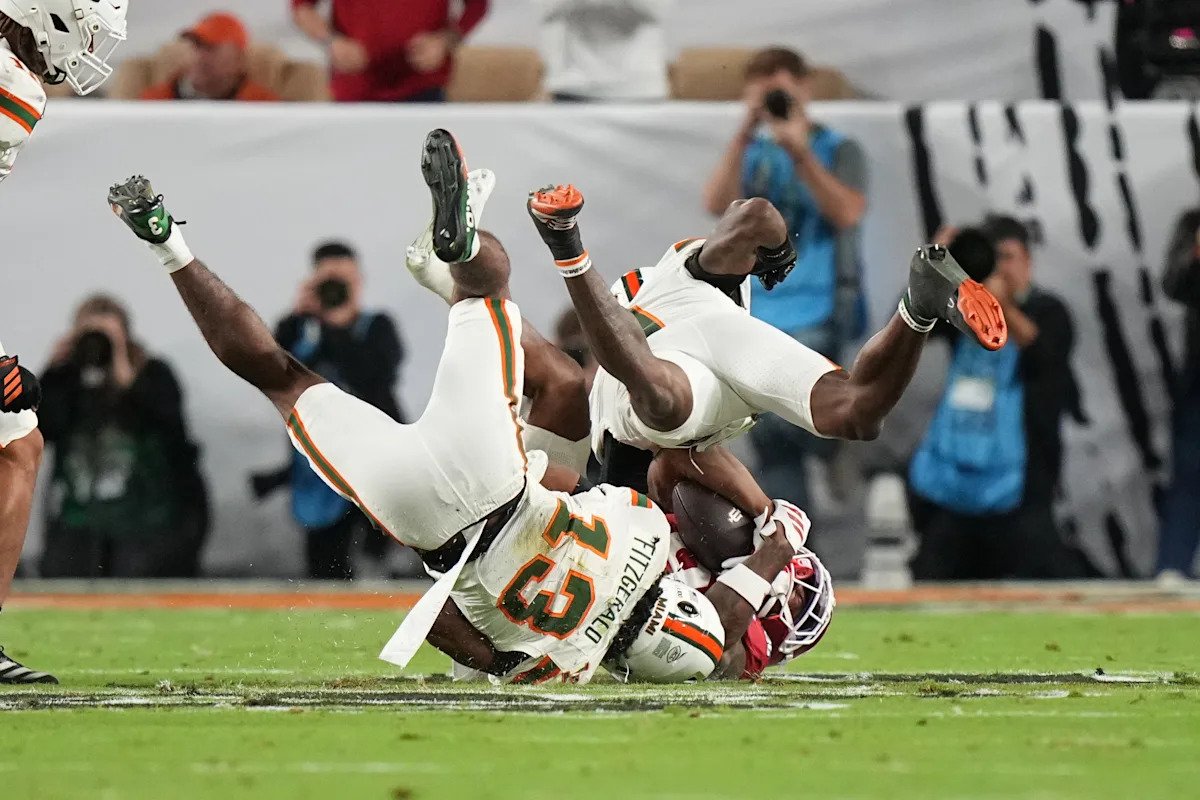
A recent article by Chris Vannini of the Athletic sparked a healthy generational-level conversation worthy of extending further in our little corner of the college football world.
And so it goes, there’s an old football saying that the game belongs to the players, but the arguments belong to the fans.
Advertisement
Right now, in living rooms, message boards and tailgates across America, two things have college football loyalists louder than a goal-line stand: targeting and pants.
Yes, pants.
The NCAA’s renewed look at targeting suspensions and uniform enforcement isn’t just procedural housekeeping. It’s philosophical. It’s generational. It’s a referendum on what this sport has been and what it’s becoming.
Let’s start with targeting.
The rule that has probably generated more replay booth drama than any other in the modern era.
No rational fan is arguing against safety. We’ve all seen enough documentaries and enough former players struggling later in life to know the sport needed guardrails. The targeting rule was born from that awareness; eliminate crown-of-the-helmet hits, protect defenseless players, make the game safer.
Advertisement
But the frustration?
It lives in the gray area.
Fans have offered specific, thoughtful suggestions that deserve more than a dismissive shrug.
One popular proposal: a two-tier targeting system.
Make incidental or technical targeting a 15-yard penalty without ejection and reserve disqualification for truly flagrant, malicious hits — the kind that make an entire stadium go silent. In other words, treat it more like basketball’s Flagrant One vs. a Flagrant Two. Same emphasis on safety, less collateral damage.
Another fan-driven idea: eliminate the automatic carry-over suspension into the next half or next game unless the hit meets that higher, flagrant standard. Why should a player miss a rivalry half because of a bang-bang collision where the offensive player lowered his helmet at the last second? Intent matters. Context matters.
Advertisement
Some fans have even suggested a centralized post game review panel; not to overturn the penalty, but to review ejections and potentially rescind next-game suspensions within 24 hours. Keep accountability on Saturday, correct excess by Sunday.
These aren’t reckless cries from the “let them play” crowd. They’re nuanced suggestions from fans who understand the need for safety but crave consistency and proportional punishment.
And that’s where the generational divide sharpens.
Older fans remember when linebackers roamed free and highlight tapes were built on jarring collisions. To them, football was a proving ground. Younger fans and increasingly, younger players see technique over violence, longevity over gladiator theater. The modern athlete trains to see what he hits, to strike with shoulders, not skulls. The sport has evolved physically; the rules are trying to catch up philosophically.
Advertisement
Now, about those pants.
On the surface, this feels trivial. Knee pads worn high, thigh pads barely visible, a little extra swagger stitched into the uniform. But even here, fans have offered practical suggestions beyond simply yelling, “Pull them down!”
Some argue for equipment checks similar to helmet inspections; quick pregame verification that pads are properly positioned, with team equipment managers bearing responsibility rather than in-game officials. Others suggest small fines to programs instead of 15-yard penalties that punish the competitive flow of the game. Keep enforcement about safety, not theatrics.
There’s also a cultural layer here.
Today’s players grew up in an era of individual branding, NIL deals, curated highlight reels. Uniform tweaks are a form of identity. For the old guard, uniforms represented discipline and sameness: name on the front, not the back. For the modern athlete, expression and confidence are part of performance.
Advertisement
The trick is finding balance.
College football has never been static. The forward pass was once controversial. So was overtime. So were conference championship games. Every era thinks it’s witnessing the game’s moral crossroads.
What this moment really represents is maturation.
Fans aren’t demanding the return of reckless hits. They’re asking for clarity. They’re asking for proportionality. They’re asking that the punishment fit the action, not the headline.
If the NCAA can refine targeting into something firm but fair AND treat uniform enforcement as a safety issue rather than a fashion crackdown, then the sport doesn’t lose its edge. It hopefully sharpens it.
Advertisement
Because the future of college football won’t be defined by how loud the collisions are or how long the pants hang. It will be defined by whether the game can protect its players without stripping away its soul.
And if the fans have shown anything this week, it’s that they don’t want less football.
They just want smarter football.

