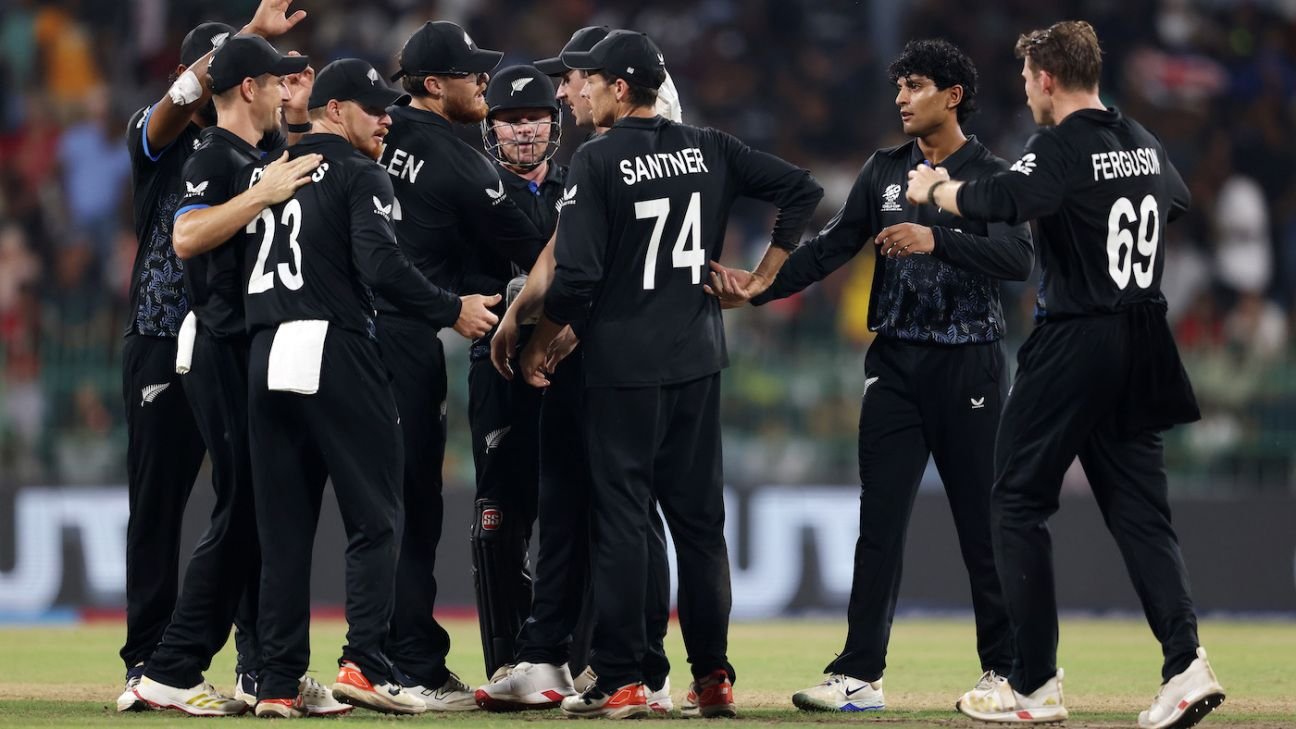
Cole McConchie, 34 years of age and largely unheralded at international level before this tournament, delivered only one over in New Zealand‘s semi-final stomping of South Africa at the 2026 T20 World Cup. But it was a match-made match-up heaven. Turning the ball away from the lefties, McConchie claimed the wickets of the most accomplished left-hander in South Africa’s top order (Quinton de Kock) and the most successful leftie of the tournament (Ryan Rickelton) till then.
Match-ups built around handedness often tend to offer only marginal advantages, but the impact of this one was emphatic. Many teams at this point would have been tempted to give a bowler who claimed two powerplay wickets another over. Not New Zealand. They had other plans for other batters, and McConchie’s offspin was surplus to requirement. This was classic tournament play from New Zealand, who came up against an opponent that was highly favoured in this game, and yet found a tiny crack in this unbeaten South Africa team’s armour which they prised open to wriggle through into another final.
McConchie had not originally been picked in this squad, and came in only as a replacement for the injured Michael Bracewell. And yet, this is the second key contribution he made in the tournament, having also struck 31 not out off 23 on a tough Khettarama track against Sri Lanka. In their five runs to ICC finals in the last seven years (2019 ODI World Cup, 2021 T20 World Cup, 2021 World Test Championship, 2025 Champions Trophy and 2026 T20 World Cup), New Zealand have repeatedly found game-turning contributions from the margins.
“For a long time we tried our best to compete thinking that we needed to be like perhaps the English or the Australians. But when you strip it all back, it’s about understanding what we are as New Zealanders. We have humility and we find a way to get things done and make things work”
Former New Zealand head coach Gary Stead
“I was playing in the 2000s, and I think things were a lot more cut-throat and a lot more selfish than they are now. There has been a shift in a positive direction. People at the Black Caps level have understood what our identity is about, with Mike, and Brendon McCullum, and with Kane Williamson also being a huge influence over the years, as well as other captains.
“The media can be pretty brutal on players without truly understanding the value of that player. Whilst they see the runs and wickets part of it, but the part they play within the team environment and the things they add away from the ground all make up what your team actually is.”
New Zealand’s tournament outlook has been to adapt strategies and personnel specifically for the next challenge – the opposition they are facing and the grounds they are playing on, which allows them to be dynamic themselves, as well as difficult to plan against for oppositions. To allow them to play this way, New Zealand have also chosen to build teams full of players who will park their egos to serve the team’s objectives. In New Zealand, player personality is often one of the key selection criteria.
“If you have close calls to make around people who would give to the team against players who wouldn’t give to the team, then I’m always going to take the people who would give to the team. I think that’s highly important in terms of selection – it’s right up there with one of the top things. We still welcome that flamboyance from people, but we have to be very clear on how they fit into different roles.”
This shift in culture has helped drive New Zealand into its most successful cricketing era, and has now become so embedded in the New Zealand system that even men’s domestic cricket has been shaped in the top team’s image.
“I think that culture has shifted more broadly in New Zealand cricket,” Stead said. “You always get guys from the Black Caps who filter back and play domestic cricket, and hopefully they bring with them the experience that they’ve had. That’s easier to do when you have only six domestic teams.”
For Stead, as for Hesson before him, and for many of the players in the side, playing cricket that is true to a New Zealand national identity (or an idealised version of that identity at least), is the idea that has helped transform their fortunes.
“For a long time we tried our best to compete thinking that we needed to be like perhaps the English or the Australians. But when you strip it all back, it’s about understanding what we are as New Zealanders. We have humility and we find a way to get things done and make things work.
“I think one of the things for us is to play as New Zealanders first and foremost, we want to be seen as good competitors, but good people as well. That really is important when you consider being role models for the children, and the people that come and watch the game.
“That’s something that I was always very, very proud of. Our guys were always out there signing autographs, etc. too, because that’s the aspirational sort of part that you do. You can give back to the game through being good, and being seen as the sort of person that I’d love my child to grow up and be like one day.”

