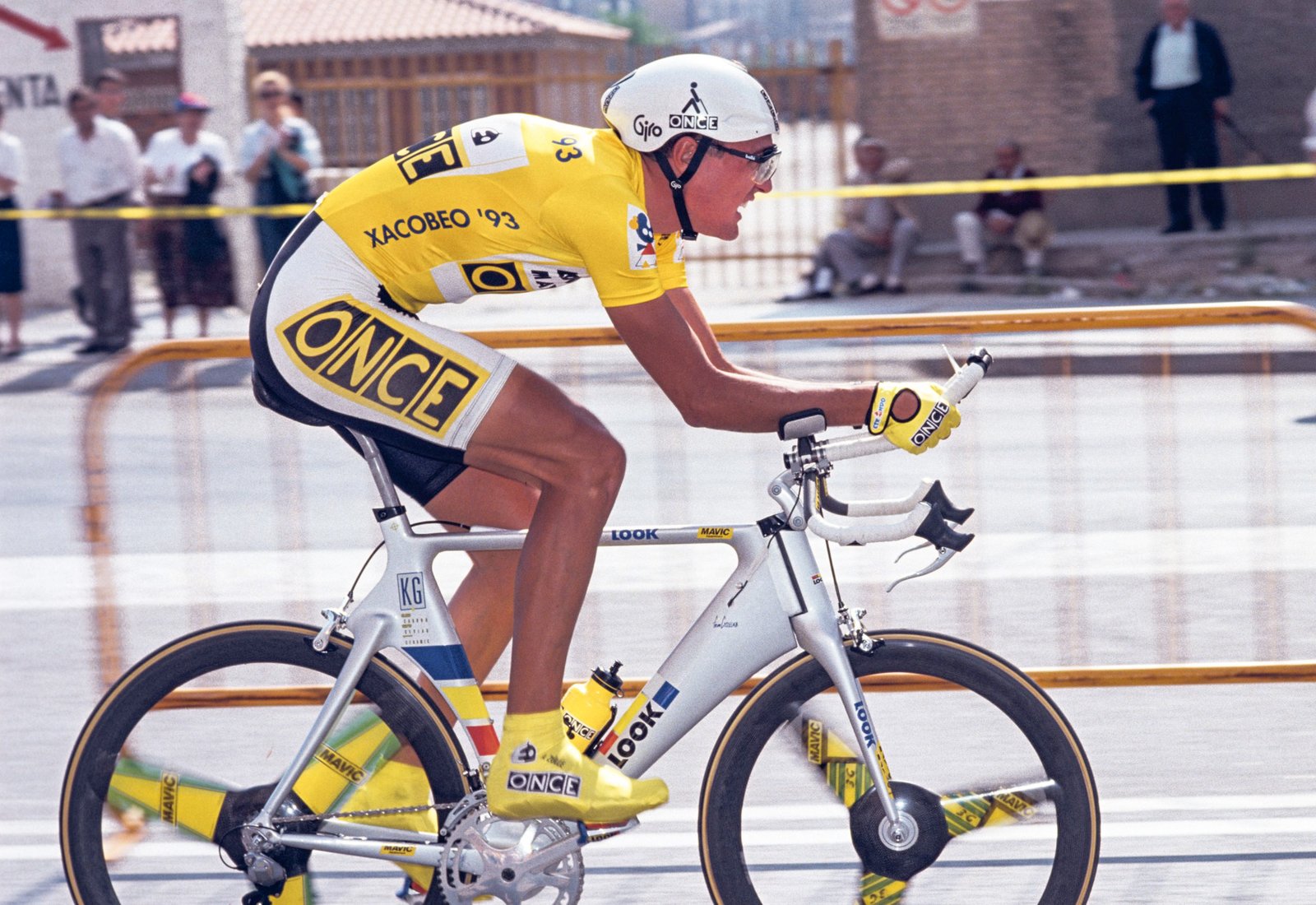
It was 20 years ago that the bicycle was voted the best invention ever in a BBC poll, taking 59% of the vote ahead of the radio, internet and nuclear power. Its appeal and value lie largely in its simplicity and affordability and while ‘the humble bicycle’ is now more than 130 years old, it has been constantly refined in an effort to make it, perhaps, a little less humble.
Some of these efforts have proved revolutionary; others failed to make the grade. While the derailleur, high-pressure valves, and clipless pedals became cycling staples, other innovations showed early promise but never took off, or were snuffed out by circumstance. We take a look back at the tech that fell by the wayside – and ponder which new creations might, or might not, break the mould in coming years.
1. Shimano Biopace chainrings
(Image credit: Shimano)
For a time in the Eighties and early Nineties, there was something that did not look quite right about a vast range of off-the-peg road bikes. The standard bicycle has grown up with a comforting triangles-and-circles aesthetic that was now being challenged by the industry giant that was Shimano – with an oval chainset. Except it wasn’t oval, not exactly.

The less wieldy but more accurate description would be non-round, and it was called Biopace. Its non-conforming shape, which was somewhere between an egg and a square, was designed to improve pedalling efficiency by ironing out the ‘dead spot’ over the top of the crank revolution, where power is much harder to put down.
Launched in 1983, it was embraced by many, attracted to the futuristic new look. The design snowballed to a point that, in the early Nineties, many road and mountain bikes came specced as standard with Biopace. So what went wrong? Bike tech expert, the late Sheldon Brown, said that Shimano shot itself in the foot by overcomplicating the marketing – in particular the claim that Biopace was optimised for a cadence of 90rpm. “Many interpreted this as an indication that Biopace chainrings would somehow interfere with pedalling faster than that,” Brown wrote. “[and] the conventional wisdom arose that Biopace was bad for high-performance cyclists for this reason.”
More recently non-round rings made a reappearance, with Sir Bradley Wiggins even winning the Tour de France on his Osymetric rings, and Chris Froome using them too. Did they really boost performance? According to then-Team Sky head of performance Tim Kerrison, “performance-wise, there is very little in it either way”. It wasn’t a team policy, he said, just a personal rider preference.
2. Campagnolo Delta brakes

(Image credit: Future)
There was a lot to love about racing bikes in the Eighties, at least 50% of which was all the gorgeous polished alloy that hung on them (the other 50%, of course, were the lithe steel frames that held all the shiny bits). Groupsets were a thing of beauty that were being refined aesthetically with each new iteration – and then, in 1985, Campagnolo raised the game with its Delta brake.
Known officially as the C-Record brake, the Delta got its nickname from its triangular shape (like the Greek letter) and was famously bad at actually doing what it was designed to do – stopping the bike. However, it looked beautiful. Unlikely as it sounds today, there are numerous groupset components from the Seventies and Eighties that might be referred to as iconic – and few would omit the Delta from that list.
Beneath a polished alloy cover adorned with the Campagnolo logo nestled a series of pivoting arms that the Italian firm called an articulated parallelogram. Between 1985 and its eventual demise in 1992, the Delta was released in five iterations, including a lower-tier Croce d’Aune edition. It has been labelled ‘the greatest worst brake ever’ by Bicycling, which probably sums it up rather well. Either way, it still has a dedicated following, as eBay prices of £1,000 and upwards for a NOS brakes attest.
3. Direct mount brakes
While we’re on rim brake systems… They’ve slowly improved over the years, and despite the advent of discs, rim brakes have very much stood the test of time. We’ve seen them offered in all sorts of formats, from early rod brakes to the dual-pivot design most modern riders have used, or at least seen – perhaps on the group ride, along with a sticker proclaiming “I heart rim brakes” or similar. While the trusty dual-pivot is the modern iteration, direct mount saw it refined even further. Unfortunately it was a design that came along just in time for cycle manufacturers to embrace disc technology.
The direct mount design is very similar to that of the dual pivot – but instead of those pivots using the standard centre bolt, they are both mounted to the frame either side of the fork or seatstay, effectively bracing the brake across the rim. This means less flex and, as a result, better modulation. They are also more accommodating of wider tyre size than the standard-drop dual pivot, but only up to a point. 30mm, for example, so don’t go looking for a gravel bike with direct mount brakes.
Unlike Shimano Biopace rings or Campagnolo Delta brakes, direct mount brakes can still be bought brand new to service the plentiful frames fitted with the appropriate bosses. Thus, they have far from died off, but the advent of disc brakes means they’ve not thrived as they otherwise might have done.
4. Shimano Octalink and ISIS
Anyone with a long enough memory to recall using square-tapered cranks may well also recall how vulnerable this system rendered your beautiful but rather soft alloy cranks – either from the bottom bracket spindle itself, or the tool used to remove them. The issue was that the cranks were effectively wedged onto the tapered spindle, with the mechanic’s own judgement usually the only measure of how aggressively this should be done. Not enough, and the crank could work loose midway through a ride, and any attempt to ride gingerly home with a loose crank could easily round-out the square hole, rendering it useless.
Alternatively, tightening the crank too hard could lead to the opposing problem – a crank that was an absolute brute to remove, with threads that could readily be stripped out by the removal tool. Again, a useless crank was the result.
Surprisingly, square-taper cranks lasted more than 50 years by the time they began to be phased out.
In their place came Octalink (a Shimano offering) and ISIS (International Spline Interface Standard), which was essentially open source. Unlike the square taper, the cranks were mounted rather than wedged onto a splined axle, meaning users were able to remove the cranks without losing their dignity or turning the air blue.
Like direct mount brakes and square taper bottom brackets, there is still a market for both these splined BB standards so they are still sold. However, the ‘big three’ groupset manufacturers now predominantly use a design that sees the axle mounted to the cranks and the bearings mounted to the bike.
5. Shimano Flight Deck with gear sensor
The idea of having a display indicating what gear you’re riding in sounds as though it ought to be appealing. After all, if you add up all the time spent looking down at your sprockets over the course of a ride, it would likely amount to an alarmingly substantial portion of it looking in precisely the opposite direction to where you’re supposed to.
Shimano’s Flight Deck, introduced in 1998 with the 25th anniversary Dura-Ace groupset, in theory did away with all that. It plugged into the STI levers and could display current gear and cadence, as well as the more usual metrics like speed, time and distance.
Nearly 30 years ago, such a gadget was pretty much akin to wizardry and, along with Campagnolo’s arguably better Ergobrain unit, had plenty of buyers. However, set-up required Olympian levels of patience, and even once that was done, not everyone got on well with it. Opinions from one selection of users ranged from ‘ultimate cool’ to ‘the best thing I ever did for my bike was take off the Flight Deck and chuck it in the bin’.
It was ultimately killed off by the advent of GPS units, and somehow nobody missed having a computer to remind them what gear they were in – although it is a feature that has made a resurgence in modern head-units.
6. Mavic Zap and Mektronic

(Image credit: Mavic)
The rise and fall of the then-ultra-futuristic Mavic Zap rear derailleur brings to mind the immortal line from Back to the Future, as protagonist Marty McFly attempts to explain away his before-its-time rendition of Johnny B. Goode: “I guess you guys aren’t ready for that yet – but your kids are gonna love it”. Electronic gearing like Shimano Di2 and SRAM AXS is, after all, unfailingly popular with modern riders – but back in the early Nineties it was a step too far.
There were, perhaps, a few reasons why Mavic’s early attempt did not gain the traction it might have. For one, unlike the modern electronic mechs, the grey and rather ugly Mavic Zap looked like it was from another planet compared to the standard polished groupset fare.
Then there was the famously lofty price tag, and the fact it was made by a brand less popular as a groupset manufacturer (the Zap came as part of a full groupset that looked otherwise rather lovely). While Chris Boardman rode a Zap to Tour de France prologue victory in 1994, the wider buying public were less enamoured. The French brand tried again with the wireless Mektronic in the late Nineties, but it wasn’t until 10 years after that, when Shimano introduced Di2, that electronic shifting began to catch on.
7. Spinergy Rev-X
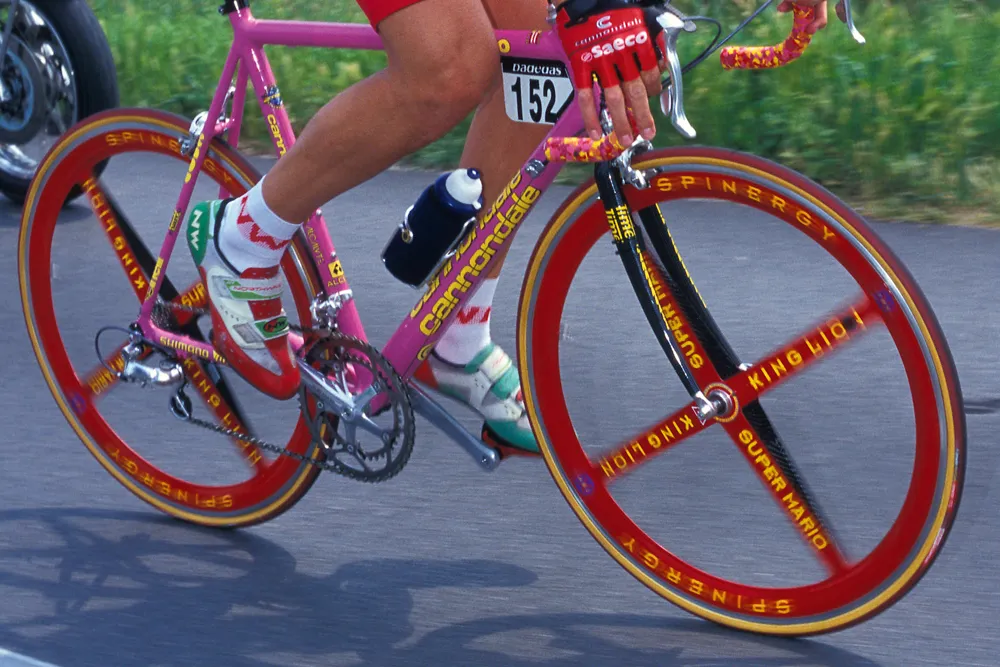
The spectrum of mid-ride component breakages ranges from inconvenient at one end to catastrophic at the other. Wheels are at the extreme end of the latter. The closest I’ve come personally to this happening is having a worn rear rim surface blow out less than half a mile from home. I might consider myself lucky though, given I was for a time the owner of a pair of Spinergy Rev-X eight-spoke wheels.
These Nineties hoops were described by a former colleague as the James Dean of wheels, with a dangerous look and an even more dangerous reputation. From a distance these appeared to have four wide-bladed carbon spokes, but there were in fact eight, bonded in pairs. They looked great, and they were very fast, but they had a reputation for failing under the rider.
That didn’t stop their use in the pro peloton for a time, which yielded various stories of their blade-like spokes inflicting injury in crashes. Eventually, in 2001, they were banned by the UCI after failing to meet updated impact test regs. Perhaps surprisingly, they continue to have a keen following and, if you really want, you can buy yourself a pair on eBay for a few hundred quid.
What comes next?

New airbag clothing in action
(Image credit: Van Rysel)
It is hard to imagine a top-tier modern bicycle feeling antiquated but it’s written, indelibly, in the stars. As new technologies and new science come down the line, the future becomes current, and current becomes old. But what exactly might those new technologies look like? Here are five things that could happen or perhaps already are to some degree. Whether they are eventually written about in years to come in a feature about technology that never made it, only time will tell.
14-speed cassettes: currently, none of the ‘big three’ produce such a thing, though Campagnolo and SRAM are currently on 13 and Shimano, by all accounts, is almost there too. However, a 14-speed option available from Chinese brand Wheeltop shows it can be done – it’s hard to imagine the big brands not following suit eventually.
Suspension tech in road bikes: with tyres get bigger and roads more poorly maintained, bike riders are beginning to realise that a lack of comfort is not inevitable. Elastomer-type road damping has been around for a long time on road bikes like the Specialized Roubaix and now, with the advent of all-road and recreational riders being less in thrall to pro peloton tech, expect to see more suspension options.
Abrasion-resistant clothing: crashes happen, and road rash is never fun. Cycling togs from the likes of Ekoi and Santini now feature in-woven abrasion-resistant fabrics to protect against tearing and grazes. While they’re not a magic bullet against crash damage, any reduction in injury has to be a good thing.
Airbag tech: Still on crash protection, if you ever looked at the Michelin Man and thought he’d be well protected in the event of an ‘off’, you might be interested in one of the latest and most futuristic developments in cycling – airbag clothing. Already garments from the likes of Decathlon/In&Motion and Aerobag offer airbag vests for cyclists that can detect a fall happening and deploy instantly. Not particularly aerodynamic, but definitely more cushioned in a crash.
On-the-fly AI coaching: Should you go for that last interval set? Is today even an interval day? With AI already able to design coaching programmes, we can expect a system somewhere down the line that allows a wearable to interact with your head unit and advise you, in real time, on the course your ride should take – using your own physiological data to urge you on to greater efforts, or tell you that today, discretion is the better part of valour.

