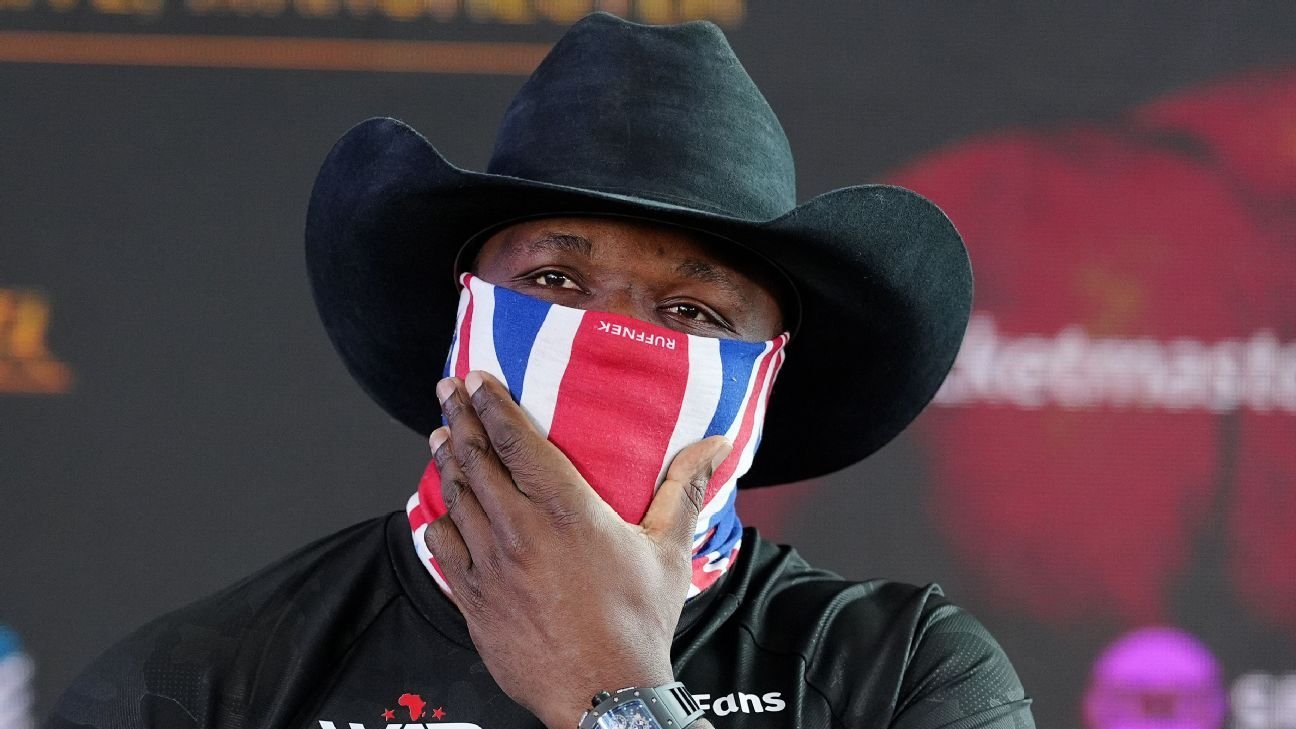
The waiter in the Four Seasons kitchen didn’t see it coming. Even if he had, he wouldn’t have stood a chance.
Derek Chisora, Kubrat Pulev and their respective teams spilled into the kitchen of the Hamburg hotel; plates, cups, and that poor waiter’s tray flying everywhere. For once, the brawl wasn’t instigated by the Brit. Someone had slapped him across the head with a plastic bottle. However, it turns out Chisora was simply beaten to the punch.
Amid the push-and-shove on stage, a sex toy dropped on the floor. The alleged plan, a source told ESPN, was for Chisora to bring out the device on stage. Fortunately, he never got the chance … Not that that stopped the chaos from making its way through the luxury 5-star hotel.
That story is just one page in the book of Chisora’s career. The 42-year-old insists he will bring the curtain down in his remarkable journey on Saturday against Deontay Wilder in London.
If it is the last time we see him, Chisora will be remembered as a warrior in the ring and someone who has entertained fans for almost 20 years. He’s excited to sign off on what he believes will be the perfect fight.
“He’s a puncher, bro. He’s a puncher. I’m excited about fighting him,” Chisora told ESPN. “I’m buzzing. 50 [fights]. O2 Arena. 50-50 fight. So why not?”
Chisora (36-13, 23 KOs) and Wilder (44-4-1, 43 KOs) insist they won’t sell the fight through verbal sparring or push-and-shoves, but through respect.
“The days of trying to sell something with violence are done. If you have a good product, people want to buy your product,” Chisora says.
“The reason why I used to sell fights back in the day because people didn’t want to spend their money, but when you give them a bit of entertainment before, they’ll spend money. But now people are like: ‘You know what? I’ve seen this guy for the last 10 years. I know what he’s going to bring. I am going to go watch this fight.'”
That attitude shows how far Chisora has come since the early days when fans, rivals and promoters didn’t know what to expect from ‘Del Boy.’
Chisora arrived in the UK as a teenager, having grown up in Zimbabwe. When he touched down in Finchley, London, he turned to boxing.
After a strong amateur career, he signed with promoter Frank Warren and went 14-0 in three years. In July 2011, he went toe-to-toe with Tyson Fury for the first time, losing on points. However, the wider boxing world knew his name.
Over the next 12 months, he would make headlines for completely different reasons, and his career took off.
Slapping Klitschko and brawling with Haye
A controversial defeat to Robert Helenius in 2011 didn’t stop Chisora from getting a WBC title shot with Vitali Klitschko in Germany in February 2012. The Brit didn’t exactly roll over and thank Klitschko for the opportunity.
It kicked off with the Brit slapping his opponent at the weigh-in. He was fined $50,000 for the stunt (fines would become a theme of his career), but it showed everyone: If Chisora is around, expect the unexpected and don’t think he’ll take a backwards step, no matter who the opponent is.
“That was the ‘Hi, I’m Derek Chisora ‘ [moment],” Kalle Sauerland, who has promoted Chisora at various times through his career and will do so against Wilder, tells ESPN.
Chisora lost the fight but gave a good account of himself, standing up to one of the biggest punchers in recent memory. But what happened in the post-fight news conference would go down in British boxing folklore.
Having just gone 12 rounds with Klitschko, Chisora wasn’t done fighting. David Haye, who was in the crowd, started calling out those at the top table. Frank Warren proposed a fight between the two Brits.
He didn’t think it would happen there-and-then.
Chisora made his way into the crowd to confront Haye. “You want to fight me?” Chisora asked. Haye obliged, smacking him flush on the chin with a thumping left hook followed by a right. The place erupted and a mass brawl followed. Chisora was detained by German police.
A rivalry was born and Warren got his wish of an official bout.
Chisora was knocked out at Upton Park, following a remarkable build-up which included the fighters being separated by cages at the news conferences.
But, through his adventures in Europe and back in London against Haye, Chisora had established himself as a cult figure, with plenty more to come. The beauty of it all, of course, is that Haye became Chisora’s manager and the two have been friends ever since.
Rolex watches and throwing tables
After the Haye defeat, Chisora went on a run of five-straight wins before losing to Fury in a rematch. He came again, winning five more before the abovementioned fight against Pulev, losing on a split decision. He returned with a win over Drazan Janjanin before the big one in 2016: Dillian Whyte. A huge all-British clash which had everyone excited for the build-up as much as the fight itself.
Sauerland was co-promoting the bout — which was on the undercard of Anthony Joshua vs. Eric Molina in Manchester — along with Matchroom’s Eddie Hearn. Sauerland knew exactly what Whyte’s plan was for the pre-fight news conference and attempted to calm Chisora down.
“We rolled into what I thought would be one of Derek’s last fights, which was the first Dillian Whyte fight. It turned out to be the main event,” Sauerland reflects. “I said to him: ‘Dillian’s going to come out today with loads of ridiculous talk. Don’t bite. Take the high road.”
Sauerland was convinced Chisora had taken the advice.
“I thought he was meditating … But of course, he wasn’t. He was listening. Something triggered him.” Indeed, Chisora kept quiet, sunglasses on, staring straight ahead while Whyte spouted various threats.
“I will end you. I’ll put your lights out with my bare fists,” he said.
Eventually, Chisora couldn’t resist.
“If you think I’m a p—-, if you think I’m a punk, then tell me right now because I am the baddest man you will ever f—— meet,” Chisora boomed as he got to his feet and launched a table across the room … Over Sauerland, Hearn and towards Whyte. It took several security men to keep the heavyweights apart in what has become one of the most infamous moments in recent British boxing history.
Frank Smith remembers the day well and recalls a brief interaction with a very calm Chisora as they made their way out of the British Boxing Board of Control hearing, which had determined that the fight could go ahead. Chisora didn’t appear overly worried about the incident, instead making small talk with Smith in an elevator about his relationship with Chris Eubank’s daughter.
“I was in the lift with him after … this was in the early days of knowing him,” Smith says. “He went to me: ‘You’re with Eubank’s daughter? He’s a crazy motherf—–.’ I said: ‘You’re a crazy motherf—- you just flipped a table!”
Hearn later revealed he played his part in riling Chisora up, promising to buy the heavyweight a Rolex if he helped sell the fight — after he previously refused to do so — as long as it did over 300,000 pay-per-view buys.
“He went: ‘You got it.’ They drove down Sky Sports for ‘The Gloves are off,’ next thing, Dillian Whyte’s thrown a glass at him, they’re rolling around on the floor, he bit Dillian Whyte on the chest … The whole thing,” Hearn said on The Overlap.
Chisora had lit the fuse by throwing water at Whyte, and yet another huge brawl ensued. Still, the work was done. The table throw was the icing on the cake to get a few more punters to buy the fight. The BBBoC withdrew the fight’s British title status, fined Chisora £25,000 and handed him a two-year suspended ban.
“Over the years, when I do a Derek Chisora fight week, I have my budget, I’ve got miscellaneous, which I have on all events, but the miscellaneous with Derek has a second line. It’s called fines,” Sauerland says.
Still, Chisora came out on top. He got his Rolex. The pay-per-view buys? Over 700,000.
That was a decade ago, and although he lost to Whyte, the next 10 years of heavyweight boxing, up until this last fight with Wilder, would be punctuated with iconic Chisora moments: A rematch with Whyte, covering himself with white paint before going the distance with Oleksandr Usyk, the third fight against Fury and three-straight wins going into this Saturday.
Tough negotiator and family man
The image the public has of Chisora may not be the full story. While he has a reputation as the volatile heavyweight who can snap at a moment’s notice, various people ESPN has spoken to have been at pains to point out he is a huge family man who always looks after those around him.
“He’s brilliant. He’s more of a friend to me than the boxing side. I spent New Year’s with him this year. My family, his kids for [a few days],” Smith says.
While Sauerland says he hasn’t changed that much since he was coming through as a young fighter, he agrees that family and friends have become his central focus.
“He’s very funny. He’s a proper family guy. You see his kids at ringside … He’s probably one of the biggest family guys that I’ve seen in the sport of boxing. He’s just driven by it,” Sauerland says.
“Derek drives around in a Smart Car; you don’t see him in a Rolls Royce Phantom. You see him driving down Hampstead High Street in a Smart Car!”
However, he has remained one of the most unpredictable fighters to negotiate with. “Nightmare. Absolute nightmare. He’s up and down like Tower Bridge,” Sauerland says. “But when Derek wants a fight, Derek really gets a fight. He’s wanted Wilder for years.”
Sauerland recalls one negotiation, despite the contracts having already been signed, when Chisora wanted a particular sponsor on the ring floor. The promoter, as you would expect, was curious about the details.
“What’s it got to do with you?” Chisora replied.
“I think some of it is just his character and in fight camps … If he’s had a bad training session, he thinks ‘who can I call?'” Sauerland explains.
His penchant for making promoters sweat and stumble over their words, especially at news conferences, has endeared him to fans, as has his durability and desire to be in big fights.
“He’s what boxers should look at. He always tests himself in the hardest fights. He’s lost [13 fights,] no one cares, because he’s a character and every time he goes in there he gives 100%,” Smith says.
“That’s what boxers can learn: If you can be a character, if you can deliver in fights, there are so many opportunities out there for you.”
Chisora has said he expects to be in tears when he enters the O2 Arena on Saturday. His ring walk song, Hotel California, will play one last time, and the boxing public will thank one of the sport’s most colourful characters.
“Man, it’s a beautiful thing,” Chisora tells ESPN. “I’m going to be flying the Union Jack all day long that day. I’m going to get my boys to flag up the O2 Arena … Raise the colours.
“It’ll be emotional. It’s going to be very emotional. 49 [fight] was very emotional … This one’s going to be emotional like mad.”
If it is to be Chisora sailing off into the sunset, there is no more fitting venue than London’s O2 Arena for a heavyweight the likes of which we’ll never see again.

