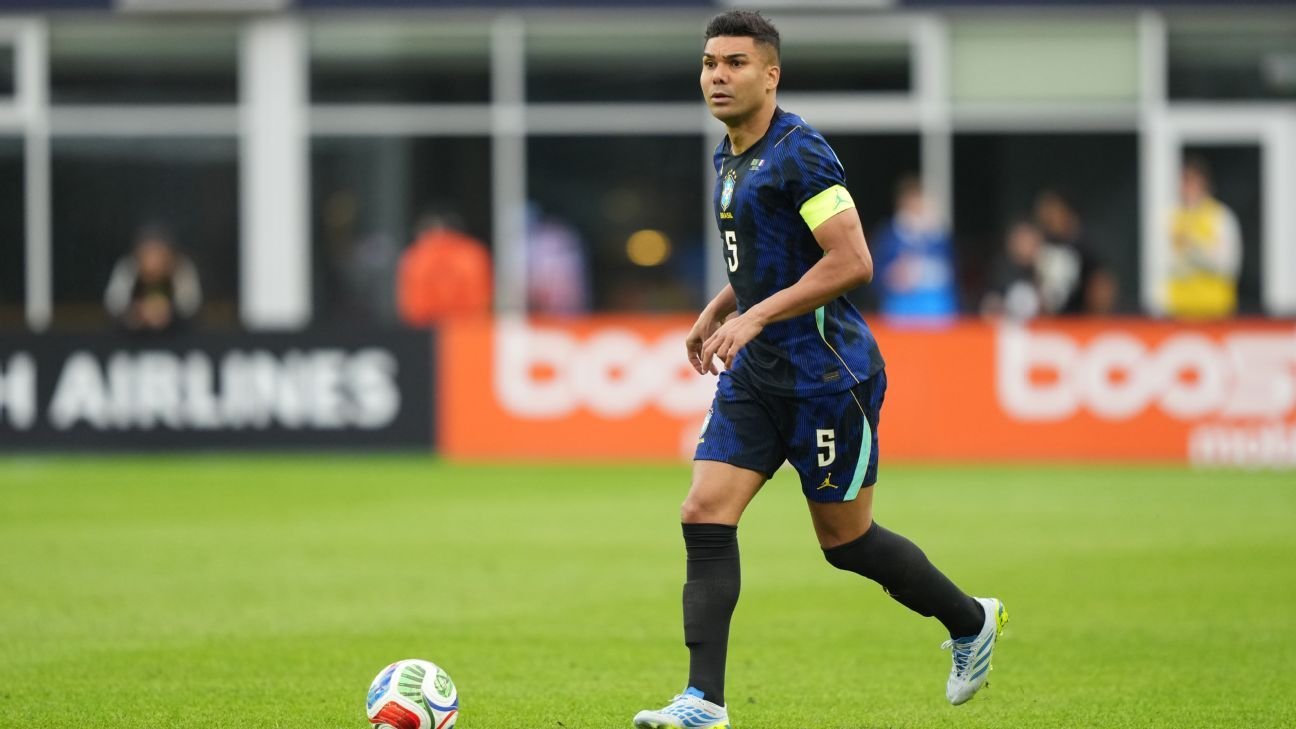
Around two years ago, some Premier League pundits were arguing that Casemiro should retire. The Brazil midfielder’s legs had gone, they said, he should give up top-class football before the game leaves him behind, they argued.
Carlo Ancelotti did not agree.
The Italian coach was sad to lose him when he surprisingly traded Real Madrid for Manchester United. And when Ancelotti took charge of Brazil last year, his first move was to bring Casemiro back to the national team after 18 months in the wilderness.
In his book “The Dream: Breaking Champions League Records,” Ancelotti refers to Casemiro as “the steady metronome at the heart of midfield.” A former international central midfielder himself, Ancelotti appears to see Casemiro as an extension of himself on the field, giving structure to the team, protecting the defense and orchestrating the first pass forward.
There is an easy indication of the success of Casemiro’s recall. Earlier this week, Brazilian outlet Globo Esporte asked readers to choose their Brazil lineup for Thursday’s friendly against France. The player with the most votes — more, even, than Vinícius Júnior — was Casemiro, who then went out to face the French at Foxborough and showed why his coach and compatriots hold him in such high esteem.
Right at the start of the game, in France’s first serious attack, he made a vital tackle on the edge of his own penalty area. Brazil’s best early chances came from his two superb long-range passes to Raphinha. He carried goal threat as well, narrowly missing the target with a shot from outside the area and a header from a corner.
Winning the ball, setting up play, finishing — Casemiro was involved in all facets of the midfielder’s task. Even so, he might have been disgruntled at halftime.
France led with a well-taken Kylian Mbappé strike, from a move that began when Casemiro lost possession close to the halfway line. The real fault, though, lay with the back line. Debutant centre back Léo Pereira had played the team into trouble with a pass out of defense that put the midfielders under too much pressure, and he was then beaten all too easily when the ball was passed beyond him.
The goal, and maybe even the final score of 2-1 to France, can highlight the danger of placing too much importance on the outcome of friendlies. If these teams meet in the FIFA World Cup, the Brazilian back line will undoubtedly be far more proficient. Injuries robbed Ancelotti of his entire first-choice defensive unit, and he took the opportunity to have a look at some fringe players.
But there is, too, a fascinating structural issue. Noting Brazil’s extraordinary strength in depth with wide forwards, Ancelotti clearly wants to go with a front four: against the French it was Raphinha, Vinícius, Matheus Cunha and Gabriel Martinelli. At full strength, Estêvão, such a success with Ancelotti, would come in for the Arsenal winger. But however dazzling the quartet, there is a question of mathematics.
With a goalkeeper, a back four and a front four, there is only room for two in the middle of the field. One of them, currently injured, is Bruno Guimarães. The other is Casemiro. A danger exists of the central midfield pair being overwhelmed, outnumbered and dispossessed — just as happened with Andrey Santos and Casemiro for that first French goal.
After the match, Ancelotti declared himself happy with the structure of the team. He pointed out that Éderson hardly had a shot to save, and that the front players had displayed admirable defensive commitment — Cunha was especially impressive in this regard. The coach has been consistent in stressing that he is not interested in anybody going to the World Cup with the intention of making a claim for the Ballon d’Or — in other words, the only way that such a system can work is with a considerable sense of sacrifice from the front men.
There is an extra factor, though, one that cannot be tested on an early spring afternoon outside of Boston. Much of the coming World Cup will be played in conditions of extreme heat — think, for example, of Brazil’s third group game, a 6 p.m. local kickoff in Miami. This adds an extra layer of challenge: can 34-year-old Casemiro really be part of a two-man midfield when the temperatures are soaring?
Brazil may choose to look at something different against Croatia in Orlando on Tuesday. It is also possible that changes might be made during the course of the World Cup. After all, such tournaments often work like time sped up, with teams coming together or falling apart.
Winning sides often change their construction during the tournament. An obvious move would be to introduce a third man in midfield; Botafogo‘s Danilo, once of Nottingham Forest, did himself no harm with a bright and dynamic second-half appearance against France, and Lucas Paquetá, left out this time, would also seem a strong candidate.
There is plenty for Ancelotti to digest as he reflects on the clash with the French. He may have expected his side to make more headway against an opponent down to ten men early in the second half. He could be concerned about the performance of Vinícius, who hardly did anything right all game. He will have heard the chants for Neymar going up in the crowd as soon as the second France goal went in. But perhaps the biggest question mark hangs over the shape of his team.
When Brazil won USA ’94, they adapted to the conditions by packing the midfield — which Ancelotti saw firsthand as assistant coach of beaten finalists Italy. The team he is building looks very different. In the heat of June and July, can he really expect Casemiro to cover so much ground and shoulder so much responsibility? Or might his steady metronome be able to exert more control as part of a three-man midfield?

