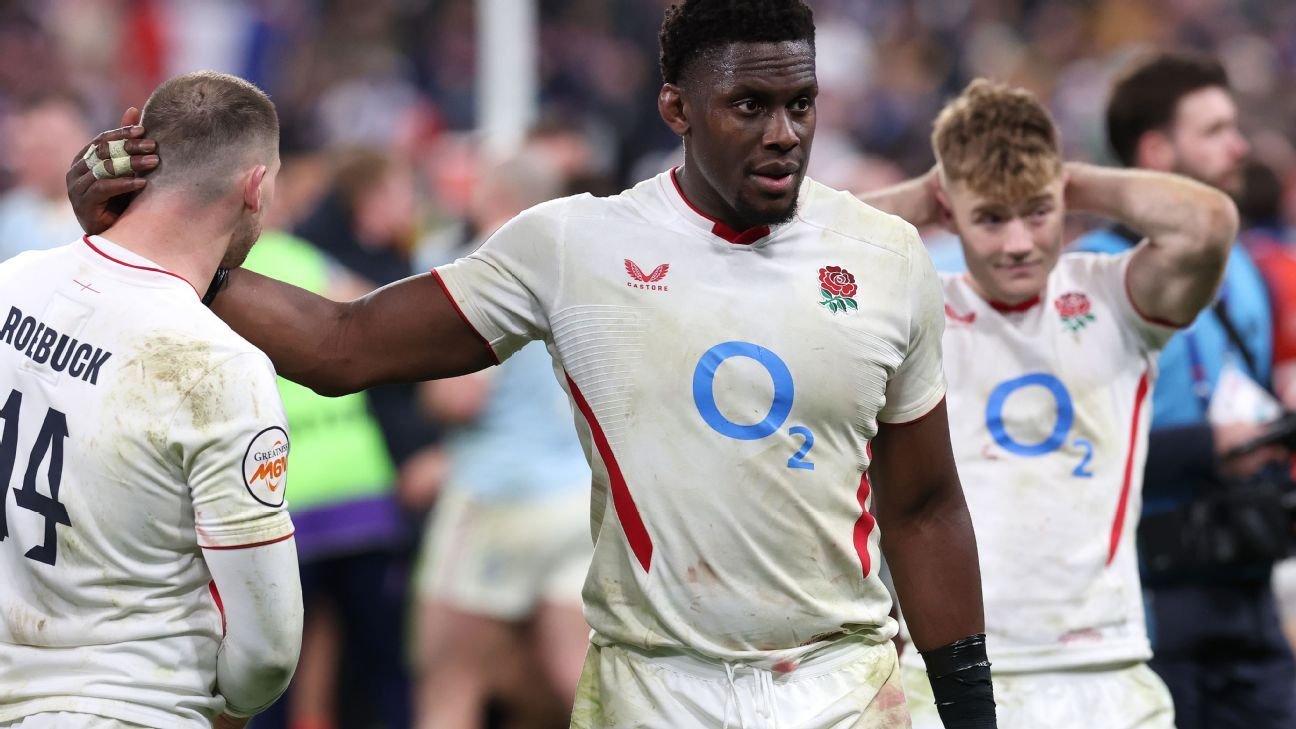
About an hour after the final whistle had blown at the Stade de France, Jack van Poortvliet spoke for every England supporter. “It’s frustrating that we know we’ve got that [performance] in us,” he said. “Why can’t we do that more often?”
The replacement scrum-half had been part of that improved performance where England were seconds from upsetting France. But yet another slip in discipline, and the unwavering boot of Thomas Ramos ended that reprieve. England lost for the fourth time this championship, their worst-ever Six Nations. As the RFU starts picking through the bones of this desolate campaign, the key question must be: How and why did this championship unravel so dramatically?
The England team flew home on Sunday, and the players will disperse back to their clubs and normal life. Borthwick will undertake his own assessment of a campaign where England promised much but underdelivered. And the RFU, who has given its backing to Borthwick for the time being at least, will ready the post-tournament review.
The immediate reaction to the defeat from within the camp was a combination of pride tinged with frustration. There was the functional, match-related disgruntlement. Borthwick was evidently furious at the decision to sin-bin Ellis Genge and award France a penalty try on the stroke of half time, and also questioned the scrambled shift in a call leading to Louis Bielle-Biarrey’s fourth try, where England were told they had penalty advantage and therefore played their hand, only to be told this has shifted to scrum advantage, subsequently making an error from which France pounced to score. When it rains, it pours.
Vice-captain Jamie George, with cuts still seeping, bemoaned the cruel déjà-vu of watching Ramos kick a last-gasp penalty to win Le Crunch just like he did in Lyon two years ago. Van Poortvliet was left looking for answers as to why England could play so brilliantly against France but fall short against Scotland, Ireland and Italy. Sam Underhill highlighted the competitiveness of the match, but said his two overriding emotions from the campaign were being left wanting more and not being satisfied.
That feeling of dissatisfaction sums up a campaign where England headed into it as one of the favourites to win the whole thing. It started well with their 12th win in a row, coming against Wales. Everything was rosy. But then things went down hill, quickly. Scotland found an emotional level above what England could harness and familiar lapses in discipline that had been previously papered over, became gaping faultlines in the team. Yellow cards — and Henry Arundell’s 20-minute red against Scotland — meant they were forever playing on the backfoot, and indiscipline again cost them against Ireland and in that first ever defeat to Italy. England’s attack was also malfunctioning while their usually dependable lineout was slapdash against Ireland — a match where Borthwick made two first-half substitutions such was their alarming start. In short, across those three defeats, one of the few areas you could find positivity in was the scrum. It was grim.
The RFU issued its statement the following morning after the Italy defeat, backing Borthwick through to the Nations Championship, but also calling on the team to learn from mistakes and “grow through adversity.” The RFU said it would seek to “understand and rectify why [the team has been] been unable to meet expectations.” Peel beneath the carefully worded vernacular, and it was damning.
Against France, England showed that growth in trying circumstances. “It’s a group where adversity will help us a long way going forward into the rest of the year and next year,” Van Poortvliet said. Box ticked on part one of the RFU memorandum.
On the field, England showed further growth in Paris. England kicked less against Les Bleus, and shifted their gameplan, despite saying earlier in the week they’d stick to their guns of a kick-first approach. Sources told ESPN the matches where England played closest to the blueprint envisaged for the team was on their tour of New Zealand in 2024. We saw that in Paris. England were far more ruthless in the France 22, mixing between kicking and keeping the ball in hand, and constantly forcing the opposition into gambling on where to shift their point of focus in defence. “We earned our chances through being physical in the middle territory,” George said. “I thought Fin Smith and Ben Spencer were fantastic in the way that they managed the game.”
– Six Nations grades: Did England fail? Results for every team
– George backs Borthwick despite worst-ever 6N
– Borthwick: Six Nations pain will help England grow
Up front, the forwards were formidable with Ollie Chessum superb at blindside and Maro Itoje putting in his finest performance of the championship. “That is our blueprint,” Van Poortvliet said. “That’s what we must take forward. The boost and the confidence it gives the team when you’re really going at a team like that, challenging them with speed of ball, it puts a great feeling into the team.”
Underhill said: “I’d say the boys put their best foot forward and like played like we knew we can. I guess sometimes it takes whatever reason or whatever circumstances to make that happen. The work off the ball, work to get set, all this stuff you probably don’t see as much – the unseen stuff all kind of came together.”
But still questions remain on how to solve their perennial downfall: discipline. England picked up nine yellow cards in the tournament, equalling Italy’s inglorious tournament-worst total from 2002. With two minutes left on the clock in Paris, England had the ball. The match was in their grasp, but it slipped as they managed to cough up two penalties offering Ramos his crowning moment. Again Genge’s yellow card earlier in the match cost them dear — it led to a penalty try, and a further two France scores.
“You need to keep 15 men on the pitch. The teams are so good that when you go drop numbers, it makes life very, very hard for you,” Borthwick said. The team continue searching for answers, saying there is no universal, over-arching reason for why their discipline has been so poor.
George says England must analyse why they started matches slowly, and find a way to be “a lot more difficult to beat”. Central to that is ensuring 15 men stay on the field. “I honestly think you have to look at each [yellow card] in isolation,” George said. “It’s really hard to pick out an overall theme as to why we’re giving away yellow cards…it is individual responsibility.”
George has been a near ever-present in the team since he made his debut in 2015. He’s experienced pretty much every emotion in the England shirt, and knows the importance of calm rational thought, and not making kneejerk decisions. Take note, RFU.
Up next is the RFU review where players and staff will provide feedback to a panel, and from there conclusions will be drawn. One figure close to the process says the overarching question needs to be: “What the hell happened?” And from there you build a picture. George says ultimately it’s the players who must take responsibility for their return of one win from five, but he leaves the tournament proud of how united they were behind the scenes.
The team’s leadership has come in for scrutiny over the past three weeks, with suggestions from sources some players were on different pages to others. But George says that’s simply not the case. “It would have been so easy for us to splinter off, and I’ve been part of any teams that have, and there’s been whispers in corridors and there’s been doubts about game plan and personnel,” he said. “Honestly, there has been none of it. Our togetherness has been a huge strength of the team for 12 plus months.”
George has also backed Borthwick to continue leading England, and says the coaching staff need to stay together too. It is not the time for one of Logan Roy’s blood sacrifices. “Steve is one of the best coaches I’ve ever worked under, [and] under Steve I think we will be right up there with the favourites to win the World Cup in 2027,” George said. “We’re a great team, a great group of players and he’s the perfect person to take us there. He’s an English coach who cares so much about this game but he’s also a very, very good coach who has created an excellent programme. When you combine that with a good group of players it’s a recipe for success.”
It’s up to the RFU whether they heed George’s advice. It doesn’t get any easier. Up next for England is South Africa in Johannesburg on July 4. “Our set-piece is in a great spot. Look, South Africa haven’t played for 10 months. It’s very difficult for us to comment on where they’re at, but they are world-class. They’re the best team in the world,” George said. “Playing them in Johannesburg is a difficult place to play them. But what an amazing opportunity.”
But in the immediate future, for the players it’s back to club duty, and with the review set to start, the ramifications from this championship will rumble on. “It’s been a painful tournament and we’re all hurting,” Borthwick said. “There’s determination to make sure this hurt makes the team stronger.” This will sting for a while. Four defeats from five is woeful for a team who should’ve been challenging for a title. There’ll be a thorough post-mortem, the RFU will make its call, and England will move forward. But they must learn lessons from this, and ensure this was the nadir.

