Everything glitters inside the hall of Vienna’s Hotel Sacher – chandeliers overhead, polished marble underfoot, and bouquets festooning every corner. Rooms here start at £550 a night. It is, by any measure, a grand setting – which makes it feel faintly absurd to be discussing the rough, muddy farm tracks of northern France. But that’s exactly what I’m doing, because opposite me is Tadej Pogačar, and I’m asking him about one of the few big races he is yet to win: Paris-Roubaix.
We have slipped into a quiet sideroom, off the main hall, and settled into armchairs. “The biggest point is,” says Pogačar, leaning forwards, “the faster you go on the cobbles, the easier they are.” Moments earlier he was on stage announcing his new ambassadorship with crypto exchange KuCoin, but it’s clear he’s more comfortable talking about bike racing. Dressed in a white shirt and navy check jacket, his hair freshly clipped into a neat short-back-and-sides, he looks disarmingly young, almost like a school-leaver eager to make a good impression at his first job interview. Yet, at 27, there is only one position he is still seeking: that of the greatest cyclist of all time.
In fact, Pogačar’s CV is now so comprehensive that it’s easier to list the races he hasn’t won – the ones that now most motivate him. Already a four-time Tour de France winner and double world champion, the glaring omissions are Paris-Roubaix and Milan-San Remo, the two remaining Monuments missing from his palmarès. Only three riders in history have collected the full set of five – Milan-San Remo, the Tour of Flanders, Paris-Roubaix, Liège-Bastogne-Liège and Il Lombardia – and they’re all Belgian: Eddy Merckx, Rik van Looy and Roger De Vlaeminck. Could Pogačar become the first rider in nearly half a century to join them? And if so, would it confirm his status as the best cyclist there has ever been?
Article continues below
(Image credit: Getty Images)
For Pogačar, racking up all five Monuments is a “challenge” that keeps his career fresh. “I won some races, and it doesn’t feel the same [to win them again] because you’ve already put a tick on them,” he tells me. Of the other three Monuments, he’s won Liège three times, Flanders twice, and Il Lombardia a record five times in a row. When a journalist asked him last year to choose between a hypothetical fifth Tour title or a first Paris-Roubaix, the Slovenian opted for the latter. Now he’s trying to make it a reality. “Well, at least this year I’ve had it in mind since last year,” he smiles.
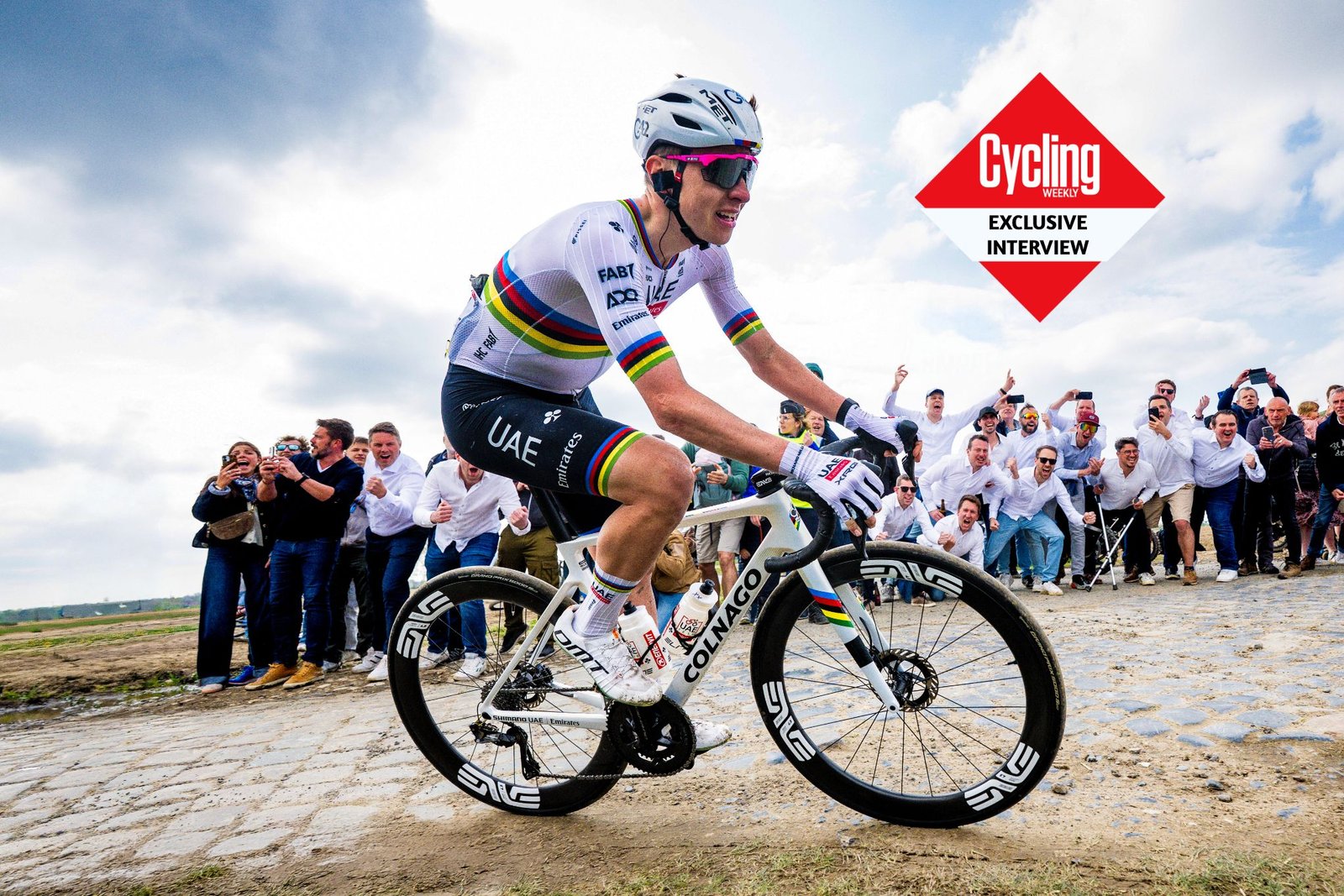
Pogačar’s Roubaix debut last spring, announced just two weeks before the race, was one of the sport’s most talked-about topics in years. Roubaix director Thierry Gouvenou called it “a huge moment for cycling”. In fact, the world champion’s presence alone made history, when he became the first reigning Tour champion since Greg LeMond in 1991 to start the race. But while LeMond finished a lowly 55th, Pogačar placed second. What did he learn from it? “It’s a f***ing hard race,” Pogačar laughs. “When I did it as a junior [finishing 30th in 2015 and 13th in 2016], I was like, ‘Damn, I don’t want to do this ever again because it’s just so hard’… If I compare my Roubaix power file [from 2025] – I know I changed the bike in the last hour, but still, up to that point, my power numbers were more impressive than in any other race.”
His attacks in last April’s race began with over 100km remaining. By 50km to go, it had come down to a duel between Pogačar and the defending champion Mathieu van der Poel, the script seemingly written for a velodrome shoot-out. The Slovenian appeared to be as assured on the jagged cobbles as he was in the mountains of France. Then came an error – small but decisive. Tracking a camera motorbike into a sharp right-hander, Pogačar misjudged his line, braked too hard too late, and tipped off into the dirt, scrambling as Van der Poel rode away. It was precisely the scenario his team had feared.

(Image credit: Getty Images)
Speaking ahead of the race, his UAE boss Mauro Gianetti told La Gazzetta dello Sport that he didn’t want his leader to compete, for fear a crash would “jeopardise” the Tour. Looking back now, Pogačar understands the concern. “Obviously, if I’m the manager of the team, I also don’t want to risk everything in the pre-Tour, because in 2023, I was not ready because of a crash [at Liège-Bastogne-Liège]. As we know, touch wood” – he taps his knuckles against his forehead – “it can happen so quickly in Roubaix, or any other race. The stress is always there, [the risk of being] out for the main goal of the season, but you need to accept it.” That second place, he says, shifted the mood. “When I came second, they saw maybe we have a chance to win another Monument.”
As such, preparations for this spring have been more focused. Rather than tagging on a first recon to his Flanders prep in February as he did in 2025, Pogačar began his visits to northern France two months earlier, riding 160km across the cobbles in December. He plans to go back at least once more before the mid-April race weekend. Course familiarity helps – Magnus Bäckstedt said he did “three, if not four” recons the year he won, 2004 – but Pogačar knows power and tactics will unlock the title.
“For me, it’s really tough to make the difference,” he says. Without any climbs on which to launch one of his trademark attacks, how does he plan to win? “Maybe the best [thing] would be to attack with surprise, but I don’t think I can do that anymore. Everybody’s looking at me,” he says. “I’ll just go with the flow, see where the race takes me, and try to gamble for the final maybe, with a small group sprint. I know after such a tough race I can do, for me, a solid sprint. There’s always a chance.”
It’s hard to believe that, for a rider who has won his last five races with solo attacks averaging 55km, Pogačar’s plan is to rely on his sprint. But the more I think about it, the more sense it makes. After all, he’ll likely have tested his dash three weeks earlier at Milan-San Remo, the race familiarly known as the ‘sprinters’ classic’. If it can work there, why not double down; refine the kick for both? Whatever Van der Poel can do, Pogačar can at least attempt to do better.
Head-to-head: Pog vs MVDP

(Image credit: Getty Images)
You don’t have to look far back in history to see when a rider last won both Milan-San Remo and Paris-Roubaix in the same season – it was only last year. That rider was Alpecin-Premier Tech’s Mathieu van der Poel, surely the greatest Classics racer of his generation, and the man standing between Pogačar and Monument immortality.
The fact Van der Poel was only the fourth person ever to pull off the double – he joined Cyrille Van Hauwaert (1908), Sean Kelly (1986) and John Degenkolb (2015) – is testament to how difficult it is. “To race against him is a big honour,” Pogačar said of the Dutchman after finishing runner-up to him at last year’s Paris-Roubaix. “If I was a kid racing now, I think he would be my idol.” Van der Poel has reciprocated the praise, hailing Pogačar a “generational talent”. Here’s how the two stack up:
Tadej Pogačar
Age: 27
Career wins: 108
Monument wins: 10 (5x Il Lombardia; 3x Liège-Bastogne-Liège; 2x Tour of Flanders)
Mathieu van der Poel
Age: 31
Career wins: 56
Monument wins: 8 (3x Tour of Flanders; 3x Paris-Roubaix; 2x Milan-San Remo)
At over 300km long, and mostly as flat as a carpenter’s workbench, San Remo is widely regarded as the easiest Monument to finish but the hardest to win. Pogačar has previously said it’s the race that will “send me to the grave”; in five participations, he’s finished 12th, fifth, fourth, and twice third. The trend shows he’s getting closer, but still, he says, finding the podium’s top step is “really tricky – these days, the climbs, I would not call them climbs anymore, because we go so fast on the Cipressa [at 22km to go] and Poggio [at 6km to go] that the draft there is so important.” As at Roubaix, there is no dependable launchpad. There’s a reason why nobody has won from a Cipressa attack since Gabriele Colombo in 1996.
Even when UAE Team Emirates-XRG ramped up the pace on the climb last year, Van der Poel and Ineos Grenadiers’ Filippo Ganna managed to hang on, and both beat Pogačar in the sprint.
“For me, it’s hard to make a difference,” the world champion says, returning to a refrain he used for Roubaix. “But I will keep trying. It’s one challenge that keeps me going. I haven’t succeeded in winning yet, and I’m getting closer. I still have a few years left to try it out.”

(Image credit: Getty Images)
Let’s imagine that Pogačar does win both races – picture him sprinting to victory on San Remo’s Via Roma and in Roubaix’s outdoor velodrome. What will it mean for his legacy? He’s the greatest rider of his generation, the Giro-Tour-Worlds treble in 2024 proved as much, but also the greatest of all time? He’ll have won all of cycling’s major crowns (bar the Vuelta a España and Olympics) and in a more competitive, professionalised era than that dominated by Eddy Merckx.
I remind Pogačar of what he said in an interview with L’Équipe two years ago – that he wanted to be “the best in history”. He scrunches his face slightly and claims he never said the line – “maybe they twisted the words a little bit” – but the point seems to stand nonetheless. “I wouldn’t mind going for it,” he says, and pre-empts a Merckx parallel. “There is so much talk about me and comparing [me] to Eddy etc. For me, it’s complete nonsense,” he says. “I like to live in the moment, in the present, not thinking too much about records.” He steers the legacy theme towards his youth team, Pogi Team, and charity, the Tadej Pogačar Foundation. “Maybe the results are not everything that I want people [to remember me for],” he says.
From many riders, a claim they are not hung up on results can sound like protective deflection. From Pogačar, it feels credible. He is driven, and hungry for new titles, intent on improving year after year, but, as he puts it, “will not lose any sleep over it”. At a press day in December he told reporters that, contrary to the narrative they were eager to build, he’s “not obsessed” with winning Roubaix or San Remo. And when a reporter asked when he would win them, he firmly corrected them: “If I win these races…”
What if both races continue to elude him – does it really matter? “I came close, but I’m yet so far,” he says. “If it happens, it happens. If not, I will live my life the same as I do now.” This laconic acceptance may be Pogačar’s greatest advantage. It is what allows him to chase races that do not naturally suit him – Paris-Roubaix chief among them – with curiosity rather than desperation, ambition unclouded by anxiety. As our allotted interview time runs out, he stands up, wanders over to a nearby marble-topped table and helps himself to three unhurried forkfuls of chocolate cake. Five Monuments or not, he seems entirely at ease with the uncertainty. Greatness, for him, is something to be savoured.
This feature first appeared in Cycling Weekly magazine on 12 March 2026. Subscribe now and never miss an issue.

