The Spring Classics are finally underway, and Opening Weekend didn’t disappoint with emphatic wins by Mathieu van der Poel and Demi Vollering at Omloop Het Nieuwsblad and Matthew Brennan at Kuurne-Brussel-Kuurne. As expected, the team paddocks were awash with fans and cycling royalty, not to mention mechanics frantically prepping bikes ahead of the start. We were fortunate enough to be on the ground at both races, camera and notepad in hand, meticulously searching for new tech and trends.
While there’s still no sign of a new Shimano Dura-Ace Di2 groupset, there was plenty of groupset experimentation behind the scenes, along with some common themes explored by most teams. There was an even split between Shimano and SRAM components (Cofidis was the only team running Campagnolo groupsets), with further subdivisions in drivetrain specifications.
While dominated the 1x setups, Tim Wellens led the charge for Shimano with a Dura-Ace Di2 single-ring configuration
(Image credit: Aaron Borrill)
One-by setups were commonplace given the nature of the punchy parcours. As such, SRAM-sponsored teams such as Lidl-Trek, Visma-Lease a Bike, and Unibet Rose Rockets employed mullet configurations, categorised by SRAM Red AXS front ends, Red AXS XPLR cassettes, and direct-mount rear derailleurs. This move allowed the teams to safely run the brand’s aero-optimised 54T chainring.
Chain guides were standard fare on all one-by setups, with Wolf Tooth dominating chain keeper duties. Tim Wellens of UAE Team Emirates XRG was seen aboard a Y1Rs with a Shimano Dura-Ace 1x setup, complete with a Carbon-Ti ring and a K-Edge chain keeper.
The humble butyl inner tube still had a small role to play, used on forks to hold the timing transponders.

Most teams were using the humble butyl tube to safely (and easily) store the timing transponder
(Image credit: Aaron Borrill)
Race profile stickers were seen in various guises, from beautifully printed glossy decals to handwritten paper and fabric adhesives. Stem lengths were pretty long, too, with nothing less than 120mm fitted. Most riders opted for 130mm while others were seen using stems as long as 145mm.

Handwritten race notes and stickers were commonplace atop stems
(Image credit: Aaron Borrill)
There was a mix of handlebar configurations, too, with both traditional stem-and-bar clamps and integrated one-piece arrangements. This was used by Lidl-Trek, with rider Kragh Andersen no doubt using a Bontrager Aero RSL bar and stem to find the right combinations before settling on an integrated setup. Most Lidl-Trek riders were using the fully integrated RSL setup.

While integration was well and truly leading the charge, there were several teams employing separate bar and stem assemblies – no doubt, for riders trialing various combinations ahead of settling on a one-piece unit
(Image credit: Aaron Borrill)
While we were at it, we weighed as many bikes as we could get our hands on to get a sense of the Classics-spec race rigs, which averaged around 7.5kg. The lightest bike was Tom Pidcock’s 7.18kg Pinarello Dogma F, while the heaviest was Cole Kessler’s Factor One of Modern Adventure Pro Cycling. His bike tipped the scales at 8.39kg, granted it was outfitted in SRAM Force AXS.

Shimano Dura-Ace SPD-SL were the most popular pedals at Opening Weekend
(Image credit: Aaron Borrill)
There was a fair bit of mixed-and-matched components on show, too, but this is nothing new owing to sponsor obligations or rider preference. As such, Shimano Dura-Ace SPD-SL pedals lead the charge and were also seen attached to many SRAM crankarms. There were Look Keo Blade Ceramic Ti and Time XPro SL pedals also on display, but the latter was used on SRAM-sponsored teams only – we didn’t see any Time pedals fitted to Shimano-equipped bikes.
Among the drivetrain component combinations, Bahrain Victorious paired regular Shimano cranksets and Chinese Elilee carbon cranks (with power meters in some configurations) with their Dura-Ace groupsets.

Bahrain Victorious were using a meld of Chinese Elilee carbon cranks and Dura-Ace components
(Image credit: Aaron Borrill)
Mathieu van der Poel went on to win Omloop Het Nieuwsblad on a two-by Shimano Dura-Ace Di2-outfitted bike, proving 24 gears are still a no-brainer for most race situations. With over 1,600m of vertical ascent to negotiate across the Flanders landscape, van der Poel‘s 56-44T, 11-34T gearing setup proved a successful recipe for the Dutchman.

Mathieu van der Poel was spotted aboard a very mildly updated Canyon Aeroad CFR frameset
(Image credit: Aaron Borrill)
There was a lot on display, but there were several clear trends seen on the bikes of all the major WorldTour teams – and we’ve compiled our findings below.
Image 1 of 11


1. The single chainring revolution
Owing to the parcours, which was predominantly flat and rolling with several steep bergs, the chainring standards were fairly diverse.
The common chainring size across both single- and double-chainring configurations was 54T. For Shimano double chainsets, 54-40T was a popular ratio, while van der Poel used a 55/40T combination on rings that looked aftermarket, albeit with laser-cut Dura-Ace nomenclature. The largest ring combination was spotted on bikes from Bahrain Victorious and TotalEnergies, both teams that used 56-44T Dura Ace-branded rings, and on the 56-43T rings seen on Decathlon CMA CGM rider Stefan Bisseger’s Van Rysel RCR Pro.
Image 1 of 4


2. The crank length debate
The crank length debate is well and truly undecided, with a host of sizes seen employed across the teams for Opening Weekend. Of all the sizes, 172.5mm was the most popular size, followed by 165mm and 175mm.
There were several oddball lengths, such as Jonas Abrahamsen’s 167.5mm SRAM crankarms, but all in all, Classics riders don’t appear too bothered by the current rhetoric surrounding shorter crank lengths.
Image 1 of 3


3. 3D-printed computer mounts and weight-saving hacks
There were some custom 3D-printed goodies seen on some team bikes, mainly pertaining to the computer mounts and cradles. While most teams seemed happy using K-Edge and other standard mounts, UAE Team Emirates XRG continued to run the custom Wahoo cradle first seen on Tadej Pogacar’s Y1Rs at last year’s Tour de France. UAE Team Emirates was also using Carbon-Ti direct-mount hangers.
Lidl-Trek was also using 3D-printed computer mounts supplied by the Dutch company, Leap Components, while Uno-X was running team-branded 3D-printed out-front mounts and custom race number holders on the seatpost.
Image 1 of 3


4. Prototype tyres, wheels and frames
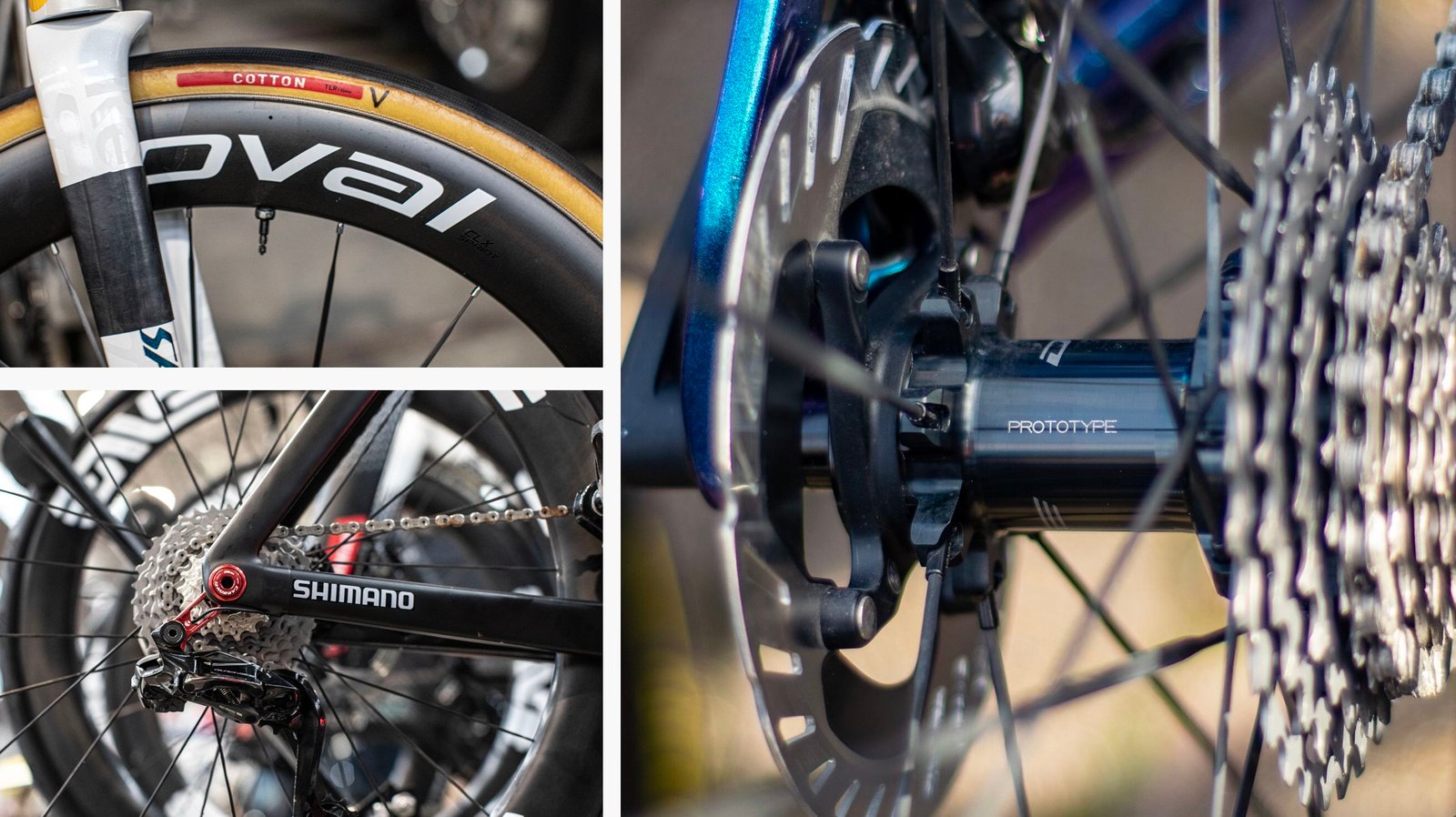
We spotted what appeared to be an unreleased tyre on many of the Specialized-sponsored teams, including Red Bull-Bora-Hansgrohe, Soudal Quick-Step and FDJ United-SUEZ. These tyres were marked with a ‘Cotton’ wordmark logo and measured 32mm in width. A closer look at Jordi Meeus’s tyres also revealed a silicon-like treatment and a handwritten ‘V’ on the sidewall. The Cotton tyre, together with the Vittoria Corsa Pro, represented the widest available at the Opening Weekend.
The other big news belonged to the man of the hour, Mathieu van der Poel, who was riding a mildly updated, custom Canyon Aeroad with redesigned CFR logos on the top tube. Not only did the frame appear to have an updated rear dropout to ensure it’s SRAM UDH-compatible, but there were also prototype Shimano Dura-Ace wheels, complete with carbon spokes and new hubs, on display.
Image 1 of 6


5. 30mm tyres rule supreme
Tyre widths were also quite experimental over the weekend. While the majority of riders were using notably wide rubber, nothing less than 28mm was seen wrapped around wheelsets. In fact, of all the teams I analysed, Davide Ballerini of XDS-Astana was the only rider using 28mm tyres, in this case, Continental Grand Prix 5000 TT TR. The most popular size was 30mm, with brands such as Pirelli, Vittoria, and Michelin catering to this requirement (32mm Vittoria Corsa Pro was also seen on some bikes). The widest option used over Opening Weekend was the unreleased 32mm Specialized Cotton TLR tyre.
Explore More

