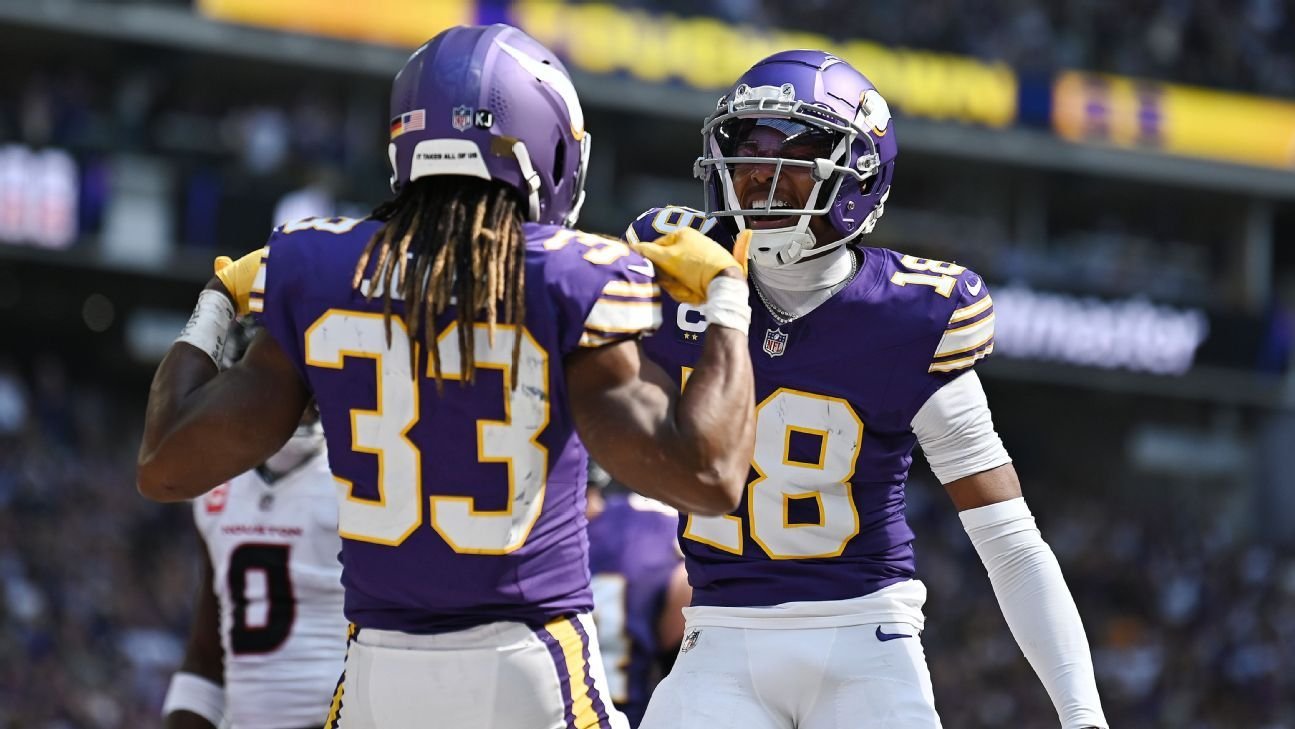
EAGAN, Minn. — For the past decade, no rational draft analyst has considered wide receiver to be a “need” position for the Minnesota Vikings. From Adam Thielen and Stefon Diggs, to Justin Jefferson and Jordan Addison, the position has been well stocked.
The same goes for most of that time period at running back, where Dalvin Cook produced 1,000-yard seasons until 2022 before eventually giving way to Aaron Jones Sr. (2024-25) and Jordan Mason (2025).
But if the draft philosophy of interim general manager Rob Brzezinski is to be taken at face value, then both positions are in play as the Vikings prepare to make four picks in the top 100 selections of the 2026 draft. Speaking earlier this spring at the NFL combine, Brzezinski articulated an approach that is structured to avoid reaching for immediate needs and instead optimize for talent across the board.
“I almost look at the draft as you rule out non-needs, and if you look at our team, is there any position that you just say 100% is a non-need?” Brzezinski said. “Let’s say if we were Buffalo and had Josh Allen. You’re not drafting a quarterback, right? But other than that, I think it’s more about you rule out non-needs and keep it open to as many possibilities as possible, rather than trying to hone in on a specific need here or there.”
That approach would open the door to the Vikings backfilling two positions they have minimized for various reasons since the late 2010s, based on the NFL’s long-applied emphasis on the value of the top 100 picks in a draft.
After selecting Cook in the 2017 second round (No. 41), the Vikings have not used a top-100 pick to draft a running back since — one of four NFL teams to do so. And in the nine years after drafting Laquon Treadwell in the 2016 first round (No. 23), they selected two receivers in the top 100. That’s tied for the second fewest in the league over that period, according to ESPN Research.
It’s fair to point out that the Vikings traded most of their top-100 picks between 2023 and 2025 and made only four total over that period. Plenty of other positions also were ignored.
And admittedly, the two top-100 receivers the Vikings did select are Jefferson and Addison, both of whom were first-rounders. But coach Kevin O’Connell has used 11 personnel — three receivers, one running back and one tight end — on 65% of his snaps since arriving in Minnesota. That is the ninth-highest rate in the NFL over that period and a reminder that the Vikings need three starting-quality receivers on their roster, and that’s assuming everyone is healthy.
Let’s take a closer look at where the Vikings stand at both positions with the draft less than two weeks away.
Running back
Last season, Mason and Jones combined to give the Vikings by far their most efficient running game of O’Connell’s tenure. The Vikings’ expected points average (EPA) when rushing ranked No. 9 in the NFL in 2025 after ranking No. 27 in the previous three seasons combined.
But both Mason, 26, and Jones, 31, are entering the final year of their contracts, and the Vikings explored moving on from Jones this spring when they bid for free agent Travis Etienne Jr. After the New Orleans Saints signed Etienne, Jones agreed to take a pay cut to return. There might not be an immediate need for a running back, but it is coming soon.
The 2026 class of running backs is not deep enough to feel assured that Brzezinski will have a value pick available to him in the top 100. The class offers one dominant, explosive playmaker who almost certainly will be a top-10 pick — Notre Dame’s Jeremiyah Love — and then a notable drop-off. At least two others appear likely to be top-100 picks: Love’s Notre Dame teammate Jadarian Price and Arkansas’ Mike Washington Jr.
In a recent three-round mock draft conducted by ESPN’s Mel Kiper Jr., Matt Miller and Jordan Reid, Kiper matched the Vikings with Price with the No. 49 pick.
Wide receiver
Jefferson, 26, has three more years left on his contract and Addison, 24, has two, including an $18 million fifth-year option in 2027. Addison’s future will be unclear until the Vikings sign him to an extension, if they choose to. Regardless, there are no proven players behind them.
There is some hope that Tai Felton, the No. 102 pick of last year’s draft, can make a leap and challenge for the No. 3 receiver’s role. But Felton played only 46 offensive snaps as a rookie and would need to take a big leap this offseason to fill the No. 3 role this season.
In the three-round ESPN mock, five receivers were selected in the first round and a total of 14 were among the top 100 players selected. The 14th was Ole Miss receiver De’Zhaun Stribling, whom Kiper matched with the Vikings at No. 97. Stribling is scheduled to make a predraft visit in Minnesota, according to ESPN’s Jeremy Fowler.
“The key is just getting them stacked objectively,” Brzezinski said, speaking generally about the draft. “We’re obviously going to do everything we can to fill our needs when we’re on the clock, but our goal is to get the board set objectively so we really see where the talent is and then kind of let it fall to us. … You can’t manufacture what’s not there.”

