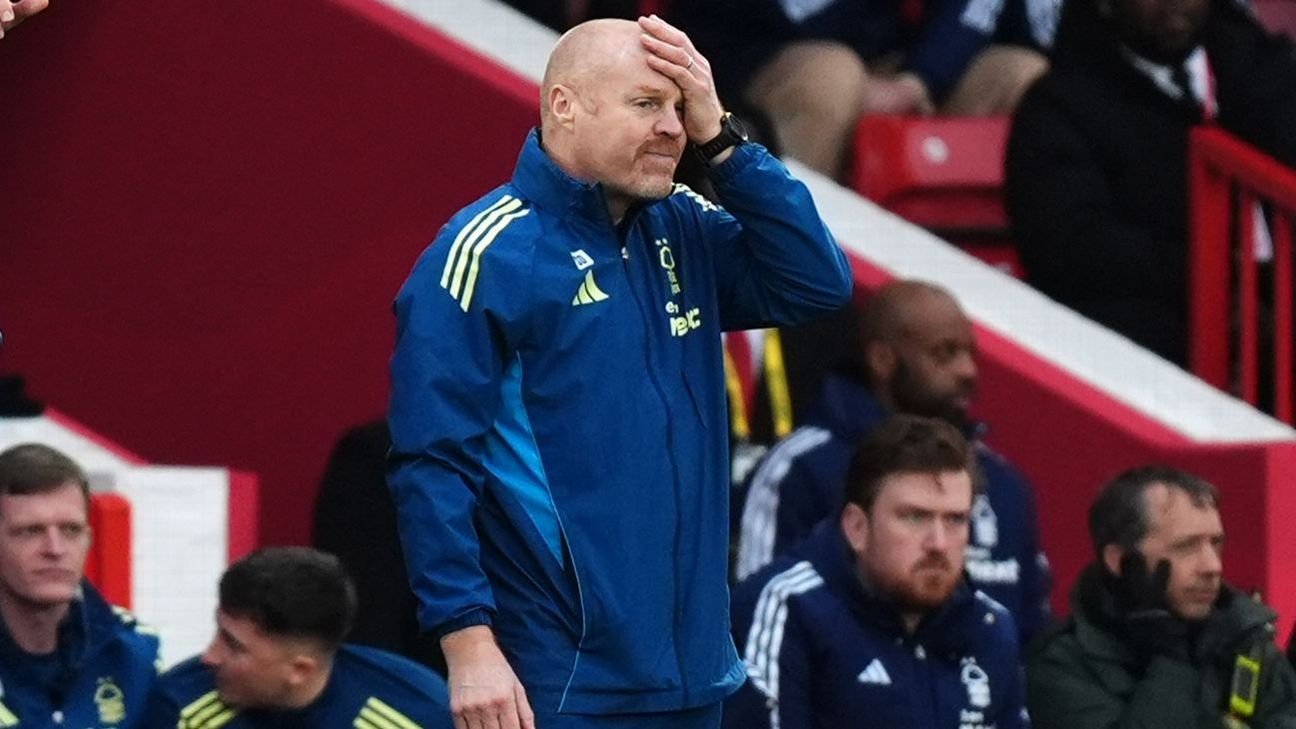
Nottingham Forest are in the process of looking for yet another manager this season after the board decided to pull the plug on Sean Dyche’s 114-day tenure in the wake of a gloomy 0-0 draw against rock-bottom Wolverhampton Wanderers on Wednesday.
Dyche is actually a candidate for the Premier League Manager of the Month award for January after earning seven points from a possible 12 last month for the relegation battlers. However, he has now been relieved of his duties less than two weeks into February after the stalemate against Wolves left his side teetering just three points above the bottom three.
Forest began the 2025-26 season with Nuno Espírito Santo in the dugout, after the Portuguese coach led them to Europa League qualification last term, but he lasted three games until a public quarrel with owner Evangelos Marinakis saw him replaced in early September by Ange Postecoglou. Postecoglou’s disastrous stint extended to eight winless games before Dyche was appointed in October with Forest in 18th place.
– Spurs job too big for Frank, but firing him won’t fix mess at club
– Who are the candidates to replace Frank as Tottenham coach?
– Ranked: The top 25 manager jobs in soccer, from best to worst
Eighteen games down the line and Forest are now 17th with 12 league fixtures left to play. Sources have told ESPN that ex-Wolves boss Vitor Pereira has agreed to be their fourth permanent manager this season, which will be a Premier League record when the new full-time coach is confirmed.
Obviously, Forest’s fate this season is yet to be decided, but there is certainly precedent when it comes to Premier League clubs chopping and changing their manager multiple times during the same campaign. Indeed, there have now been 21 occasions (including Forest) when teams have employed three permanent managers in a single season. Here’s a look at how it went for them.
When it ‘worked’
Crystal Palace, 2014-15 (Tony Pulis, Neil Warnock, Alan Pardew) — Finished 10th
Palace’s season began in suboptimal fashion when Pulis walked out less than 48 hours before the opening game to be immediately replaced by Warnock, who managed to win just three games in 18 before being dismissed in the wake of a home defeat against Southampton on Boxing Day that left the side mired in the relegation zone. Pardew then arrived in January, and the ensuing bounce was enough to propel the Eagles to the giddy heights of mid-table obscurity by the end of May.
Swansea City, 2016-17 (Francesco Guidolin, Bob Bradley, Paul Clement) — Finished 15th
While it’s a slight stretch to suggest that 2016-17 was a vintage season for Swansea, they did at least successfully navigate their way up and out of a relegation dogfight by rotating through a trio of head coaches. In truth, the Swans were patchy throughout, but they did benefit from a marked upturn in results following Clement’s arrival in January (including three wins in their final three games of the season), which ultimately proved enough to avoid the drop by seven points.
When it made no real difference
Leicester City 2001-02 (Peter Taylor, Dave Bassett, Micky Adams) — Finished 20th
Set against a backdrop of financial plight, Leicester made a dire start to the season with Taylor getting sacked before the end of September. Multiple managerial and structural swaps were made, but nothing could deliver the Foxes from relegation after they spent almost the entirety of the campaign bogged down inside the bottom three.
Portsmouth 2004-05 (Harry Redknapp, Velemir Zajec, Alain Perrin) — Finished 16th
Having made a decent start to the season, Redknapp had Portsmouth 10th in the table when he abruptly left in controversial circumstances following a dispute with chairman Milan Mandaric over Zajec as his new director of football. Zajec then stepped into Redknapp’s wake, but the disruption saw a downturn in results as Pompey slid down toward the relegation zone. Perrin then replaced Zajec in April and the French just about managed to secure the club’s Premier League status with a smattering of games left to play.
Southampton 2004-05 (Paul Sturrock, Steve Wigley, Harry Redknapp) — Finished 20th
After just six turbulent months in charge, Sturrock left Southampton in August to be replaced by Wigley, who failed to inspire any discernible change in results and/or morale. Redknapp then made the unthinkable decision to leave local rivals Portsmouth in a bid to save the Saints from relegation, and did have the chance to do so going into the final day of the campaign. Unfortunately, a home defeat against Manchester United sent Saints back into the second tier.
Portsmouth 2008-09 (Harry Redknapp, Tony Adams, Paul Hart) — Finished 14th
Having won the FA Cup the previous year, things began to fall apart for Portsmouth in 2008-09 as Harry Redknapp walked out in October with the club in seventh place. Despite Adams overseeing a five-match unbeaten streak early in his tenure, a disastrous December and January period saw Pompey lose eight of their nine league games as they gradually slid down into the lower recesses of the table. Fortunately enough, Newcastle United, Middlesbrough and West Bromwich Albion all suffered far more abject seasons, meaning that Portsmouth were never really in danger of going down.
Fulham 2013-14 (Martin Jol, Rene Meulensteen, Felix Magath) — Finished 19th
A dire season for all involved saw Fulham sink down into the relegation zone by the middle of September and, barring a couple of brief moments of hope, remain there until the end of the campaign.
West Brom 2017-18 (Tony Pulis, Alan Pardew, Darren Moore) — Finished 20th
The writing was very much on the wall for West Brom in 2017-18 as a poor run of form saw them sink down to the foot of the table by early November. Pulis and Pardew both came and went, but the Baggies found themselves rooted in the relegation zone by December. They did muster impressive wins over Manchester United and Tottenham Hotspur under Moore at the tail end of the season but it was much too little, much too late.
Fulham 2018-19 (Slavisa Jokanovic, Claudio Ranieri, Scott Parker) — Finished 19th
Newly-promoted Fulham struggled to gain a foothold in the Premier League and, as a direct result, spent 32 of the season’s 38 gameweeks in the relegation zone. Parker did conjure up a mini-resurgence via a three-game winning run in April, but alas, the Cottagers were pretty dire throughout.
Watford 2019-20 (Javi Gracia, Quique Sánchez Flores, Nigel Pearson) — Finished 19th
Gracia was sacked after taking just one point from the opening four games of the 2019-20 season though Quique Flores similarly failed to inject any tangible impetus as the Hornets spent the majority of the campaign in the bottom three. They were seven points adrift at the bottom when Pearson took charge in December and three points above the dotted line of doom when he was sacked with two games remaining. Watford then duly lost both matches and were relegated — and you’d be hard pressed to say they didn’t deserve it.
Watford 2021- 22 (Xisco Muñoz, Claudio Ranieri, Roy Hodgson) — Finished 19th
Another season of now-familiar managerial upheaval at Vicarage Road saw Xisco, Ranieri and Hodgson all enter and exit through the revolving door. After a fairly underwhelming start, things got gradually worse as the campaign went on and a meagre two wins under Hodgson from January onwards finally saw them jettisoned from the Premier League in May.
Leeds United 2022-23 (Jesse Marsch, Javi Gracia, Sam Allardyce) — Finished 19th
After bumbling through to February under Marsch’s oft-confusing tutelage, Leeds fired the American coach after finding themselves outside of the relegation zone on goal difference following defeat against fellow stragglers Nottingham Forest. Gracia failed to make any gains at all during his 12-game stint before Big Sam was brought in for the final month of the campaign to hopefully help stave off the drop. It didn’t work.
Tottenham Hotspur 2022-23 (Antonio Conte, Cristian Stellini, Ryan Mason) — Finished 8th
With Tottenham fourth in the league and out of all cup and European competition. Mounting friction between Conte and the board reached a tipping point in March as the Italian departed the club after just 16 months in charge. Things didn’t exactly go horribly awry in the aftermath, but short stints under Stellini and Mason saw Spurs tumble out of the European qualification spots in the final two games of the season and wash up in eighth place.
Southampton 2024-25 (Russell Martin, Ivan Juric, Simon Rusk) — Finished 20th
On record as one of the most pathetic seasons in Premier League history, Southampton were utterly risible from the off. Looking hopelessly doomed from the very start, the Saints desperately cycled through three managers only to get relegated after 31 games — thus breaking the previous record for the Premier League’s earliest relegation, held by Derby County (2007-08) and Huddersfield Town (2018-19).
When it all went wrong
Crystal Palace 1997-98 (Steve Coppell, Attilio Lombardo/Thomas Brolin, Ray Lewington) — Finished 20th
With long-serving Coppell in charge, newly-promoted Palace were 10th in mid-November before a takeover well and truly pulled the rug from beneath their collective feet. Coppell moved upstairs to become director of football, with Palace installing marquee stars Lombardo and Brolin as joint player-managers as an interim solution. Results absolutely tanked in the aftermath and the Eagles were promptly relegated in April. Lewington then stepped in for the final handful of league fixtures.
Sunderland 2002-03 (Peter Reid, Howard Wilkinson, Mick McCarthy) — Finished 20th
After flirting with and then narrowly avoiding relegation the previous season, Sunderland very much picked up where they left off in 2002-03 by dipping in and out of the drop zone for the first half of the campaign. Reid was sacked in October to be replaced by Wilkinson, who had been out of management for six years at that point. Somewhat predictably, results fell off a cliff and the Black Cats went on to lose all but three of their Premier League games from mid-November until the end of the season before being emphatically relegated.
Charlton Athletic 2006-07 (Iain Dowie, Les Reed, Alan Pardew) — Finished 19th
With popular manager Alan Curbishley resigning after 10 years at the helm, Charlton moved quickly to fill the void by appointing Dowie, who had been in charge at neighbours Crystal Palace the previous season. Dowie spent the majority of his brief stint down in the drop zone before being sacked in November to be replaced by his assistant coach Reed, who infamously lasted just 41 days in charge at The Valley — a Premier League record until Postecoglou’s horror show at Forest earlier this season. Reed produced just one victory during that time and Pardew was unable to salvage anything from the wreckage as Charlton were consigned to relegation.
Newcastle United 2008-09 (Kevin Keegan, Joe Kinnear, Alan Shearer) — Finished 18th
Keegan left Newcastle in September after falling out with the board over a lack of control over transfers. Chris Hughton then came in as interim, only for the results to nosedive, prompting the club to appoint Kinnear. Massively unpopular from the get-go, Kinnear kicked things off with an infamously foul-mouthed news conference before having to step down in February over health issues. With the Magpies wallowing in the mire, Hughton returned as emergency caretaker before club legend Shearer was entrusted with saving the season with eight games remaining. Shearer did muster one win (against rivals Middlesbrough), but the writing was already very much on the wall by that point.
Aston Villa 2015-16 (Tim Sherwood, Remi Garde, Eric Black) — Finished 20th
A far cry from the high-fliers of 2025-26, Villa found themselves in the doldrums a decade previous when Sherwood’s initial happy-go-lucky surge ran out of momentum and quickly gave way to months of barren misfortune. After arriving in early November with Villa bottom of the table, Garde proved to be too much of a grim disciplinarian to rally his sullen troops and they remained utterly rooted from that point on to ensure the club were relegated from the top flight of English football for the first time since 1986-87.
Chelsea 2022-23 (Thomas Tuchel, Graham Potter, Frank Lampard) — Finished 12th
After bobbing about in the top eight for the first few months of the season, the whim of new co-owner and chairman Todd Boehly ushered in something of a debacle at Stamford Bridge as Champions League-winning coach Tuchel was dismissed to be replaced by Potter. Despite a smart new haircut, the former Brighton coach failed to mesh as the underperforming Blues slid down into the mid-table morass while also being knocked out of all cup competitions into the bargain. Potter was fired after just 31 games, with Lampard handed the reins for the final leg of what proved to be a fairly forgettable season.

