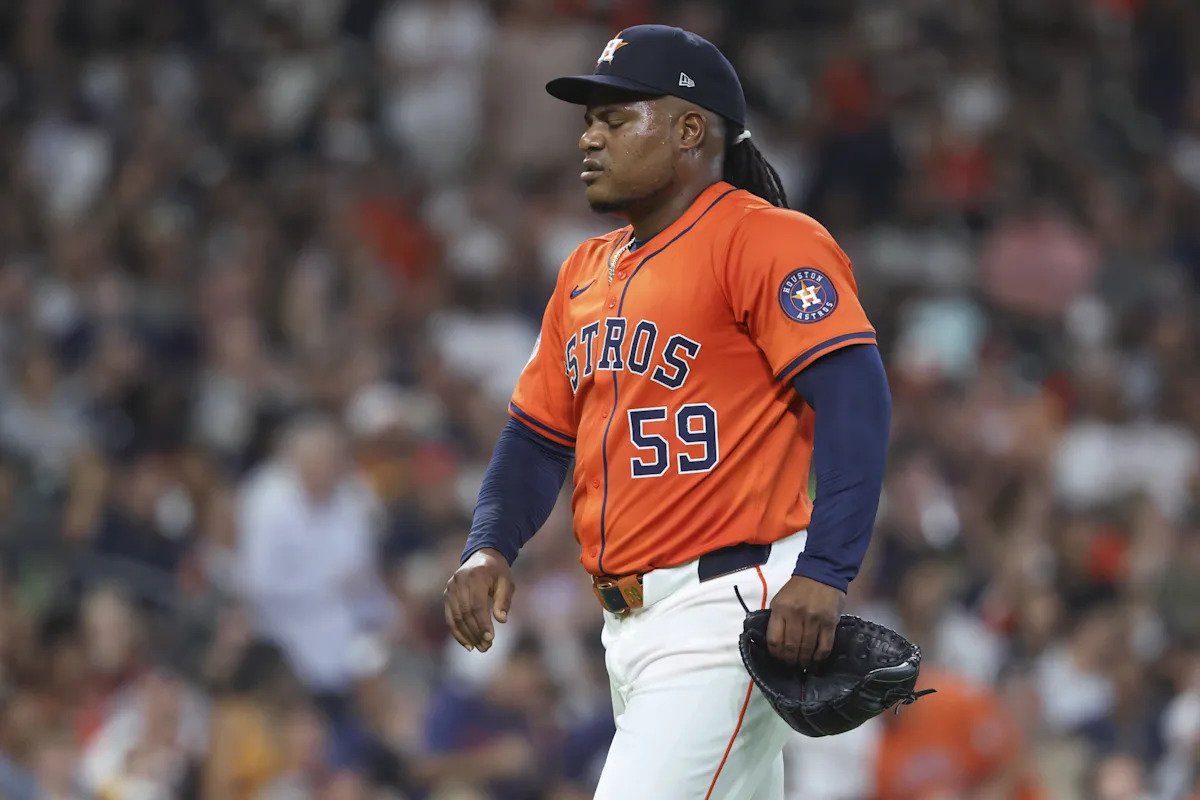
On Wednesday, the Detroit Tigers made the biggest addition of the Scott Harris era. After a pretty quiet offseason that drew a ton of frustration from the fanbase, they made one of the biggest moves of the offseason by signing left-handed free agent starter to a three year deal worth $115 million. Valdez will have the ability to opt out after the second year, giving him some freedom to pursue his next deal in the 2027-2028 offseason, after the next CBA is completed.
This is a huge move for the Tigers and it came right out of the blue on Wednesday evening. Valdez elevates the Tigers from a slightly above average team into a good one with a much more durable pitching staff, whose playoff odds will skyrocket after this move. The Tigers are instantly two wins better, and possibly more as the cascading effect of pushing starters into the bullpen adds up over the course of the season. Maybe more to the point, this is a move designed to make the Tigers better in October and beyond as well.
Advertisement
For four years straight, Valdez has ranked as one of the top 15 pitchers in baseball. His durability, command, and high ground ball rates enable him to eat up innings, prevent home runs, and generally make it very difficult for teams to drop a big number on him. Not only is he rocking a clean 3.21 ERA and 3.29 FIP combination in that timespan, he’s also averaging over six innings per start, which isn’t so easy to find these days. Valdez is going to be a godsend to A.J. Hinch as he can deploy his bullpen aggressively knowing he’s got Skubal and Valdez to keep them more rested on their start days.
|
Season |
IP |
ERA |
FIP |
K% |
BB% |
HR/9 |
fWAR |
|---|---|---|---|---|---|---|---|
|
2022 |
201.1 |
2.82 |
3.06 |
23.5 |
8.1 |
0.49 |
4.4 |
|
2023 |
198.0 |
3.45 |
3.5 |
24.8 |
7.1 |
0.86 |
4.4 |
|
2024 |
176.1 |
2.91 |
3.25 |
24.0 |
7.8 |
0.66 |
3.7 |
|
2025 |
192.0 |
3.66 |
3.37 |
23.3 |
8.5 |
0.70 |
4.0 |
Valdez has averaged roughly 60 percent ground balls over that four year span. Typically he keeps opponents’ line drive rates low as well, making it very tough for them to do any major damage. Beyond the batted ball table, his walk rates are average, so even when he does give up homers or extra base hits, he isn’t hurting himself much by putting people on base to be driven in either.
Valdez hasn’t been too victimized by the Crawford Boxes in Houston. It’s possible Comerica Park would have held a couple of home runs in 2025, but the difference isn’t that significant. Below is a chart of all Valdez’s fly balls allowed, with Comerica Park’s dimensions overlaid. One or two balls may heve left Comerica that Minute Maid Park held in play. So it probably balances out. Valdez only allowed 15 home runs across 31 starts in 2025 anyway.

Valdez’s strikeout rates need to hold up
If there’s a question mark with Valdez, it’s whether he can continue to strike out an above average amount of hitters. His strikeout rates have dipped a little bit each year since his peak in 2023. His command and the consistency of his sinker say that walks and homers aren’t going to be an issue and he should be able to sustain his performance into his mid-30’s in both respects. The question is whether the whiffs will hold up or whether hitters will start putting the ball in play a little more in the years ahead. He doesn’t feature the nasty slider or splitter, nor the high 90’s gas that typically leads to huge whiff rates.
Advertisement
Bolstering the strikeout argument is the steadiness of his whiff rates over the past four years. He’s posted whiff rates of 11.3, 11.6, 11.4, and 11.5 percent over those seasons. So there’s no sign of a falloff. More importantly, his whiffs come from the curveball and the changeup. So the moderate decline in fastball velocity since his peak isn’t really involved there too much. The curveball drew a whopping 43.7 percent whiff rate in 2025, while the changeup was at 28.7 percent, which is solid. He will mix in the odd slider as well, but while that pitch has at times been effective, he’s really relegated it to a rarely thrown fourth pitch over the last two seasons.
Valdez leads with his sinker, which he typically used 45 percent of the time. He averaged 93.7 mph with it in 2025, which is still pretty good gas for a lefty starter, but pedestrian compared to the league’s starters overall. His second most used offering is his curveball, which he threw 33 percent of the time in 2025. The 79-80 mph breaker has good depth and can add tilt to it and vary the break against hitters of either hand, but it’s his main secondary weapon against lefties. He’ll mix in the more average changeup against right-handed hitters.
His peak sinker velocity was 95.7 mph in 2023. The past two seasons that’s dipped to 94.5 mph in 2024 and 93.7 mph in 2025. That’s not an ideal trend, but again, it hasn’t impacted his underlying performance. He gives up plenty of hard contact against it, but hardly any of it is in the air and it’s not the pitch he racks up his whiffs against in the first place. The sinker only accounts for 12-14 percent of his whiffs in recent years, so as long as he’s keeping the ball on the ground with it and surpressing home runs, the whole package looks very sustainable.
The movement profiles on the sinker, curveball, and changeup have all remained steady over the past few years as well. So short of an injury or some real disaster in terms of his stuff, the results should continue to be very good.
Advertisement
Advantages and disadvantages in moving to Detroit
While I don’t think the change in ballparks is going to have much of an effect based on the spray charts up above, pitching in a little cold weather in the spring is probably to his advantage. Hitters hate a nasty sinkerballer in cold weather and Valdez is outstanding in terms of setting hitters up and jamming them with sinkers that numb hands and get beaten into the ground. The rare one that gets lifted may be smothered a bit by the cold weather early in the year. So, I wouldn’t expect Valdez to be better in Comerica Park, but it is a factor that could help him early on as long as he’s as comfortable throwing in colder weather as hitters are uncomfortable hitting in it.
While we’re big fans of the Tigers’ coaching staff, Houston is typically well coached on the pitching side. It’s doubtful that Chris Fetter and Robin Lund are going to squeeze much extra out of Valdez that the Astros didn’t get to. However, he will get a major upgrade in catchers going from Victor Caratini and a cast of depth catchers to Dillon Dingler and Jake Rogers. Valdez thrives by pounding the bottom edges of the zone for strikes and weak contact, and Dingler in particular got a lot better at getting low strikes over the past two years. The catching upgrade in Detroit is going to be good for Framber Valdez.
The big fly in the ointment is that the Tigers infield isn’t as good as defensively. DRS says the difference isn’t that great, but per Outs Above Average via Statcast, the Astros infield collected 38 more OAA than the Tigers did last year. There really are no signs of a defensive upgrade coming for the Tigers either. Gleyber Torres played through a hernia for two months, so perhaps his defensive numbers will rebound somewhat, but they also played Zach McKinstry a lot at third base. If Colt Keith plays a lot more third base and McKinstry is at shortstop, things could look worse rather than better. The imminent arrival of Kevin McGonigle isn’t going to change that equation unless he’s playing second base. Either way, Valdez is probably going to give up a few more hits over the course of the season than he did with the Astros infield behind him.
Advertisement
All around, there are advantages in pitching for the Tigers for Valdez, but most of them may be negated by worse infield play. The Tigers are really just looking for the same results for two or three years, however, and on that front things look pretty positive. He should have no trouble giving the Tigers 3.0-4.0 fWAR seasons unless a real physical breakdown occurs. Valdez keeps himself in shape and is pretty ferociously competitive and hard-working by reputation, with some chip on his shoulder, but it’s all the luck of the draw where pitcher injuries are concerned.
Putting Valdez into the Tigers rotation alongside Tarik Skubal gives them a case to have the best 1-2 punch and perhaps the best starting rotation in all of baseball. It improves their bullpen and their pitching depth for 2025 by pushing guys like Troy Melton, Drew Anderson, and Keider Montero to the pen until they’re needed to fill in a rotation spot. Valdez also offers the Tigers a good starting pitcher to keep leading the way beyond 2026 once Tarik Skubal presumably departs in free agency.
The 2026 Detroit Tigers now look like more of a force to be reckoned with in the American League and hopefully deep into October. They aren’t a powerhouse yet but they project like a good team and perhaps the class of the AL If they get some help from their top prospects by season’s end, and have a successful trade deadline, they may even be a problem for the mighty Los Angeles Dodgers. For now, it’s just great to see more serious commitment from ownership and the front office to try to win right now, while developing post-Skubal contingencies at the same time.

