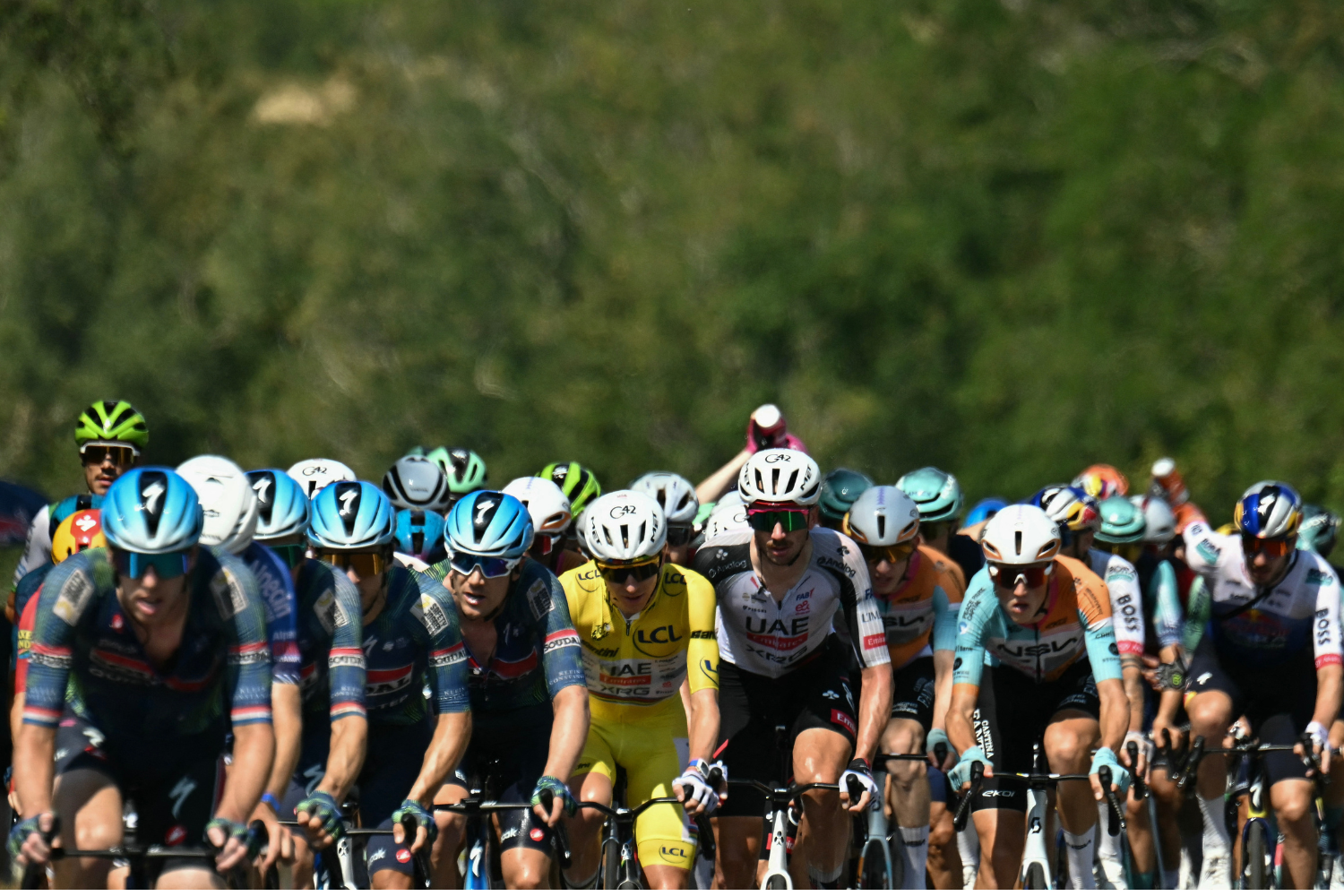
“The reason the Tour de France is one of the hardest sporting events in the world is that we race in the peak of summer and it’s all about attrition,” Luke Durbridge of Jayco-AlUla, veteran of 12 Tours, says.
Three weeks of intense racing, often under the baking hot sun, provides a thrilling spectacle, but it also poses dangers for the 184 riders: injuries, illnesses, burnout and more severe issues such as cardiovascular problems can afflict them.
In the past decade, WorldTour riders Nathan Hooydonck (Jumbo-Visma, 2023), Wesley Kreder (Cofidis, 2023) and Sonny Colbrelli (Bahrain-Victorious, 2022) have all suffered cardiac arrests and been forced to retire prematurely from cycling. Others, including Elia Viviani (Cofidis, 2021), Zdeněk Štybar (Deceuninck Quick-Step, 2021) and Peter Sagan (Pierre Baguette, 2024), have detected problems and had minor heart surgery. Sam Bennett, the Tour’s 2020 green jersey winner, also had a heart scare recently.

Tour de France cyclists are some of the fittest athletes on the planet – but what they do is not normal. They require close medical attention to ensure that they’re not pushing beyond their limits. At the start of every season, riders undergo a mandatory heart examination, while additional check-ups take place periodically. Just like the general population at large, cyclists cannot take any chances with their heart.
“I’d say that only checking your heart once a year is not enough,” explains Netcompany-Ineos’s former world champion Michał Kwiatkowski. “That’s what happened in the past but with all the daily checking now I feel much safer. The last thing we want is to not wake up in the morning after not being diagnosed with something.”

Sonny Colbrelli was forced to retire from cycling just six months after winning Paris-Roubaix
(Image credit: Getty Images)
A reasonably fit amateur male athlete has, according to the fitness tracker platform Whoop, an average resting heart rate (RHR) of 57 beats per minute (bpm); the average for women, who typically have a slightly higher heart rate than men, is 61.
A Tour de France cyclist’s RHR is even lower.
Cycling Weekly spoke with around a dozen riders at the 2026 race, and the common consensus was that the average RHR of a professional cyclist is between 33 and 37bpm. Some are closer to 50, but others are much, much lower.
“I’ve heard rumours of one rider having a resting heart rate of 27,” says Pinarello Q36.5’s Damien Howson. Jan-Niklas Drost, director of health and performance at Red Bull-Bora-hansgrohe, corroborates those figures. “I’ve seen below 30,” he says. “For the normal population that would be too low, but these athletes are used to it and it’s something we do see.”
It does not always correlate, however, that lower is better. “I can get as low as 36 on days I’m really rested, but that doesn’t mean I’ll perform well the next day,” Bahrain-Victorious’s Matej Mohorič tells Cycling Weekly. “All of my best performances have been in the last week of a Grand Tour when my body is significantly fatigued but it leads to great endurance performance. Last night [stage five of the Tour] my heart rate was 44, but I’m pretty sure in the last week it won’t go below 50.”
Just as a rider’s physical and mental state evolves during a three-week race, so too does the functioning of their heart. Durbridge explains: “My maximum heart rate is 185bpm, but already in the leadout [on stage five] my maximum peak was 164bpm. I’ve done final day time trials in the Tour and gone full gas, aiming for a top-10, and averaged 145bpm at threshold. It’s just the way the engine goes – you get more efficient.”
Howson reports the same trend. “As the race goes on, fatigue creeps into the body and the biggest difference I notice is how my maximum heart rate drops by around 20bpm between stages one and 21,” he says. “I’m pretty confident that by stage 19 or 20 I won’t get over 170bpm anymore.”

A time trial effort sees a rider approach their maximum heart rate
(Image credit: Getty Images)
As has been well documented, the first week of the 2026 Tour has been blighted by record high temperatures, conditions that affect a rider’s heart rate. As an imperfect rule of thumb, for every degree the body’s core temperature increases, the heart rate rises by 10bpm. In a sport where significant demand is already placed on the heart through intense exercise, the additional heat is another stress.
Riders wear heart rate straps during a race, while various wearables measure a rider’s pulse 24 hours a day. Another measurement that has become increasingly popular in recent years is heart rate variability (HRV) which tracks beat-to-beat changes in one-thousandths of a second.
A higher HRV is typically associated with better health and fitness, while a lower HRV can be expected when the body is more physically or mentally stressed – often as a consequence of illness, day–to-day life or exercise.
Kwiatkowski notes that “on hot days most of the guys in the bunch have lower HRVs.” But the riders CW canvassed at the Tour all reported that, except for small differences registered on the more fatiguing days, HRV stays relatively stable during a Grand Tour.
Not everyone is as fixated on their cardiac function, though. Both Marco Haller of Tudor Pro Cycling and Cees Bol of Decathlon CMA CGM say that they don’t monitor their heart rate as it’s just one extra data point among many that risks overwhelming them.
“I don’t even wear a heart rate belt when I’m racing,” Haller says. “I know that in the heat it’s a big stress for the heart and the overall system, but if I tell Pogi to slow down because my heart rate is too high, he won’t listen anyway so what’s the point!”
Bol voices a similar, if less frivolous point. “Often it’s quite obvious: if you’re sick, you know you’re sick; and if you’re feeling good, you can feel it. I don’t think they [heart rate monitors] are accurate enough for anything else in the middle.”

The UCI mandates every professional bike rider to sit annual cardiac screening
(Image credit: Getty Images)
The aforementioned cardiac cases can make it seem like there’s a trend of more and more top-level cyclists having heart complications. But Red Bull-Bora-hansgrohe’s Drost warns against reading too much into such incidents: “The ratio is still quite low compared to the amount of athletes and I think everybody has a good awareness of it in this sport.”
Drost explains that the main cause of heart conditions are due to genetics and illnesses, which then get exposed during sport: “The reason why something happens can vary, but it’s often related to genetics and events, such as infections.
“We also know there are certain types of stresses that can lead to problems so it’s super important to educate everyone. If someone is having palpitations or whatever, there would be a fast follow-up with a cardiologist to see if there’s something we need to react to and monitor.”
Cycling’s governing body, the UCI, mandates all professional riders to sit an annual cardiac test which consists of an ECG and a cardiovascular risk questionnaire.
Teams, including Drost’s Red Bull-Bora-hansgrohe, take additional measures, including putting all riders and staff through CPR training in the off-season. “It makes them not feel helpless in what would be a stressful situation as they practice at least once a year,” Drost says.
“When a rider first enters the team, they have a full cardiac assessment – we don’t only do what the UCI recommends,” Drost adds. “If there’s an indication that there’s an issue, we do a long-term ECG, of seven days or more, to get a better understanding. There are also mobile devices that can track the heart for three months.
“Every heart is different, so we have individualised follow-ups. That’s once a year for every athlete, but for some it’s every six or three months.”
Drost clarifies why taking such precautions is necessary. “We know that, in general, endurance sport is beneficial for the cardiovascular system, but this is not normal endurance sport, and there are extreme conditions like the heat we have at the Tour de France and extreme load.
“The cardiac system adapts to that: the heart gets bigger and there are minor changes in how it acts and how blood is pushed out. And that’s why we need a good, consistent monitoring system.”
Kwiatkowski for one is grateful to the level of support and care: ”You probably hear more about heart problems but that comes from the fact that we’re checking our heart more often, with wearables and sleep trackers. I’m just glad that we’re doing sport and getting these checks.”
It’s a particularly pertinent topic for Mohorič who was a teammate of Colbrelli who retired after collapsing at the 2022 Volta a Catalunya. “We’re really mindful of it in our team because of the experience with Sonny,” the Slovenian says.
“I’m still not sure if what we do is more or less healthy than the alternatives but personally I put a lot of emphasis on it. I don’t just do the UCI mandatory checks – every year I do a cardiac MRI with contrast so I can be really sure that my heart is in good health. It costs a bit of extra money but it’s important to invest in yourself and not be surprised by anything as you never know.”

