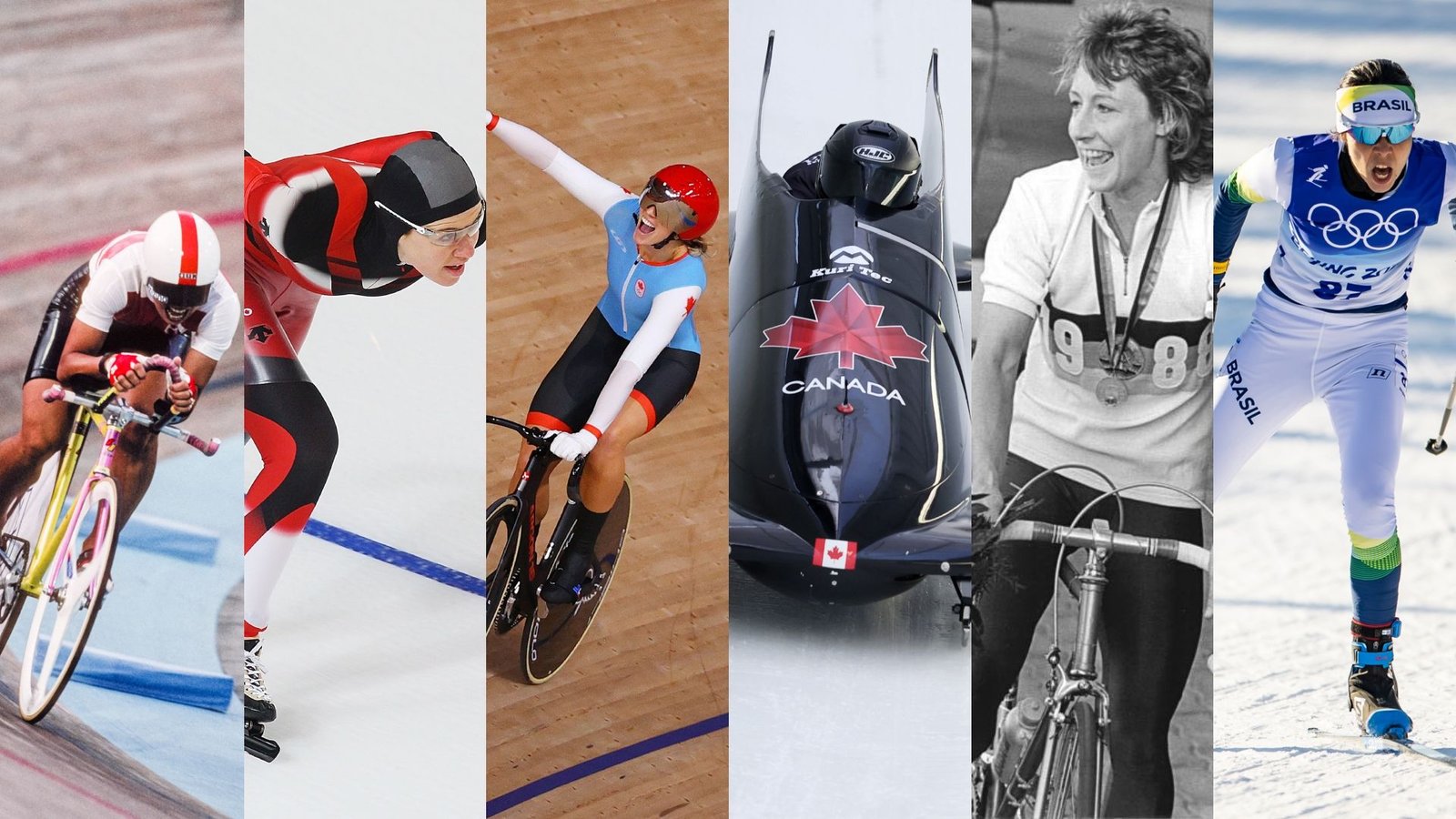
With the 2026 Winter Olympics kicking off in Italy this week, the sporting world turns its attention to frozen ovals, icy tracks and snow-covered descents. For cycling fans, much of what’s unfolding on the ice feels strikingly familiar. Beneath the blades and sleds lies the same explosive power, anaerobic capacity and finely tuned efficiency that define elite performance on two wheels.
And for decades, high-level cycling has quietly served as both a training tool and launchpad for winter-sport success. The demands overlap closely: explosive start efforts, aerodynamic precision, tolerance for sustained discomfort and an obsessive focus on marginal gains. From track riders swapping velodromes for ice ovals to road racers carrying their diesel engines into winter disciplines, the pathway from bike to ice is well established.
As the Games get underway across northern Italy, we scoured the Olympic archives to spotlight the athletes who’ve made that transition, many of whom have reached the very top level in both sports and represented their countries at the Summer and Winter Olympic Games alike.*
Cyclists at Milano Cortina 2026
Kelsey Mitchell: Track Cycling → Bobsleigh
Olympic track cycling champion Kelsey Mitchell headlines the cycling crossover story at Milano Cortina 2026. The Canadian sprint powerhouse won gold in the women’s keirin at Tokyo 2020. Now, at 31, she’s bringing her ferocious peak power and velodrome explosiveness to a bobsledding. Mitchell will represent Canada in bobsleigh as a brakewoman, a role defined by explosive push power.
In this role, she’ll be responsible for maximising the initial speed of the sled by pushing it at the start before loading into the back behind the pilot. During the descent, they stay tucked for aerodynamics and, after crossing the finish line, pull the brakes to stop the sled.
Milano Cortina will mark her Olympic debut in this discipline and her third Games overall, following her track cycling appearances at Tokyo 2020 and Paris 2024.
Mia Manganello Kilburg: Road → Speed skating

American Mia Manganello arrives at Milano Cortina 2026 for what she has confirmed will be her third, and final, Olympic Winter Games. The 36-year-old enters her swansong season in career-best form. A late-career surge that shows both her longevity and her engine, the latter built as much on two wheels as it was on ice.
While Manganello started speed skating at an early age, she took a brief break from speed skating to pursue professional cycling, racing for DNA Pro Cycling on the U.S. domestic circuit.
The endurance base and pacing discipline she honed in the peloton translated seamlessly back to long-track speed skating, helping power her return to the Olympic stage at PyeongChang 2018. There, she was part of the U.S. women’s team pursuit squad that captured bronze. After briefly retiring from skating following Beijing 2022, she reversed course for one last campaign on the ice in Italy.
Past Winter Olympians Who Were Also Professional Cyclists
Clara Hughes: Road Cycling ↔ Speed Skating

Few athletes have embodied the cycling–to-speedskating crossover better than Clara Hughes. The Canadian remains one of the rare Olympians to have won multiple medals in both Summer and Winter Games.
Her tremendous endurance first helped her reach the Olympic podium on the bike, winning two bronze medals in road cycling and the time trial at the 1996 Atlanta Games. She later reinvented herself on the ice, claiming four Olympic medals in long-track speed skating between 2002 and 2010, including gold in Turin.
Connie Carpenter-Phinney: Speed Skating → Road Cycling

A true pioneer of women’s cycling, Connie Carpenter-Phinney’s Olympic journey began not on the bike, but on the ice. She competed in speed skating at the 1972 Winter Olympics in Sapporo at just 14 years old, one of the youngest Winter Olympians in U.S. history.
Twelve years later, she made history again by winning gold in the inaugural women’s Olympic road race at Los Angeles 1984. That victory didn’t just make her a dual-season Olympian; it crowned her the first-ever women’s Olympic road cycling champion, giving her a foundational place in the sport’s history.
Christa Luding-Rothenburger: Track Cycling ↔ Speed Skating

East Germany’s Christa Luding-Rothenburger accomplished one of the most extraordinary dual-sport feats in Olympic history when she won medals at both the Winter and Summer Olympics in the same year.
A dominant force in long-track speed skating throughout the 1980s, Luding-Rothenburger built her reputation on explosive power and technical precision, collecting multiple Olympic medals across successive Winter Games.
Her crossover reached its historic peak in 1988. Just months after winning gold and silver on the ice at the Calgary Winter Olympics, she lined up on the velodrome at the Seoul Summer Games and won silver in the sprint.
With the Winter and Summer Olympics still staged in the same calendar year at the time, her dual medal haul became a once-in-history achievement, unlikely ever to be repeated in the modern Olympic schedule.
Seiko Hashimoto: Track Cycling ↔ Speed Skating

Japan’s Seiko Hashimoto has built one of the longest Olympic careers of any crossover athlete. Competing in four Winter Games as a speed skater and three Summer Games as a track cyclist, she amassed seven Olympic appearances between 1984 and 1996.
While Hashimoto never reached the Olympic podium, her dual-discipline endurance and national prominence made her one of Japan’s most recognisable Olympic athletes of the era. And her influence only grew after retirement. She went on to serve as president of the Tokyo 2020 Organising Committee, guiding the pandemic-delayed Games to delivery. She has since entered Japanese politics as a member of the House of Councillors, and still serves there today.
Christine “Chris” Witty: Speed Skating → Track Cycling

American Chris Witty carved out one of the most decorated dual-discipline careers of her era, competing across five Olympic Games in long-track speed skating and track cycling.
Her primary success came on the ice. At the 2002 Winter Olympics in Salt Lake City, Witty delivered a career-defining performance, winning gold in the 1000m and bronze in the 500m. Her 1000m time of 1:13.83 set a new Olympic record, which still stands today.
Between her Winter campaigns, Witty also pursued Olympic ambitions on the bike. She competed in track cycling at the Sydney 2000 Summer Olympics, lining up in the women’s 500-meter time trial.
At her final Games in 2006, she was elected by her fellow athletes to carry the United States flag at the Opening Ceremony of the Turin Winter Olympics.
Jaqueline Mourão: Mountain Biking ↔ Cross-Country Skiing ↔ Biathlon

Brazil’s Jaqueline Mourão belongs in a category of her own: an eight-time Olympian who has competed across three disciplines spanning both Summer and Winter Games.
She made her Olympic debut at age 28 in mountain biking at Athens 2004, then returned to the MTB start line at Beijing 2008 and again at Tokyo 2020, keeping her biking career alive across a 16-year Olympic window.
In winter, Mourão built an even more remarkable run, representing Brazil in cross-country skiing at five consecutive Winter Olympics from 2006 through 2022.
And as though two sports weren’t enough, she expanded her repertoire again by adding biathlon for Sochi 2014, combining endurance skiing with rifle marksmanship. In Sochi, she was recognised by her peers for her remarkable Olympic career by serving as her country’s flag bearer during the opening ceremony.
Laurine van Riessen: Speed Skating → Track Cycling

Dutch athlete Laurine van Riessen began her four-Olympics career on the ice, competing in long-track speed skating at the Vancouver 2010 and Sochi 2014 Winter Games, where she captured bronze as part of the Netherlands’ dominant sprint program. Like many athletes in the Dutch speed-skating system, much of her off-ice conditioning was spent on the bike, which suited her well.
Following Sochi, van Riessen committed fully to track cycling and quickly emerged as one of the Netherlands’ leading keirin talents. She went on to represent her country in this discipline at the Rio 2016 and Tokyo 2020 Summer Olympics, but came away empty-handed.
Other crossover athletes who competed at both Summer and Winter Games
- Robert “Bob” Boucher (Canada)
- Speed skating — 1968 Winter Games in Grenoble
- Track cycling — 1968 Summer Games in Mexico City
- Harry Haraldsen (Norway)
- Winter: Speed skating — 1936 Garmisch-Partenkirchen
- Summer: Track cycling — 1936 Berlin
- Anton Collin (Finland)
- Winter: Cross-country skiing — 1924 Chamonix
- Summer: Road cycling — 1924 Paris
- Arnold Uhrlass (USA)
- Winter: Speed skating — 1960 Squaw Valley
- Summer: Track cycling — 1964 Tokyo
- Alain Masson (Canada)
- Winter: Cross-country skiing — 1972 Sapporo
- Summer: Road cycling — 1976 Montreal
- Pierre Harvey (Canada)
- Winter: Cross-country skiing — 1976, 1980, 1984, 1988
- Summer: Road cycling — 1976 Montreal
- Connie Paraskevin-Young (USA)
- Winter: Speed skating — 1980 Lake Placid
- Summer: Track cycling — 1984 Los Angeles (bronze)
- Ingrid Haringa (Netherlands)
- Winter: Speed skating — 1988 Calgary
- Summer: Track & road cycling — 1992 Barcelona, 1996 Atlanta
- Aleksandar Milenković (Independent Olympic Participant)
- Winter: Cross-country skiing — 1992 Albertville
- Summer: Road cycling — 1992 Barcelona
- Evgeniya Radanova (Bulgaria)
- Winter: Short track — 1994, 1998, 2002, 2006 (multiple medals)
- Summer: Track cycling — 2004 Athens
- Sophie Villeneuve (France)
- Winter: Cross-country skiing — 1998 Nagano
- Summer: Mountain biking — 2000 Sydney
*This is not an exhaustive list. Archive source: www.Olympics.com

