
Long overshadowed by Southern California in youth water polo, a Northern California group built around trust, role clarity, and unselfish play turned an underdog run into a breakthrough championship.
Editor’s Note: The USA Water Polo Olympic Development Program National Championship gathers top regional athletes from across the country in one of the sport’s most competitive development environments. The 2026 boys championship took place March 6–8 in Chula Vista, California.
Northern California wasn’t supposed to win this tournament.
For years, the power center in American youth water polo has lived in Southern California. The depth, the reputation, the pipeline — it all points south. Northern California has produced strong teams and elite athletes, but the broader script has rarely changed.
Not this time.
In Chula Vista, a Northern California group flipped that script, turning a team-first philosophy into a championship and delivering one of the clearest statements yet that the gap is narrower than many think.
Representing the Pacific zone as PAC Red at the USA Water Polo Olympic Development Program National Championship, the team didn’t just win the Boys Youth division. It changed the conversation.
Different Programs, One Identity
ODP teams are built fast.Players arrive from different clubs, systems, and coaching styles. They have limited time to train, limited time to connect, and then are thrown into one of the most competitive environments in youth water polo. Chemistry is not guaranteed. PAC Red made it their priority. Head coach Marcus Longton worked alongside Giorgio Alessandria, St. Ignatius head coach John Roberts, and Scott Andron — coaches from across Northern California. Each brought a different approach. None tried to override the others. Instead, they aligned.
“We all have different strengths,” Longton said. “Some guys are stronger tactically, some are better one-on-one with players, some bring energy. But we trusted each other and let those styles work together.” That trust showed up immediately. “There was no feeling of stepping on toes,” Longton said. “We just worked really well together.” Before the players bought in, the coaches did.
The message to the team was simple. Play for each other. Not in theory. In execution. “We really tried to get the guys to buy into the idea of playing for each other,” Longton said. “Taking pride in setting up your teammate more than yourself.”
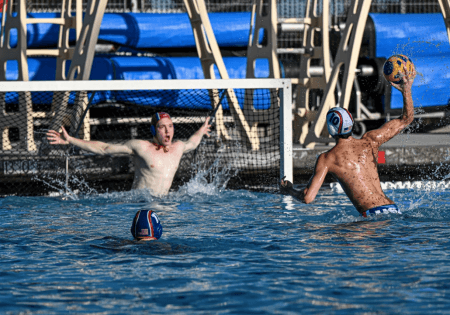
That mindset shaped everything.
Sometimes the most important play isn’t the shot. It’s the pass that sets it up.
If one player had the better look, the ball moved. If a defender created pressure, someone else found space. If a role needed to change, players adapted.
“I told the guys they had to be comfortable getting uncomfortable,” Longton said.
They were.
“Everybody played a critical role,” he said. “And everyone understood their role really clearly.” That clarity became an advantage.
The Edge
Northern California teams have lived with the same narrative for years.
Southern California dominates. Southern California develops the most talent. Southern California sets the standard.
PAC Red didn’t ignore that.
They used it.
“There’s always kind of been this stereotype that Southern California water polo is superior,” Longton said. “We came down here ready to prove people wrong.”
That edge turned into fuel.
Before the championship game, PAC Red players heard that a coach from the other side of the bracket told his team that whoever won their semifinal would likely win the tournament.
The message made its way across the deck.
“I told the guys, ‘Just so you know, they think they’re going to come over here and spank our asses,’” Longton said.
That was enough.
PAC Red responded with one of its most complete performances of the weekend, tightening defensively and pulling away in the second half.
“They were playing for something bigger than themselves that day,” Longton said.
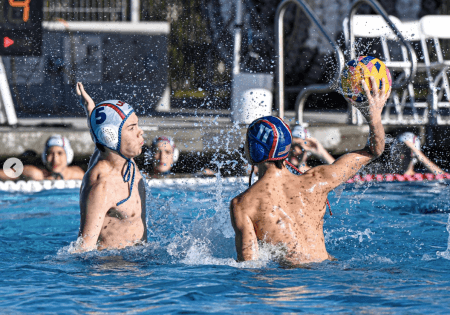
PAC Red in action during the ODP championship run
Calm in the Chaos
Water polo doesn’t stay steady.
Games swing. Momentum shifts. Emotions spike.
Longton believed the coaching staff’s role was to counter that.
“Younger athletes need a source of stability,” he said. “The coach needs to be the one to anchor that — to show through body language that everything is going to be fine.”
That philosophy became part of the team’s identity.
“What we focus on is what we can control,” Longton said. “The way we play offense, the way we play defense, and how we react.”
The score didn’t change the approach.
“If we’re up three, down three, or tied, we stay the same,” he said. “We just keep chipping away.”
And they did.
Rising Contributors, Shared Purpose
The championship wasn’t built around one player.
It was built around a group.
Still, several athletes stood out within that framework.
Hunter Coleman, a cadet-aged player from Stanford Water Polo Club, showed rare versatility.
“He’s about 6-6 and only 15 years old,” Longton said. “But what stood out was how coachable he was.”
Lamorinda’s Trent Smith made an equally important impact after being elevated from the Pacific Blue roster.
“He completely rose to the occasion,” Longton said. “Played phenomenal defense, moved the ball well, and scored some big goals.”
Their performances mattered.
But they weren’t the story.
The story was how the group functioned.
More Than a Title
For the first time in recent memory, Northern California’s PAC Red finished first.
That matters.
But what mattered more was how it happened.
A group of coaches from different programs aligned around a shared message. A roster of players from different clubs bought into roles. A team-first approach replaced individual agendas.
In a sport where pedigree often sets expectations before the first whistle, Northern California showed something else:
You can build something quickly.
You can trust it.
And if everyone commits to it—
You can win with it.
“We came down here ready to prove people wrong,” Longton said.

3 Months Free! Get ahead of Summer with SW!

