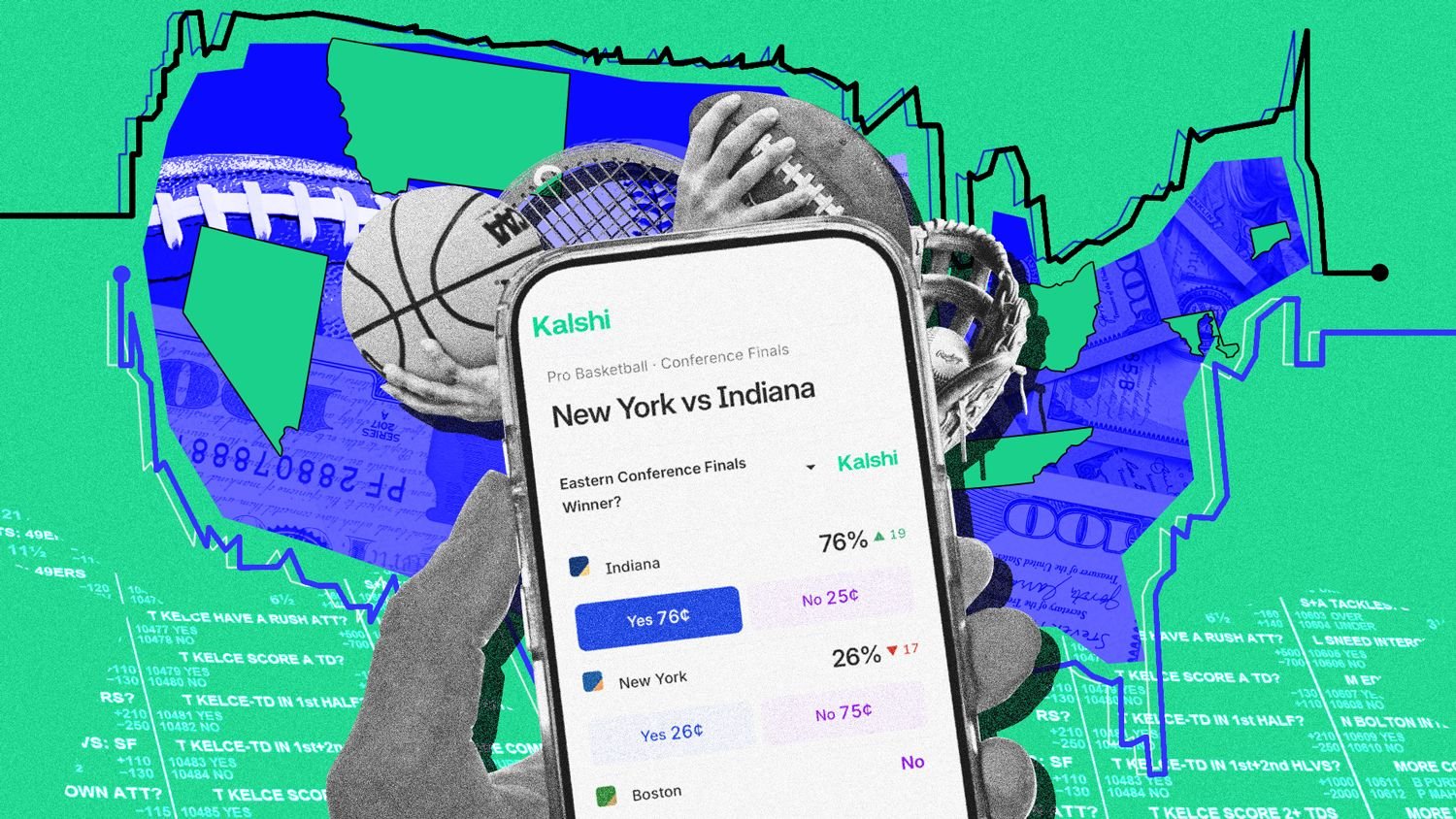
The sense of legal confusion surrounding prediction markets appeared to deepen this week as a federal court ruling directly contradicted another court regarding state regulatory powers. Democrats in Congress weighed in with legislation to support the states, while the Trump administration reiterated its defense of the prediction markets Thursday.
The week’s events offer a glimpse into the battle for jurisdiction over prediction markets between state gaming regulators, industry participants and federal lawmakers — a battle that legal analysts say will likely end up in the Supreme Court.
At issue in the courts is whether sports event contracts offered by prediction markets qualify as commodity market swaps, which only the federal government may regulate, or fall under state jurisdiction.
Critics argue that prediction markets are simply gambling operations by another name and that existing law allows states to impose regulations on them, such as requiring taxes, setting age limits and punishing insider trading. Sports wagers constitute an estimated 90% of trading volume at Kalshi, an industry leader that is the target of recent litigation.
Prediction markets say their service is similar to trading stock shares or commodities, which is limited to federal regulation. The Commodity Futures Trading Commission, which regulates such trading, opposes attempts by states and Congress to set regulations, arguing that prediction markets are already empowered to police themselves.
Democratic Sens. Richard Blumenthal of Connecticut and Andy Kim of New Jersey introduced legislation Wednesday that would ban insider trading, restrict users under the age of 21 and make clear that prediction markets are not exempt from state oversight.
The CFTC countered with an advisory Thursday emphasizing “the federal oversight framework” and prediction markets’ “self-regulatory obligations.”
The agency wrote that prediction markets are “rapidly increasing in popularity with the American public both as a financial asset class and as a proven source of reliable information for news media, sports leagues, financial institutions, and everyday Americans.”
More than 20 federal lawsuits have been filed against prediction markets in a growing legal battle over regulatory powers. Tennessee and Ohio are the latest states to issue contradictory rulings, with an Ohio judge favoring state regulatory rights and a Tennessee federal judge telling his state to stand down.
The Tennessee judge sided with Kalshi in late February, agreeing that its sports event contracts are federally regulated. The judge issued a temporary stay that allowed the company to continue operating while the lawsuit proceeded.
But on Monday, Chief Judge Sarah D. Morrison of the U.S. Southern District Court in Ohio questioned the “absurdity” of sports event contracts being considered swaps and ruled that Kalshi must follow state gaming regulation.
Morrison ruled that swaps are financial instruments that directly affect commodity prices. “Currency exchange rates, the weather, and energy costs all do that; the number of points scored in the Huskies-Bobcats game does not” affect commodity prices, her ruling stated.
Courts tend to disagree with each other when laws are written too vaguely. “Open-ended questions” left by such laws require “the judiciary to give the meaning and apply the spirit of the law. And that’s why we see different rulings,” Johnny P. ElHachem, an attorney specializing in gaming law, told ESPN.
Kalshi appealed the Ohio ruling Wednesday.
Three other federal appeals courts already are weighing the question of federal versus state regulation of prediction markets. Supreme Court involvement would become clearer once the appeals courts issue their decisions, ElHachem said.
Andrew Kim, an appellate lawyer specializing in gaming law, told ESPN that the process could take until 2027 or 2028, unless a request for an emergency ruling prompts quicker Supreme Court action.
The Trump administration, whose arguments in favor of federal regulation have mirrored those of prediction market executives, has repeatedly requested emergency rulings — known as the “shadow docket” — in other cases, with an 80% favorable record, the Brennan Center for Justice reported this month.
CFTC Chairman Mike Selig has backed the stance of prediction market companies in online posts and in an amicus brief supporting a federal court lawsuit in Nevada targeting a prediction market company.
The CFTC has, however, raised the specter of regulation to prevent insider trading. In the advisory released Thursday, the agency “encouraged” prediction market exchanges to consider whether certain event contracts create “heightened potential for manipulation” like those involving an individual athlete. The advisory listed contracts on physical altercations between athletes and officiating actions as examples.
According to the six-page note, the commission is “actively discussing” integrity issues with sports leagues, which it said could lead to enhanced oversight.
The agency on Thursday also requested public comment for rulemaking regarding event contracts offered by prediction markets. The document included questions on contracts that involve “gaming,” which the agency’s regulations currently prohibit.
“For example, should a sports competition be treated differently than an award competition, and if so, what factors support this distinction? What other types of contests should or should not be considered to be gaming?” the document asked.
Jake Preiserowicz, a former CFTC special counsel, told ESPN that the questions asked by the agency provide insight into the direction it might be heading.
In response to the CFTC’s advisory, the NFL released a statement that “sports prediction markets need a robust regulatory framework, with the same high standards for integrity and consumer protection that apply to legal sports betting. Today’s guidance and notice of rulemaking begins a process that we hope eventually leads to the CFTC setting the necessary guardrails to protect both the integrity of the game and consumers participating in these rapidly evolving markets.”
Congress and various states have introduced bills to regulate and restrict prediction markets, the latest example being the legislation from Sens. Blumenthal and Kim.
In Hawaii, lawmakers have introduced a bill to redefine gambling to include “the purchase, sale, or financial speculation of securities, commodities, or other similar financial products where the outcome or future contingent event” relates to sports or other topics such as politics and death.
Illinois and Connecticut are weighing bills to set age limits. Currently, only people 18 or over may trade on prediction markets, the same as investing in stock markets.

