You wake up groggy after a late night, pick up your phone and check the day’s training. Instead of hard threshold efforts, your app reveals the plan has changed to an easy spin. It knows your sleep was poor, your stress levels are high, and your recovery suboptimal. The decision seems logical but it wasn’t made by a human being – it was made by Hugo, HumanGo’s digital coach, powered by artificial intelligence.
AI is already big business in sport and is projected to be worth £27bn by 2030. At the elite level, it’s fully embraced, used by WorldTour teams such as UAE Team Emirates-XRG and Visma-Lease a Bike to ride faster, recover better, and win the biggest races. But what about the everyday cyclist, the keen amateur juggling a busy schedule, family life and training – can AI help us all train better without the need for a costly coach? Or is it prone to giving misleading advice that could do more harm than good?
What is AI?
Put simply, AI refers to technology that can learn from data, spot patterns and make decisions – skills we usually associate with human intelligence. It’s already in your everyday life, from Google Maps rerouting your commute to Spotify suggesting the next song on your playlist.
In cycling, AI has the ability – ostensibly, at least – to analyse your training data, spot weaknesses, adjust plans and even suggest recovery, all in real time, without a human coach.
AI training apps, powered by large language models (LLMs) or machine learning algorithms, process data from your wearable devices – heart rate, sleep, power output, HRV – to generate personalised training plans. The theory is that these models, trained on vast datasets, can spot patterns and adjust your workouts accordingly. So, if your sleep is poor and your heart rate variability drops, the AI might downgrade your session to something easier.
It’s this hyper-responsiveness that’s part of the appeal of AI. Now, with some apps starting from as little as £3.99 a month, this coaching approach no longer seems like a luxury reserved for those with big budgets.
Digital Assistant
AI-powered tools are already built into dedicated apps, wearables like Garmin and Suunto, and indoor training platforms like Zwift, which use the technology to personalise workouts and simulate real riding conditions.
One of the latest AI platforms to enter the market is Vekta, which has partnered with World Tour teams Jayco-Alula, Arkéa-B&B Hotels, and FDJ-Suez. Founded by Paul-Antoine Girard, Vekta takes a different approach from fully automated coaching tools: rather than replacing a human coach, it positions itself as an AI-powered assistant with a “human-first” approach.
“Our goal is to help coaches and athletes save time and get more insights, rather than just build training plans,” Girard says.
“When you have a coach, you think it’s just a training plan and you have to do the sessions. But having a coach is also having support, motivation, or the push you need when you don’t want to train. That’s always going to be hard to replace with AI.”
Instead, Vekta takes on the role of providing immediate feedback to athletes and their coaches. After each workout, the app tells the user whether they have improved and if they’re progressing towards their goal. It also combines data from wearables – such as Garmin watches, Oura rings, or Whoop bands – to deliver real-time analysis and performance insights.
(Image credit: Shutterstock)
Apps like Vekta hope to offer something coaches can’t: 24/7 availability. The platform will soon go a step further, introducing ‘Vekta Agent’ – an AI assistant to whom athletes can ask questions about their own data, such as those surrounding sleep quality or carbohydrate intake. The vision is a round-the-clock partnership, the human coach and the AI assistant working in tandem.
Bernd Eichinger, an amateur cyclist who has a coach, has been using Vekta to add a new dimension to his training. After 12 years using TrainingPeaks, he says the platform’s “AI possibilities” have brought clear, practical benefits for him and his coach. That said, his initial reaction was caution. “I was concerned that the [power] zones would not be accurate,” he admits. “I thought it might be a ‘best guess’ and that [manual] testing would be better. But I was surprised how accurate it was.”
Five AI Training Myths Busted
Myth: AI will replace human coaches. AI might be able to provide the training plan, but it won’t be able to provide the emotional support of a human coach.
Myth: AI knows everything. AI only knows the data it’s given. If that data is incomplete or inaccurate, then so is the plan.
Myth: AI creates perfect plans. The training plans are only as good as the tech behind them.
Myth: AI can predict and prevent injuries. AI cannot replace professional medical advice or the basics of self-care.
Myth: AI training is only for the pros. Many platforms are designed with all cyclists in mind, with lower price points and no need for high-tech set-ups.
Unlike standard coaching, Vekta doesn’t ask users to perform regular functional threshold power (FTP) tests to calculate heart rate or power zones. Its AI software analyses each workout, estimates the rider’s critical power, and adjusts training zones automatically. Training platforms like Zwift work in a similar way. This automation, Eichinger says, is a big advantage, effectively testing and adjusting continually: “It prevents you from spending months in the wrong zone and then regretting not having re-tested earlier.”
Alongside real-time zone adaptations, Eichinger has made use of other AI features such as side-by-side comparisons of similar sessions and data integration from other devices. He believes it’s helped him, a competitive rider, to train more intelligently.
“I’m the kind of guy who has a very strong head, so when I have a session and I feel tired, I will push through it, which is not good every day. There are days when I’d be better off stopping,” he says.
Now, if his Whoop recovery score is red or his plan suggests a lighter session, he’s more likely to listen. Thanks to AI, decisions once guided by instinct and occasional testing can be backed by continuous, data-driven insight, offering a new kind of intelligence that’s changing how athletes at every level understand performance.
Beware of over-reliance
David Bailey, head of sport science at NSN Cycling Team (previously Israel Premier Tech), believes AI is opening doors for amateur riders like Eichinger. For Bailey, the data-driven tools make training more personalised and effective, able to create quick, tailored plans for each individual. A key shift, he notes, is accessibility. “Ultimately, AI democratises sophisticated training insights, helping recreational cyclists achieve their goals more effectively and enjoyably.”
Though the technology is “still in its infancy”, Bailey sees huge potential in the years to come – from ultra-personalised training and enhanced biomechanical analysis to predictive injury prevention and even talent identification. That said, he is clear that individuals should use the technology “thoughtfully”.

(Image credit: Vetko)
“Recreational cyclists risk becoming too reliant on AI, potentially ignoring their body’s feelings,” he says. “Over-dependence on tech can overshadow internal cues, intuitive training, and body awareness. While AI offers valuable guidance, a balance is crucial.”
This caution is echoed by Sam Lloyd, a PhD researcher at the University of Strathclyde, whose work explores the use of AI in track cycling. Lloyd’s concern lies more with generative platforms like ChatGPT, an online chatbot, being used to create training plans.
“A bit of common sense should always be applied,” he says. “There’s been some evidence in the literature to say that there have been some almost impossibly hard sessions recommended by ChatGPT – so be aware of that. But the evidence isn’t there yet on how effective the training [it generates] really is.”
In contrast to his scepticism around ChatGPT written training plans, Lloyd has confidence in AI-powered platforms such as HumanGO, Garmin Coach, Whoop and Vekta. They give a clearer picture of health, he believes, and also improve how effective and confident people feel in their training.
“I recommend platforms that are based on a lot more qualitative data, rather than ChatGPT generalising from what’s found on the internet,” he says.

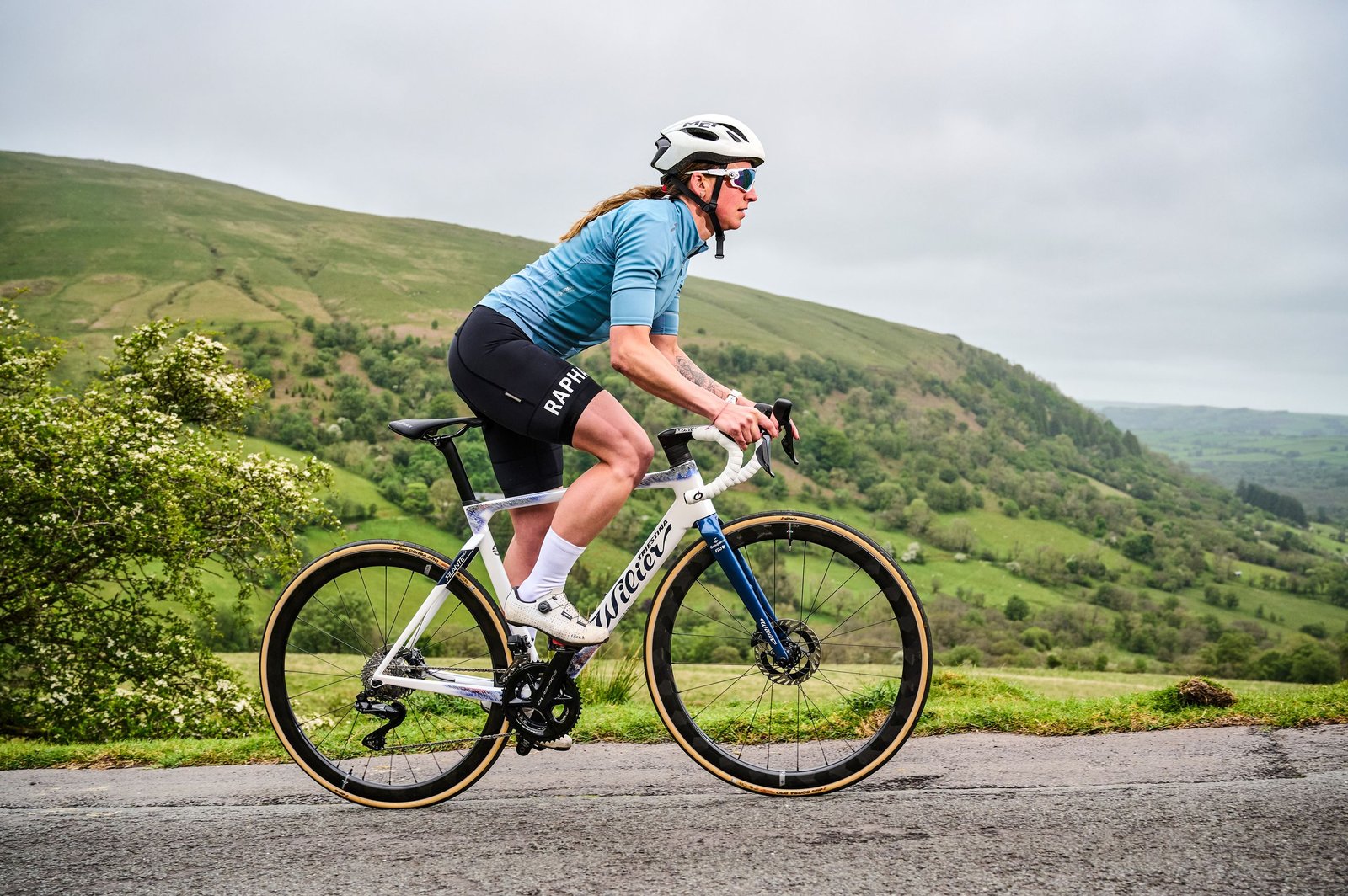
India Paine is seeking an AI that knows how to climb like Demi Vollering.
Coaches add value
For those new to cycling or structured training, it can be hard to know whether an AI-generated plan is too tough or too easy. Jake Hales, head coach at RideRevolution, has evaluated a range of AI tools and apps over the years, noting varying degrees of quality and accuracy.
“It could be hard for a rider to discern whether what they’re following is correct or suitable,” he says. “As the saying goes, you don’t know until you know, and a good coach can add a lot of value as a mentor and educator. It’s fair to say your average coach is more expensive than AI coaching apps, but what you’re paying for is someone’s time and years of experience.”
Hales is less concerned about the presence of AI in training and more about how it’s used – or misused.
“There’s a skill and knowledge required from the user to truly get the most out of an AI programme, and I’d fear it could be quite easy to end up in a rabbit hole if the user starts steering things wrongly,” he says.
“There’s a certain level of assumption on the rider’s part that everything is always ‘correct’. A good coach is using the data but taking a much more holistic approach to things – looking at data, listening to the rider, and factoring everything else in. In theory, an AI app can also do this, but it relies on the quality of the feedback given by the rider.”

(Image credit: Future)
That’s where a human coach still has the upper hand. “One of the main reasons to get a coach is to take the thinking out of the rider’s hands and remove any emotional bias in decision-making,” Hales says.
“An athlete coaching themselves may think they are being objective about their performance, but are they really? It’s much easier for a coach to be truly objective.”
But it’s not just about objectivity – it’s about emotional intelligence. A good coach doesn’t just read your data; they read you. They’ll notice when you’re feeling flat, ask the right questions, and adjust your training not just based on numbers, but on how you’re coping mentally and emotionally.
AI can track trends in your metrics, but it can’t recognise when life stress is affecting your motivation, or when you simply need a confidence boost. That human nuance still matters – and right now, no algorithm can fully replicate it.
The Verdict
Can AI help you train better? In short: yes. Thanks to fast feedback on physical performance data, AI can make you less likely to overtrain or get injured. Still, the human side of training remains essential. Platforms that blend AI and human coaching deliver the best of both worlds.
|
App |
Description |
Price |
|
HumanGO |
Hugo is a virtual coach able to revise plans in real-time. |
From £14 a month |
|
Spoked |
Builds dynamic plans using ride data and subjective feedback; no power meter required |
From £3.99 a month |
|
Vekta |
Offers automatic threshold analysis and dynamic training zones. |
From £12 a month |
|
Garmin Coach |
Builds adaptive training plans for compatible smartwatches. |
Free with smartwatch |
|
Join |
Analyses effort rating, workout data, and readiness to automatically adjust plans. |
From £8.33 a month |
|
Whoop |
Whoop Coach lets users ask questions about recovery, sleep, and strain. |
From £15 a month |

