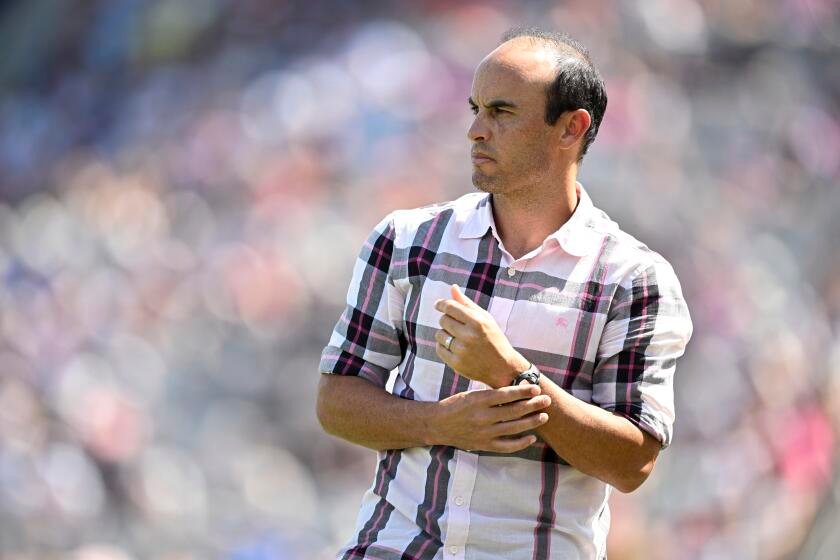
You know Landon Donovan, right?
Six-time MLS champion who retired as the league’s all-time top scorer and as U.S. Soccer’s all-time leader in goals and assists? Played the most World Cup games and scored the most World Cup goals of any American?
Advertisement
Well, you may know those numbers. But that doesn’t mean you know the man.
I thought I did. I covered Donovan for a decade and a half. I shared airplanes and locker rooms with him, following him to South Africa and Mexico and nearly a dozen states to watch him play before sharing countless press boxes with him when he became a broadcaster.
Read more: Galaxy can’t capitalize on early Portland red card in draw with Timbers
Then I read his memoir, “Landon,” which was released on Tuesday. Turns out I didn’t know him at all.
It’s not that Donovan necessarily kept things hidden. It’s that no one thought to ask the right questions. We were all interested in the goals, the wins and the trophies and not the extraordinary price he had to pay to win those things.
Advertisement
In the memoir, masterfully told by Southern California-based writer and podcaster Ryan Berman, Donovan pulls no punches. He not only reveals the cost of his fame and fortune, but he brings the receipts as well.
“Otherwise, why do it?” Donovan said in a phone interview. “I don’t need anything from it. I don’t need money. I don’t need attention. You want to share your story and you think it’s going to help people, do it.”
Read more: American-owned Inter Milan aiming for global recognition on and off the pitch
And Donovan has a lot to share. So while soccer is part of the book’s narrative, the memoir is as much about the sport as “To Kill a Mockingbird” is about avian homicide.
Advertisement
Instead, Donovan goes deep into his battles with depression and his embrace of therapy to manage his mental health, issues that were already well-known and predate the stories of Simone Biles, Naomi Osaka, Noah Lyles and Kevin Love. In fact, Donovan’s courage in confronting the stigma of mental health in professional sports likely made the journey easier for those who followed.
It certainly educated Bruce Arena, the Hall of Fame manager who gave Donovan his first cap with the national team (Donovan scored the opening goal in a 2-0 win over Mexico) and coached him through two World Cups and to three MLS titles with the Galaxy.
“Professional athletes are like anybody else,” he said. “Sometimes we think professional athletes are just very tough people and have no weaknesses. But they’re sensitive and deal with issues that everybody deals with.”
Landon Donovan reacts as he walks off the field after a game with the Galaxy in September 2016. (Jae C. Hong / Associated Press)
There were three major bouts with depression in Donovan’s career, the most infamous being the five-month sabbatical from soccer in the winter of 2013, a much-needed mind-clearing that cost him the captain’s armband with the Galaxy and a spot on the 2014 U.S. World Cup team. (He still hasn’t forgiven Jurgen Klinsmann, the coach who cut him.)
Advertisement
That hiatus ended with a frightening hallucinogenic nightmare that you’ll have to read the book to learn about.
An equally frightening story that’s not in the book involves a two-week stretch in his MLS career during which Donovan was so wracked by depression he couldn’t get off the couch.
“My mom came, my sister came and my brother flew in from DC and they just sat with me,” Donovan said. “I didn’t eat. I would sleep maybe an hour a day. And I had to get up and go train.”
There was no way he could play a game but he got little sympathy from Arena or the Galaxy coaching staff so Donovan’s therapist told him to pick out a child in the crowd during warmups and play for that child as if he were a young Landon Donovan.
Advertisement
“And that’s exactly what I did. The whole game is a fog. I can’t remember it at all but I just got through it,” he said.
Read more: Angel City embarks on a ‘new beginning’ in dominant, season-opening victory
In the memoir, Donovan confronts the origins of his mental health issues, talks about growing up poor in a 900-square-foot home managed heroically by his single mother, Donna, and how even his greatest successes on the field left him unfulfilled. But mainly his writes about his father, Tim, a one-time semi-pro hockey player from Canada who largely abandoned Landon and his twin sister, Tristan, as they were growing up.
What the book is not is a recitation of big games and important goals.
Advertisement
“I get bored reading sports memoirs and biographies. It’s a timeline of events and it’s kind of like ‘OK, I watched that. I know that happened,’” Donovan said. “I didn’t want it to be like that.
“Being a single mom, growing up really poor is a common story in this country. Having a father who’s not around is a very common story. Dealing with depression is really common. So there’s lot of things in the book that people can take away.”
Donovan, 44, played 15 seasons with the Galaxy and San José Earthquakes, arguably saving MLS by returning from an unsuccessful stint in Germany at a time when the league was in danger of going bankrupt. He retired and un-retired multiple times, playing his final outdoor game with Leon of Mexico’s Liga MX in 2018 before making 10 appearances with the San Diego Sockers of the Major Arena Soccer League in 2019. He then went into coaching with the San Diego Loyal of the second-tier USL Championship and the San Diego Wave of the NWSL and into broadcasting with Fox.
Since his first retirement, he’s also gotten married and had three children.

Landon Donovan celebrates after the Galaxy defeat the New England Revolution to win the 2014 MLS Cup title. (Rick Loomis / Los Angeles Times)
“I’m not bored,” he said. “I’m looking for my next passion. And what I’ve done over the last few years is make peace with not having to find that next passion. My wife has helped me a lot with that.”
Advertisement
But it’s the troubled relationship with his father that has fueled most everything in Donovan’s life, including both his depression and his success. It also inspires the rawest and most emotional passages in the book.
“The part with my dad that was hard was sending him the book in August and saying ‘Dad, this is going to be really painful. I need you to read it’,” Donovan said.
He did and barely changed a word. Then four months later Tim Donovan died, his relationship with his son finally at peace.
“If one — literally one — person reads this book and picks up the phone and calls their dad and wants to reconcile, then the whole thing was worth it,” Landon Donovan said.
Advertisement
Consider that the most important goal in his career.
⚽ You have read the latest installment of On Soccer with Kevin Baxter. The weekly column takes you behind the scenes and shines a spotlight on unique stories. Listen to Baxter on this week’s episode of the “Corner of the Galaxy” podcast.
This story originally appeared in Los Angeles Times.

