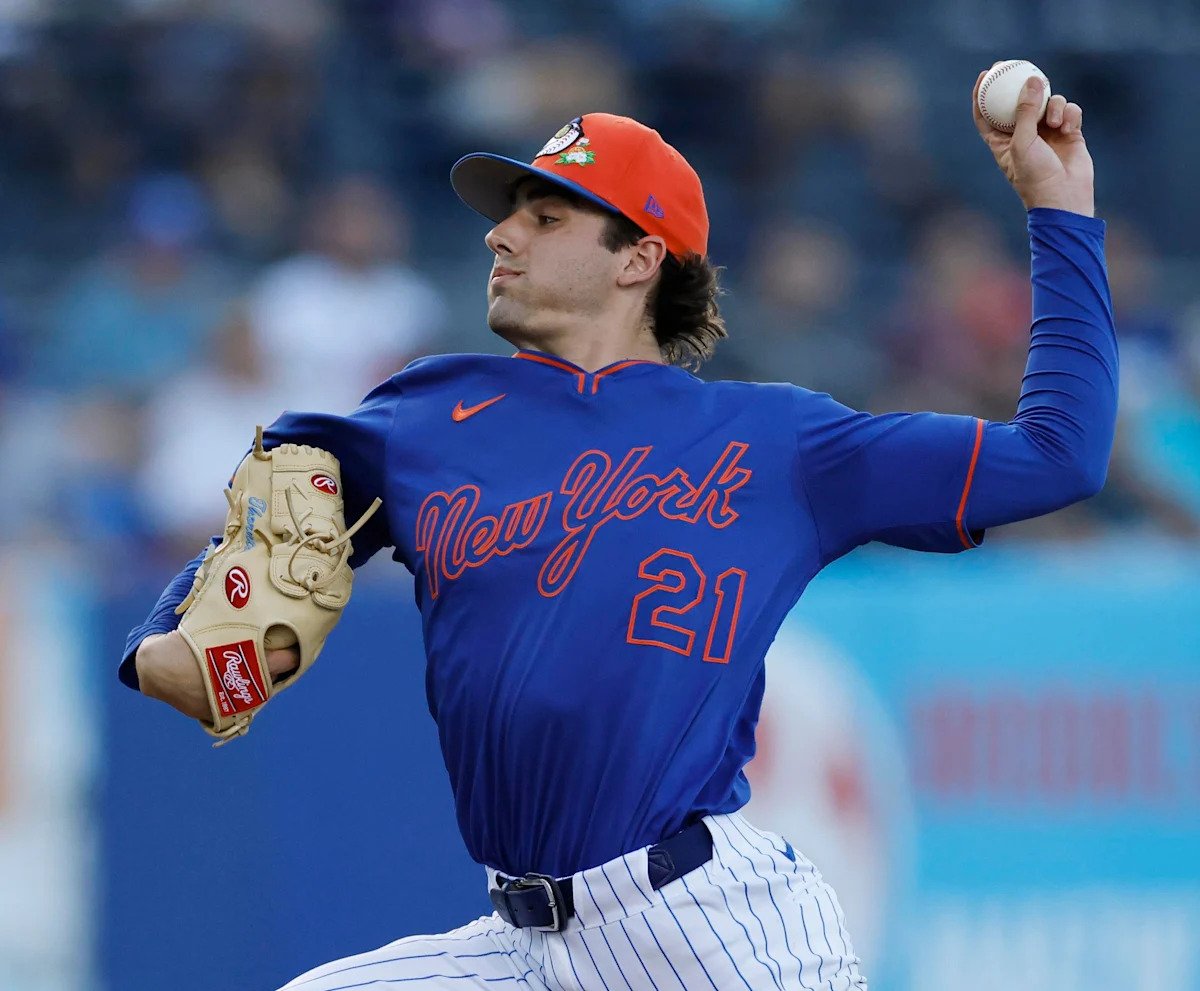
Zach Thornton is the son of a pair of collegiate track athletes, but his athletic career went in a different direction. Excelling on the baseball diamond, he attended Lawrence Free State High School in Lawrence, Kansas. Despite the modicum of success he had as a high school pitcher, he was far from a must-follow prospect. Combined with the fact that he lost his junior season due to the COVID-19 pandemic and then was draft eligible in the player-rich 2021 MLB Draft, the left-hander went undrafted after graduating. Along with three teammates, Thornton attended Barton Community College, a junior college in Great Bend, Kansas, a few hours away from Lawrence.
Thornton made the Barton baseball team and appeared in 14 games for the Cougars, starting 13 of them. In 60.2 innings, he posted a 4.01 ERA, allowing 58 hits, walking 21, and striking out 79. Following the conclusion of the season, he pitched for the Great Bend Bat Cats of the Sunflower Collegiate League, where he posted a 4.18 ERA in 32.1 innings, allowing 33 hits, walking 18, and striking out 41.
Advertisement
He returned to Barton for his sophomore season and appeared in 15 games, starting all 15, posting a 2.63 ERA in 78.2 innings, with 60 hits allowed, 26 walks, and 91 strikeouts. That summer, he returned to Great Bend and played with the Elizabethton River Riders of the Appalachian League and the Mahoning Valley Scrappers of the MLB Draft League as well. While he was not drafted in the 2022 MLB Draft, the supplemental pitching work, combined with his performance at Barton Community College, put him on the radar of bigger schools, and Thornton was offered a spot at Grand Canyon University for his junior year.
A mainstay in their weekend rotation, Thornton posted a 3.87 ERA in 88.1 innings with the Antelopes, allowing 99 hits, walking 18, and striking out 91 in his first taste of NCAA Division I baseball. After the season ended, the 21-year-old once again pitched some supplementary innings, this time with the West Virginia Black Bears of the MLB Draft League. The Mets selected the southpaw with their 5th round pick in the 2023 MLB Draft, signing him for $350,000, $28,000 below the MLB-assigned slot value for the 159th overall selection, $378,000. The team elected to not have Thornton play for the rest of the season, and his professional career began instead in 2024.
Assigned to Single-A St. Lucie to begin the year, the left-hander appeared in 13 games, making 6 starts and posting a 4.39 ERA in 41.0 innings, allowing 47 hits, walking 16, and striking out 32. He was promoted to the High-A Brooklyn Cyclones in August and finished out his season in Coney Island, posting a 3.67 ERA in 27.0 innings, allowing 30 hits, walking 2, and striking out 22. All in all, Thornton posted a combined 4.10 ERA in 68.0 innings in his first professional season, allowing 77 hits, walking 18, and striking out 54.
Zach Thornton’s performance in 2025 put him on the map as a prospect. Making 14 starts for the High-A Brooklyn Cyclones and the Double-A Binghamton Rumble Ponies, the southpaw posted a combined 1.98 ERA in 72.2 innings, allowing 48 hits, walking 11, and striking out 78. Along with Jonah Tong and Jack Wenninger, the trio formed a fearsome buzz saw that batters needed to navigate past. Unfortunately for Thornton, an oblique injury in early July ended his season prematurely and suddenly. When all was said and done, we ranked the left-hander the Mets’ 14 prospect coming into the 2026 season.
Advertisement
Thornton returned to the mound with Binghamton in early April, and while he did not pitch poorly at any point, he looked less crisp and more hittable as compared to 2025. In 25.0 innings over 5 starts, the southpaw posted a 3.60 ERA, allowing 10 earned runs, with 24 hits, 9 walks, and 27 strikeouts. Promoted to Triple-A Syracuse after almost exactly a month, Thornton began looking a bit better. Through a pair of starts prior to his promotion, the left-hander had allowed three runs over 12.0 innings, scattering 8 hits, walking 3, and striking out 13.
The 6’3”, 170-pound left-hander throws from a three-quarter arm slot, having lowered it a bit this season as compared to 2025. He also does not drop and drive off the mound as much as he did in prior seasons, keeping his planting leg stiffer and more erect as he lands, thus keeping his upper body and release point higher. His pitching motion has some up-tempo funk to it, and he slings the ball with an extremely long arm action through the back and a crossfire release. Despite the jerky movement in his delivery, Thornton possesses above-average command and control of all of his pitches, attacking batters and putting them in pitcher’s counts earlier.
Thornton relies on a five-pitch mix, working with a four-seam fastball, two-seam fastball, changeup, slider, and curveball. During his time in Triple-A, where his pitch usage was tracked by statcast, he utilized his four-seam fastball 14% of the time, his two-seam fastball 25% of the time, his slider 37% of the time, his curveball 19% of the time, and his changeup 5% of the time. This tracks with past data from past seasons, with perhaps more fastballs over the course of a longer sample size.
His fastball has roughly fringe-average velocity for a left-hander, sitting in the low-90s, averaging 91 MPH. The pitch does not average a particularly high velocity or spin rates, but Thornton has maintained a 44% CStr+Whiff% in limited usage with the pitch in Triple-A thanks to elite induced vertical break. In the past, the highest IVB that the left-hander had ever publicly recorded was 16 inches, an above-average number to be sure but not elite per se. In his two Syracuse starts this season, Thornton’s four-seamer averaged 19 inches of IVB. His sinker has also been extremely effective, maintaining a 42% CStr+Whiff%. The pitch, which sits in the same velocity band and also has averaged 91 MPH, has a higher spin rate than the average sinker. With a higher spin rate, Thornton’s fastball is able to resist the force of gravity longer, giving it later sink. Because of the lack of premium velocity, batters have been able to barrel both pitches and do damage when they make contact, but Thornton has been able to keep his hit hard rates a minimum thanks to both pitches’ natural movements and his ability to command both.
Advertisement
Thornton’s slider has always been his bread-and-butter pitch. The mid-80s offering has averaged 35 inches of vertical drop and 5 inches of horizontal movement by statcast measurements. His curveball is similar, sitting in the high-70s and featuring 44 inches of vertical movement and 14 inches of horizontal break. Thornton can command both, throwing strikes in the zone or spotting either outside the zone to tempt batters to swing.
Rounding out his arsenal is his changeup, but the pitch is little more than a change of pace offering at present. Its low spin rate gives the pitch a lot of downward drop, but most of its effectiveness comes from the randomness in terms of when it is thrown, not its nastiness.
There is risk in Thornton’s profile because, as mentioned, his fastball does not have premium velocity. He can mask the weakness with atypical pitch usage, optimized sequencing and finesse, but that still leaves him with a very thin margin of error. Keeping the ball out of the air—which Thornton generally has had success with, with ground ball rate hovering between 45-50% over the course of his career—and damage to a minimum is the key for any pitcher to be successful, but Thornton especially.

