Super Bowl LX will be the first time Seattle Seahawks quarterback Sam Darnold and New England Patriots QB Drake Maye face each other as competitors, but Darnold’s familiarity with Maye dates back eight years.
Maye was a sophomore at Myers Park High School in Charlotte, North Carolina, and his coach, Scott Chadwick, ran a football camp with Josh McCown, who was a backup QB with the New York Jets.
“The moment Josh and I saw him working out, we knew there was something different about the kid,” Chadwick said.
“Josh was with the Jets in 2018 and not around [Myers Park] that much during the season. As soon as our game was over, I’d get him on [streaming platform] Hudl. He’d watch late Friday nights. Most of the time he was watching he would be sitting there with … Sam Darnold.”
Darnold will get an up-close look at Maye on Sunday in Levi’s Stadium as the two battle on the biggest stage in sports.
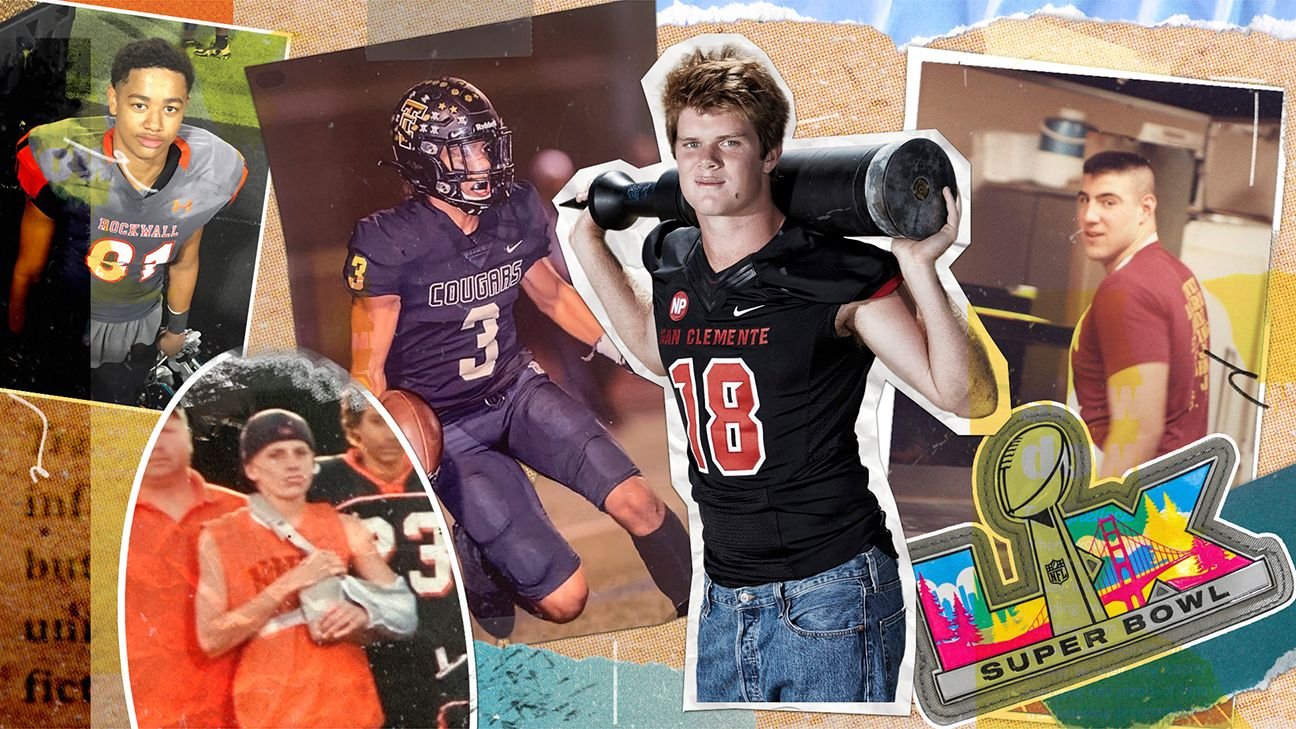
Each player and coach has a story from high school that helps convey who they were off the field. From TreVeyon Henderson giving a prize he won to someone who might have needed it more to Kenneth Walker III overcoming blood clots in his lungs to Mike Vrabel’s silly sense of humor, these are the lasting memories for many of the people who know these Super Bowl-bound stars.
ESPN’s David Newton, Mike DiRocco, John Keim, Marc Raimondi, Kris Rhim, Katherine Terrell, Josh Weinfuss and Eric Woodyard contacted the high school coaches of 11 players and both head coaches to learn more about the personalities who will gather on the biggest stage in sports.
Jump to:
Maye | Walker | Henderson | Vrabel | Williams
Gonzalez | Kupp | Macdonald | Darnold
JSN | Thomas | Jones | Chaisson

Rejecting Mike Macdonald’s lunch request; breaking his coach’s sprinkler
Xarvia Smith, who coached New Centennial High School in Roswell, Georgia, wasn’t sure what to make of the phone call. Rising senior Mike Macdonald phoned him with an unusual request.
“Coach, my name is Mike Macdonald. I’m the team captain, and you and I need to go out to lunch together.”
To which Smith said he replied, “Mike, I will never go out to lunch with you. You are a kid, I am a coach, and don’t ever think about us going out to lunch together.
“Now, once you graduate, we can do all the lunches you want, but I will not do that.”
Macdonald then told him it’s what his former coach used to do. Smith reminded him he’s his new coach and “I won’t be having lunch with you.”
“I was like, ‘Are you crazy?’ I was like, ‘We’re not on that same level,'” Smith said.
Then came Macdonald’s father visiting Smith’s home for the first time.
“His dad was my booster club vice president,” Smith said. “He drives over to my house the first time, runs over my sprinkler system and busts the sprinkler head.
“So my first interaction with Mike is I got to tell him we’re not going out for lunch. His dad busts my sprinkler system. [But] my neighbor fixed it for us, so it was good.”
Macdonald’s senior season was cut short by a neck injury and then a torn ACL, but he stayed in contact with Smith after high school. When Macdonald called Smith, then at Cedar Shoals High School, about a coaching position after he graduated from college, there was no hesitation.
That’s when Smith saw what the NFL eventually did. It’s why Smith told Macdonald at the time that he’d be an NFL head coach by 36. Macdonald became the Seahawks’ head coach in January 2024 at the age of 36.
“He coached our ninth grade and they had six shutouts that year,” Smith said. “On Friday nights, he helped me, and our defense that year gave up 4.2 points a game in the state of Georgia, which is phenomenal.
“I could literally sit on the sideline and Mike could say, ‘They’re doing this. I think we can go ahead and run this now. They can’t pick that up.’ And a majority of the time I just let him, whatever he told me, I just did it because he was already on point, had already figured it out.”
And they eventually made it out to eat. Macdonald took him and others out to eat when Seattle played at Atlanta in December.
“We laugh about going out to eat,” Smith said. “I told him, ‘Don’t worry, I’ll never pay for another meal. … You are paying for every meal.” — John Keim
The inside story of Mike Vrabel and ‘taco days’
More than three decades since Mike Vrabel graduated from Walsh Jesuit High School in Cuyahoga Falls, Ohio, he still greets his former head coach, Gerry Rardin, the same way.
“He asks about taco days,” Rardin said with a laugh. “I say, ‘Goddamn it, Mike!”
Rardin, who retired in 2014 after 35 years at the school, also taught Spanish, and he had Vrabel as a ninth-grader who sat in the front row. A few times, Rardin treated the class to tacos, and now Vrabel doesn’t let him forget it.
“We had two of those, but he talks like we had five a week,” Rardin said. “He always goes, ‘I don’t remember any Spanish, but I remember how to make tacos.'”
Even back then, Rardin said Vrabel was always comfortable being himself — a personality that mixed nonstop humor with an intense work ethic, a combination that Rardin believes propelled Vrabel to the pinnacle of sport as a player and coach.
“Mike was just probably the most fun kid to have in class,” he said. “He’d work at what he was doing, but nothing was real serious for more than 10 minutes. He’s always been that kind of person. He’s been able to, I guess, blend the two just to be a normal person, but he means business.
“I think Mike has never been afraid to be Mike.” — Kris Rhim
How Cooper Kupp was a ‘different deal’
From the time Cooper Kupp entered high school, the NFL was on his radar.
And he was willing to do everything he needed to get there.
It didn’t matter that he was a 125-pound freshman at A.C. Davis High School in Yakima, Washington: Kupp was focused on the future. One day during his freshman year, while Kupp was recovering from a broken collarbone, he was waiting for his coach, Jay Dumas, outside the weight room with a question: What would it take to play wide receiver or running back at the University of Southern California?
“I thought to myself, ‘A lot of Wheaties and steroids,’ at the time,” Dumas said with a laugh. “I just kind of told him about the hard work and the work ethic that it would take to be able to make it.
“And, in the back of my mind, thinking that this little 125-pound kid has a long way to go, but without batting an eye, his next question was: ‘What does it take to get in the NFL?'”
Watching a young teenager have those kinds of goals and that kind of foresight stuck with Dumas.
“Then just along the journey, he keeps setting his goals and he keeps reaching them,” Dumas said.
Kupp’s focus on playing college football and then making it to the NFL was singular and laser-like.
He not only lived in the weight room, Dumas said, but Kupp was beyond his years when it came to his nutrition as a high school student. After every game, regardless of wherever it was, Kupp’s team would have a postgame meal at McDonald’s. During Kupp’s sophomore season, Dumas noticed Kupp wouldn’t eat while his teammates and coaches scarfed down Big Macs and fries.
“We’d be like, ‘Coop, I know you’re starving. You just scored like three, four touchdowns,'” Dumas remembered. “He was like, ‘No, man, that stuff’s not good for you, and I don’t eat it.'”
However, there was one time Dumas remembered Kupp eating an ice cream cone during one of those postgame dinners.
“I just remember it became normal that he wasn’t going to eat,” Dumas said. “By his senior year, we never asked him why he wasn’t eating again. We kind of knew that that kid was on a different deal.” — Josh Weinfuss
The time Drake Maye decided to shed the Mr. Nice Guy role
Maye’s sophomore football season extended five or six games into the basketball season, and Maye’s character was illustrated by how he approached his hoops teammates.
“He was just trying to fit in,” Chadwick said. “He wasn’t trying to take over. He wanted to let the basketball kids know they still have control of the team.
“Well, they were kind of struggling around .500 and weren’t playing to their capabilities. I’ll never forget. It was a Friday night in January and they were playing a conference game against Porter Ridge, a team they should have beaten by double digits. Drake is still in that hands-off kind of mode. They were down by 10 points going into the fourth quarter when they went to the bench. He went out and had like 13 points and nine rebounds and they came back and won the game.
“You could see where he was like, ‘OK, I’ve been the nice guy enough. It’s time for me to take over, for me to become a basketball player.’ They eventually went on to the state quarterfinals where they lost in overtime. He averaged like 25 points and 16 rebounds in the playoffs. That was just a microcosm of what his mentality is.
“People ask me all the time about his ‘aw shucks, yes sir, no sir’ demeanor. They’re like, ‘Is that really who he is?’ So that’s real. But don’t get confused. There is a guy with a deep, deep competitive nature inside who takes a tremendous pride in the product that he puts out there.
“Don’t mistake that ‘aw shucks’ personality for the guy he is underneath that. He reminds me of like a trained assassin, you know, just kind of like you don’t expect it and all of a sudden … bam! He’ll do something and you’re like, ‘Where did that come from?’ That’s how he was in that basketball game. He just kind of played Mr. Nice Guy for three quarters and all of a sudden in the fourth quarter he was like, ‘All right. Enough. I’m done with this nice guy and I’m going to take this whole thing over.” — David Newton
Why Kenneth Walker III didn’t think he could continue playing football
Adam Sykes received a surprise text message from Kenneth Walker III that scared him.
It was well after midnight during the spring of 2018, and the text read: “Coach, I don’t think I can play football anymore.”
Sykes, the varsity football head coach at Arlington (Tennessee) High School, was taken aback. While waking up in a stupor, he responded to Walker with “What are you talking about?”
Leading up to his senior season, blood clots were discovered in Walker’s lungs. One morning he woke up having trouble breathing, so his mother, Shaunteshia Brown, rushed him to the emergency room. An X-ray revealed the issue, and he was immediately shut down from sports.
However, after seeking a second opinion, Walker recovered after being placed on blood thinners and taking a shot twice a day for three months. During that time, he participated in noncontact workouts with his father, Kenneth Walker Jr., to stay fit.
“Long story short, he battled that all spring and going into his senior year, finally got cleared to play, I want to say the week before our first game,” Sykes told ESPN. “He didn’t have any preseason, and he just kind of comes out the first two games of the year and has 10 touchdowns total in the first two games.”
He would end his senior season with 1,403 rushing yards and 27 touchdowns after being named a team captain.
“It was tough to watch him go through it because he couldn’t do things, and not knowing what your future is, and being a really good athlete,” Sykes said. “And then to see him fight through that kind of stuff and come out and explode onto the scene his senior year like he did, it was a great thing and to see where he is now. It’s all kind of come full circle.” — Eric Woodyard
The time TreVeyon Henderson won by losing
TreVeyon Henderson was a junior in 2019 and already a local celebrity in Hopewell, Virginia, on account of his football accomplishments.
Ricky Irby, coach of then-undefeated Hopewell High School, got a call one day from the owner of a local Save A Lot supermarket that would soon be holding its grand opening. The store was going to be doing a shopping dash as a promotion. Two shoppers would go head-to-head attempting to buy as many groceries without going over a specific price in a certain amount of time. Whichever shopper got as close to the amount without going over would get to take the groceries home.
The store specifically asked Irby if Henderson could compete. Irby said there was another Hopewell player who would need the groceries more than Henderson, but he would still bring Henderson to help promote the grand opening.
The Hopewell player competed against an older woman and ended up beating her to win the groceries. The player got to keep the groceries and was also given a $50 gift card for the supermarket. The store gave Henderson one as well.
Minutes later, during the celebration, Irby lost track of Henderson.
“So, we’re kind of up front and they got balloons and everything and it’s a big spectacle,” Irby said. “The CEOs are there.
“Well, I look around and Trey was gone.”
Irby went searching for his star athlete, aisle by aisle. He found him near the back of the store, where the older woman was finishing her shopping. Neither Irby nor Henderson said anything at the time.
“So, we get in the car and I looked at him, I said, ‘You gave her your gift card, didn’t you?'” Irby said. “And he’s like, ‘Yeah, Coach, she needs it more than me.’
“Just the humility of a kid that was 17 years old at the time, and that’s just the kind of kid he was. So, I always tell that story. That’s just one of my favorite stories about Trey as a person, more so than the football player.” — Marc Raimondi
Riding a skateboard isn’t unusual for a teenager. Riding a skateboard at nearly 300 pounds, however, can be tricky.
Seahawks defensive end Leonard Williams and his brothers rode skateboards throughout their childhood in California, Michigan, Arizona and Florida. They tried stunts, too, until Williams started blossoming as a football player in high school. At that point, per a 2015 ESPN predraft story, Williams’ oldest brother Nate forbade Williams from doing any more stunts because of the injury risk.
Williams’ mother, Aviva Russek, also put an end to Williams’ rugby playing, according to the article. “I went off when I saw him out there doing that,” she told ESPN in 2015. “He was a teenager, and he was playing against grown men in their 30s. I told them I didn’t sign any permission slips for him to do that.”
But Williams still rode his skateboard, and that’s how he would sometimes arrive at offseason workouts at Mainland High School in Daytona Beach, Florida. A.J. Mallory, who was the Buccaneers’ receivers coach in Williams’ senior season (2011), said it was an impressive sight to see someone that big being that smooth on the skateboard.
The 6-foot-5 Williams didn’t weigh the 310 pounds he does now, or the 300 pounds he was listed as weighing at USC, but “he was close to it,” Mallory said.
“Early in the morning he’d just roll in [on the skateboard] if he didn’t get a ride from one of his teammates,” said Mallory, who is Mainland’s offensive coordinator and assistant athletic director. “He was pretty good.”
Williams didn’t give up his enjoyment of risky hobbies once he entered the NFL. He posted an Instagram video of himself surfing in 2020. — Mike DiRocco
When Patriots cornerback Christian Gonzalez intercepted Denver Broncos quarterback Jarrett Stidham in the AFC Championship Game, it sealed his team’s ticket to the Super Bowl. But that’s not the first time an interception had changed the course of his career.
The summer before Gonzalez’s junior year of high school, he was a junior varsity player who had played offense all his life. Gonzalez transferred to The Colony [Texas] High School, where he met head coach Rudy Rangel.
Some of the members of the team were in a local 7-on-7 tournament that day, and Rangel urged him to play some cornerback, just to see what he could do.
“I said, ‘You know what, Christian, I don’t know you at all, brother — jump in the truck, go play a little bit. Let’s just find out what’s up,'” Rangel said. “It’s midsummer. We play him at corner for the very first time in his life. … He gets three picks in the very first game he played in.
“It was like a fish to water.”
According to the Patriots’ website, Gonzalez transferred from a struggling school to The Colony, which featured a strong program, to play with his friend, Keith Miller III. Gonzalez credits that move, which Miller persistently encouraged, for the reason he’s a successful NFL player.
Miller died last spring, and Gonzalez honored his friend during the NFL’s My Cause My Cleats program. Gonzalez’s act also was an homage to KyleCares, which promotes mental health awareness.
“[Keith had] a son named Luca,” Rangel said. “[Luca] just had a birthday, and when I tell you that Miles [Battle], and Christian and Marcus [Jones], all that group, they all tag-teamed taking care of that kid. It’s unbelievable what they do for him.” — Katherine Terrell
Why Sam Darnold was in no hurry to play in All-American Bowl
When the prestigious U.S. Army All-American Bowl invited Sam Darnold to play in the 2015 game, his reply should have been an instant “yes.”
It was not.
“We had to convince him to play,” said Jaime Ortiz, his coach at San Clemente [California] High School.
Ortiz said Darnold struggled with the decision for a reason that, he said, highlights his priorities.
“He was concerned about missing part of his basketball season and didn’t want to let his teammates down,” Ortiz said. “A lot of people like the recognition that being an All-American and going to San Antonio brings. But his biggest concern was not being there for practice and games.
“Myself and his basketball coach said, ‘You need to do this.’ We both had to convince him to play in the game. It took about a week. He got the honor and was like, ‘Oh, cool.’ But he said, ‘It’s during the basketball season.’ He missed two games, but that was a good sign of his character and commitment to the team.”
The honor was also the culmination of a quick rise by Darnold. As a sophomore, Ortiz said they knew Darnold would eventually be their quarterback — but he was behind a strong senior starter. So he played receiver and linebacker. In one game he caught a slant pass for a touchdown and then returned an interception for a score on the next series.
As a junior, he broke a bone in a foot in the second game of the season and missed the rest of the season. Earning an invite to this game, and being a four-star recruit, was the result of one season of play.
But it wasn’t the first time he wanted to put off football because of basketball. After Darnold committed to USC, he opted not to enroll for the start of the winter semester. Instead, he waited until after his basketball season ended — he was named the league co-MVP — to go to USC. Basketball mattered to Darnold: He once suffered a small fracture in his right hand punching a locker after a close loss.
“I had to tell him that the locker always wins and that hand is too valuable,” Ortiz said. “But he’s just a humble kid and lets things play out. Sometimes guys get caught up in the flash and attention. Sam downplayed it.” — Keim
When Jaxon Smith-Njigba needed a ride, ‘Pookie’ found a way
Rodney Webb, head coach of the Rockwall [Texas] High School football team, isn’t exactly sure where Jaxon Smith-Njigba’s nickname came from, but it still makes him smile. Webb and those who have known Smith-Njigba since he was an adolescent call him Pookie — a family nickname since his childhood, and one his brother used in a video aired on the night the Seahawks selected him with the 20th pick in the 2023 draft.
It’s also what some fans call Smith-Njigba after big games, though unrelated to his childhood nickname. Among Gen Zers, pookie or pookie bear is a term of endearment reserved for partners or admired athletes. “My glorious pookie bear JSN stunted on alllllllllll those teams he’s really like that,” one user posted to X.
The nickname was fitting for the 14-year-old who had made varsity when he wasn’t old enough to drive. Following practice most days, if his mother was working, Smith-Njigba surveyed his older teammates and coaches for rides. He always found one, and to Webb, it was a reflection of the determination that’s made Njigba one of the league’s best receivers. Even then, Smith-Njigba was going to find a way, whether that was making plays on the field or finding a ride home.
“Pookie never had a ride,” Webb said while laughing. “But I think it’s just woven into the fabric of his character. He’s never been a guy to just dip his toe into something. If he does it, he’s all-in. And I think that just speaks to that mentality all the way back to 2016.” — Rhim
Trust the process — and Drake Thomas
Wallace Clark was an assistant coach at Heritage High School in Wake Forest, North Carolina, when a ball boy caught his eye. That ball boy, Drake Thomas, has emerged as a key player for the Seahawks.
“He was a seventh- or eighth-grader down on the field helping out as a ball boy,” Clark recalled. “Some of them kind of run on, run off the field. But he was pretty in tune with everything, following through with every aspect the referee was asking him to do, running the ball on and off the field, chasing the ball down.
“One day I [jokingly] said, ‘Drake, you don’t know what you’re doing.’ He was like, ‘Coach, when I get here, I want to be the starting linebacker for Heritage High School.’ I said, ‘You don’t know how to play football.’
“Fast forward, when he got there as a freshman, he proved he was that guy. He followed through with everything he promised and he was our starter ever since he was a freshman. He impressed all of us with his skill set and his intellect of the game.”
Thomas also impressed Clark with his poise.
“We always told the kids to trust the process,” Clark said. “There was one moment in a playoff game, and I will say I was in a panic at the time. We were in a situation where it seemed like we were going to go into overtime and lose the game if we didn’t make certain plays.
“He just turned around and pointed a finger at me and said, ‘Coach, just trust the process.’ It kind of made me feel small, but a guy like that, having the confidence in him and knowing what he’s doing, made everything work out well. We advanced to the third round of the playoffs, which was good for us.” — Newton
The Seahawks linebacker formerly known as ‘Coach Jones’
Seahawks linebacker Ernest Jones IV looks every bit the part of his position at 6-foot-2, 230 pounds.
But his high school coach, Franklin Stephens, still sees him as lanky, 175-pound kid who showed up at Ware County High School in Waycross, Georgia, as a freshman.
Stephens had a conversation with Jones’ mother, Porsche Johnson, prior to his junior year. If he was going to be the collegiate linebacker Stephens knew he would be, he needed to gain weight.
“I’ll take care of it,” she said.
Jones grew an inch and gained more than 30 pounds as a junior before signing with South Carolina and graduating midway through his senior year. The transformation was remarkable, according to Stephens.
It took Jones some time to catch up physically, but Stephens knew he was always going to be capable of directing any defense. Jones was so smart that he earned the nickname “Coach Jones” before he was a starter.
“He blossomed between his sophomore year and his junior year with the weight gain,” Stephens said. ” … And the thing about him as a 10th grader, he had some good players in front of him, and I used to call him Coach Jones all the time because he knew everything.
“That’s one thing that I think that’s just kind of evident and I hope that everyone who’s coached him, they would know this, too. He’s like a coach on the field. His instincts and his IQ as a football player is unbelievable.”
Jones always had the answers when the team sat down to study film, and when he’d come back to visit from South Carolina, Stephens would put him to work on the whiteboard with his high school kids.
“He wasn’t ready to be one of the starters in football for Friday night, but from a mental perspective, he was more ready than anybody,” Stephens said. “He was the one individual who knew everything.
“So when you’re asking questions, some of those other guys ain’t answering, then you go, ‘All right, coach Jones, what’s the answer?” — Terrell
K’Lavon Chaisson believed in himself, and it paid off
K’Lavon Chaisson wasn’t sure if he wanted to attend an LSU football camp for high school players in 2015. He was going to be a rising junior at North Shore High School in Houston and hadn’t played varsity football. But he decided to go.
And it was soon evident he made the right move as the defensive end opened the eyes of LSU coach Les Miles.
“He automatically went into the group with all 5-stars, and he was a no-star at this point,” said Shaun Wynn, an assistant coach at North Shore.
“He’s going one-on-one pass rush [against] some of the top recruits on the offensive line, and I mean K’Lavon is doing them up and making them look bad. … To see him doing those kids up like that I was like, ‘Holy s— he’s really good.’ There was one five-star recruit and he was making this kid look stupid. I’m thinking this kid already has the frame, and now you see the movement with it. [I’m thinking], ‘Yeah, he’s going to play on Sundays one day.'”
That’s the same message delivered two years earlier by Willie Gaston, who was Chaisson’s freshman basketball coach and was then a varsity assistant football coach. Gaston, who played four games with the Baltimore Ravens in 2007, told him: “If you play football, you’ll play on Sundays.”
Meanwhile, after the drills ended at the LSU camp, Wynn said then-Tigers defensive coordinator Kevin Steele approached them.
“He said Coach Miles wanted to see him in his office after they were done,” Wynn said. Within 90 minutes after the camp ended, Chaisson — who hadn’t played football as a sophomore — walked away with quite a prize.
“They saw enough and said, ‘You’re the guy we want to go with,'” said Wynn, who was in the room with North Shore head coach Garrett Cross. “They offered him that day.
“Had a talk with Miles, he said, ‘We want you to be an LSU Tiger and we’re offering you a scholarship.'”
Eventually Chaisson committed to the Tigers.
“He made the commitment,” Wynn said, “and it paid off.” — Keim

