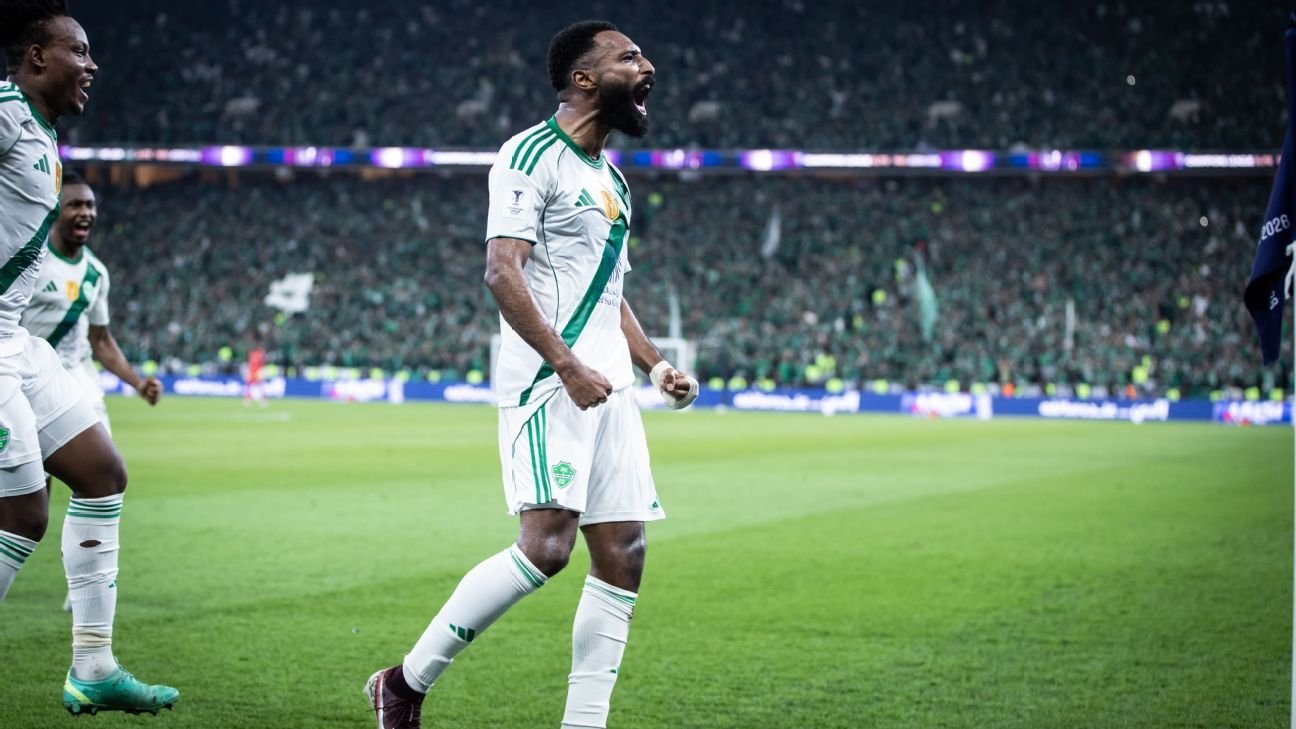
Al Ahli have no shortage of stellar names in their team to call upon.
As do many of their compatriots, ever since the Saudi Pro League boom exploded in the wake of the last FIFA World Cup in 2022 — initially kickstarted by Cristiano Ronaldo‘s shock move from Manchester United to Al Nassr.
Riyad Mahrez, Ivan Toney, Franck Kessié and Édouard Mendy would have read like a who’s who of world football’s most-prominent names just a couple of seasons ago. Al Ahli even had Roberto Firmino captaining them last term, while Merih Demiral and Roger Ibañez are hardly slouches either from their time playing in Serie A for Juventus and Roma respectively.
But as Al Ahli became only the second team in AFC Champions League Elite history to successfully defend their title on Saturday evening, it was poignant that a homegrown hero emerged in the form of Firas Al-Buraikan — who came off the bench to score a 96th-minute winner and help his side become champions of Asia for the second successive season with a 1-0 triumph over Machida Zelvia in the final.
Al Ahli coach Matthias Jaissle deserves plenty of credit for insisting his team still showed attacking endeavour, even though they went down to ten men in the 68th minute following a straight red to Zakaria Hawsawi for a headbutt on Machida striker Tete Yengi.
It was such enterprise that eventually saw them come up with the game-defining moment six minutes into extra-time.
Of course, the illustrious imports would have an involvement.
After a largely frustrating evening, Mahrez would send the telling ball into the box after teasing his opponent to create just enough space for a delivery in trademark fashion down the right.
Kessié, who would go on to deservingly be named the tournament’s Most Valuable Player, then stayed calm when others panicked — keeping his eyes on Mahrez’s cross all the way as it sailed over a couple of desperate missed headers, before deftly bringing it down at the far post.
It was undoubtedly an attempted trap but, as the ball trickled a couple of yards ahead of Kessié, Al-Buraikan reacted quickest — instinctively pulling the trigger ahead of his team-mate to squeeze a left-footed effort past opposition goalkeeper Kosei Tani.
It served as a reminder that, amid all the star power that the SPL — and, to a larger extent, the ACL Elite — now boasts, there is still a stage, and on occasion, for the homegrown talent to shine.
In fairness, Jaissle again deserves credit for his insistence of regularly relying on at least a couple of locals in his starting XI. He could easily field an entirely-foreign one if he wanted to.
The same can be said of Sérgio Conceição at Al Ittihad, who were eliminated in the quarterfinals, while Al Hilal even surprisingly started with six locals when they were eliminated on penalties in the round of 16.
This is in stark contrast to the quarterfinal clash between Thailand’s Buriram United and United Arab Emirates’ Shabab Al Ahli, where a solitary Thai and Emirati were named in the respective starting lineups.
In their quarterfinal loss to Al Ahli, the 15 players that featured for Malaysia’s Johor Darul Ta’zim were all foreign-born — if captain and naturalised Malaysia international Natxo Insa is included.
There is obviously nothing wrong with primarily relying on imports, especially for teams like JDT and Buriram who are looking to take the next step and get even closer to the level of some of the continent’s leading lights.
If it is within their means, the tournament certainly isn’t going to stop them, with new regulations from the birth of the ACL Elite era last season removing the “5+1” foreigner quota — essentially allowing for just five imports with no restrictions and one more from an AFC member association in a starting XI. That was already an increase from the previous “3+1” rule.
Still, for the long-term growth of a nation’s footballing ecosystem, one would imagine that it would still be beneficial for a fair share of locals not only get the compete at the highest level of continental football — but also improve from playing alongside these top-level foreign signings.
It was this conundrum that indirectly led to Roberto Mancini’s dismissal as Saudi Arabia coach back in October 2024, when an-already tense relationship with the football association was exacerbated by his criticism of the lack of game time his national team players were getting in the SPL — especially among his strikers.
Mancini certainly did not help his case but there was some validity behind his frustration as the likes of Al-Buraikan, Salem Al-Dawsari and Saleh Al-Shehri all warmed the bench for Ronaldo, Firmino, Karim Benzema, Sadio Mané and Aleksandar Mitrović to name but a few.
In the 2023-24 season, the first full campaign after the SPL went fully star-studded, Al-Buraikan was the top local scorer with 17 goals — 18 behind Golden Boot winner Ronaldo and 11 less than second-placed Benzema, with Al-Dawsari the only other Saudi Arabian in the top ten on 14 strikes.
With still a month to go this term, Al-Dawsari is the only homegrown player in the top ten with his 15 goals ten behind the chart-topping Ronaldo.
For a team heading for the World Cup in June, and hoping to again makes waves like they did with their stunning 2-1 victory over eventual champions Argentina four years ago, a lack of regular game time for their key players on the club scene is certainly far from ideal.
Because, as Al-Buraikan — born in the Saudi Arabian capital of Riyadh, just a two-hour flight from where the final was played at King Abdullah Sports City Stadium — showed on Saturday, they certainly can have an impact for the teams — even on the biggest stage of all.

