The college basketball offseason has reached the place where most programs feel confident with how their rosters look for the coming year. One or two spots may be left to fill, but generally teams have transitioned from building a roster to setting those pieces in place ahead of summer exhibition trips.
The Big 12’s 16 programs underwent an array of roster changes over the past few months, with practically every team losing a substantial share of their contribution from the 2025-26 season. Some teams experienced wholesale personnel changes, whether by hiring new coaching staff or simply wiping the slate clean.
Advertisement
The process of relearning a whole conference’s worth of new players is a formidable challenge but an insightful, perhaps even enjoyable one. Below is a comprehensive albeit non-exhaustive list of where Big 12 rosters stand after a dizzying past few months of player movement.
Teams are ranked as they appear on college basketball analytics site BartTorvik’s 2027 projections. Rosters are subject to change.
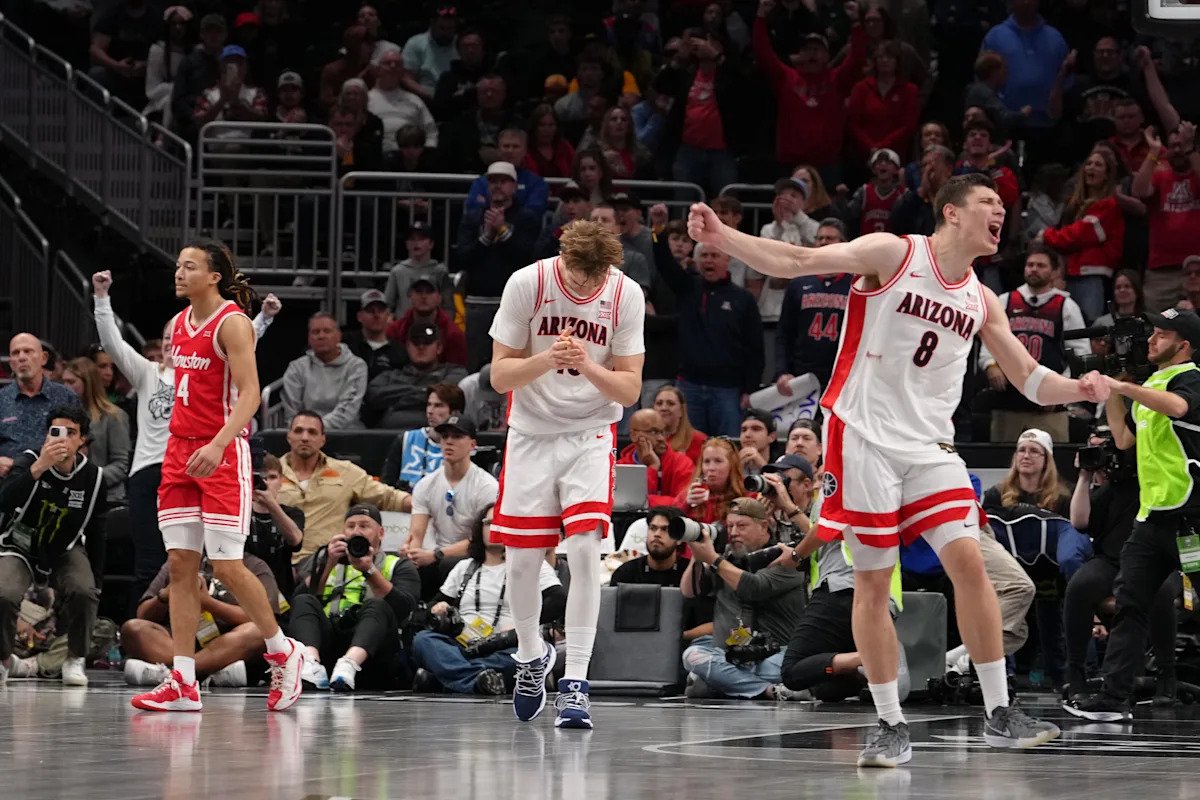
No. 1 Houston – It’s a testament to the machine that is Kelvin Sampson’s Houston program that the Cougars can lose an All-Freshman guard in Kingston Flemings plus seniors Emanuel Sharp and Milos Uzan and maintain their perch at or atop the Big 12. In typical Sampson fashion, Houston went out and landed a handful of transfers who fit their DNA. The big name is point guard Dedan Thomas Jr., a onetime UNLV Rebel who played last season at LSU. Thomas Jr. would have led the SEC in assists (6.5 per game) if he hadn’t missed half the year with a foot injury. His recovery is ahead of schedule.
Houston also added ex-Kent State forward Delrecco Gillespie, who finished fourth nationally in rebounds with 11.3 per game and led the nation with 22 double-doubles. He’ll share the front court with Joseph Tugler, one of three key returners along with Chase McCarty and Mercy Miller. Houston should also get production from 7-foot-1 freshman Arafan Diane. The Guinean native was ranked the top center in the 2026 class by On3/Rivals.
Advertisement
No. 2 Arizona – The reigning Big 12 regular season and tournament champions must replace five of their top seven scorers, which is no small task. Tommy Lloyd and his staff got a head start by signing five-star guard Caleb Holt, who is Arizona’s highest ranked signee since Deandre Ayton. Holt doesn’t possess the offensive flourish of Brayden Burries, but his two-way play makes him more valuable. Holt and returning wing Ivan Kharchenkov will cause havoc on opposing backcourts all season long.
Arizona replaces point guard Jaden Bradley with North Carolina transfer Derek Dixon. Though Dixon has room to grow as a distributor, his three-point shooting (39.7 percent as a freshman) gives Arizona a much-needed weapon on the perimeter. Up front, Arizona should receive All-Conference level production from fifth-year senior Motiejus Krivas, but questions remain at the power forward position. Will Arizona go after another player overseas or rest on Nebraska transfer Ugnius Jarusevicius as the starting four?
No. 3 Kansas – How do you replace the No. 1 pick in the NBA Draft? If you’re Bill Self, you simply go get yourself another one. Out goes Darryn Peterson and in comes Tyran Stokes, a 6-foot-7 wing and the top player in the 2026 recruiting class. Stokes is considered an explosive athlete who is relentless at driving to the hoop but also shoots from the perimeter at a high clip. Stokes is one of 11 new Jayhawks in what is basically a fresh start for the 63-year-old Self.
Kansas’ other top newcomers include a pair of point guards: five-star freshman Taylen Kinney (Overtime Elite) and Toledo transfer Leroy Blyden Jr., the MAC Freshman of the Year. KU also added big men transfers Keanu Dawes (Utah) and Christian Reeves (College of Charleston). Dawes was one of the top defensive rebounders in the Big 12 last season on his way to averaging 12.5 points and 8.8 boards. Reeves started his career at Duke before transferring to Charleston. He recently underwent shoulder surgery.
Advertisement
No. 4 Iowa State – The Cyclones face the highest risk of taking a step back among the Big 12’s upper echelon after losing Joshua Jefferson and Tamin Lipsey to graduation and Milan Momcilovic to the transfer portal (he picked Kentucky over Arizona and Louisville). Returning guard Killyan Toure is expected to take on a bigger role in the Cyclones offense, whereas his defensive is excellent – coach T.J. Otzelberger calls him the best on-ball defender in the country. Iowa State also returns big man Blake Buchanan and combo guard Jamarion Batemon.
Iowa State went for experience in the transfer portal, adding seniors Ryan Prather Jr. (Robert Morris), Leon Bond III (Northern Iowa) and Taj Manning (Kansas State). The Cyclones will rely on Bond III or Northwestern transfer Tre Singleton for timely buckets. Lipsey’s replacement is Bradley transfer Jaquan Johnson, a First-Team All-Missouri Valley selection who averaged 16.9 points, 3.9 rebounds and 3.6 assists. Johnson is undersized at 5-foot-11, but his effort on defense (he averaged 2.5 steals) makes him a good fit under Otzelberger
No. 5 Texas Tech – JT Toppin’s season-ending ACL injury was soul crushing for the Red Raiders, but getting to bring back the Big 12’s top player for another year is a nice consolation. Texas Tech hinted at Toppin’s return in a social media video Wednesday, putting to rest any speculation he might redshirt the 2026-27 season. Toppin averaged 21.8 points and 10.8 rebounds before his injury. It’s a safe guess that he’ll be the preseason Big 12 Player of the Year for a second straight season.
Outside of Toppin, Texas Tech will have a new look starting five highlighted by UNLV transfer Dra Gibbs-Lawhorn. The senior guard averaged 20.7 points and shot 41.4 percent from three last season. He’ll share a backcourt with Hofstra transfer Cruz Davis, the 2025-26 CAA Player of the Year. Davis is an electric scorer off the bounce and catch, according to a CAA coach. Texas Tech also brings in top 30 recruit DaKari Spear, a 6-foot-5 combo guard. Scoring won’t be a concern for Grant McCasland’s squad.
Advertisement
No. 6 BYU – Kevin Young’s team got away from last season, with BYU dropping eight of its final 12 league games. Cougars sputtered through scoring droughts and defensive lapses, exacerbated by the loss of Richie Saunders. Despite the disappointment of how last season ended, Young took a rather conservative approach this offseason. He scored big by retaining point guard Robert Wright III, replaced Saunders with Kentucky transfer Collin Chandler and reeled in former Clemson and Utah big man Jake Wahlin. The wild card is forward Tyler Betsey, a former top 50 recruit who had an up and down season at Syracuse.
BYU’s offense should once again flow through a ludicrously talented freshman wing, this one being Bruce Branch III. The Gilbert, Arizona native chose BYU over the UA among other top programs. He is considered a lengthy, versatile scorer with a high-end perimeter game. Branch will be competing with Kansas’ Stokes and Arizona’s Holt for Big 12 Freshman of the Year honors. All three players are projected top five NBA Draft picks.
No. 7 Cincinnati – Seeing Cincinnati so high on this list may come as a surprise, but former Utah State coach Jerrod Calhoun has the pieces to make a postseason run in Year 1. Arizona fans got a taste of Calhoun’s well-oiled offense in the NCAA Tournament Round of 32. Last season Calhoun’s team ranked top 25 nationally in offensive efficiency and 10th in two-point shooting. Calhoun will look to add on to his success with a roster of 12 transfers.
Cincinnati’s top ranked portal pickup is ex-Towson forward Tyler Tejada. The 2024-25 CAA Player of the Year was inconsistent as a sophomore but still averaged 17.7 points and 5.5 rebounds. Former Tulsa point guard Tylen Riley gives the Bearcats a well-rounded floor general. He’ll play alongside Georgia Tech transfer Akai Fleming and Wake Forest transfer Myles Colvin. Cincinnati’s biggest question mark is at center, where it’ll rely on George Mason transfer Riley Allenspach to take a big leap.
Advertisement
No. 8 Baylor – Scott Drew’s Baylor program missed the NCAA Tournament last season for the first time since 2017-18. Whether the Bears move back into the Big 12’s upper half could depend on the health of freshman guard Dylan Mingo, a five-star prospect with an extensive injury history. The one-time North Carolina signee opted out of his pledge when Hubert Davis was fired and committed to Baylor, joining his brother Kayden Mingo. Dylan missed most of his senior season of high school and re-injured himself in March, according to Matt Norlander of CBS Sports. His status will be a top storyline heading into the fall.
Baylor lost its top contributors from this past season, with Cameron Carr entering the NBA Draft and Tounde Yessoufou transferring to St. John’s. In addition to the Mingo brothers, Baylor’s newcomers include ex-Yale forward Isaac Celiscar and former Liberty guard Brett Decker Jr. Baylor brings back point guard Isaac Williams IV, who averaged 10.4 points and 3.3 assists.
No. 9 TCU – The Horned Frogs return three key players from a team that earned a nine seed in the NCAA Tournament. Forwards Xavier Edmonds and Micah Robinson give TCU one of the most experienced front court courts in the Big 12, which should help offset the loss of wing David Punch, who transferred to Texas. Edmonds was one of the most efficient scorers in the conference last season and also one of its top offensive rebounders. At point guard, TCU brings back Brock Harding, whose 5.6 assists per game is highest among all returning Big 12 players.
Coach Jamie Dixon signed the nation’s top ranked JUCO player, Trent Lincoln, a 6-foot-3 guard who averaged 19.4 points, 4.5 rebounds and 6.1 assists at Gulf Coast State last season. Another JUCO transfer, Ryan Hunt, is a 7-foot Australian center who played last season for Eastern Arizona College. TCU also adds West Virginia transfer DJ Thomas, a 6-foot-7 sophomore who scored double figures five times in Big 12 play.
Advertisement
No. 10 UCF – Johnny Dawkins made his long-awaited breakthrough this past season, leading UCF to a surprise NCAA Tournament bid. Whether Dawkins can repeat that success will depend on how well he and his staff added talent to offset the departures of the team’s three top scorers. The Knights lost seniors Riley Kugel and Themus Fulks to graduation, and Jordan Burks transferred to Oklahoma State (more on him in a moment). UCF’s top returners are center John Bol and combo guard Carmelo Pacheko. Otherwise it’s a fresh start for the Knights, who feature at least 10 new players.
Dawkins signed sibling duo Mister Dean, a 6-foot-6 junior from Charleston, and Arturo Dean, a 6-foot senior from Oklahoma State, who joined UCF last offseason but opted to redshirt. Arturo is a menace on defense: He led the nation in steals (2.5 per game) in a prior stop at FIU and ranked second nationally in steals percentage at OSU. Mister is a standout defender in his own right but is recovering from an ACL tear in November.
No. 11 Oklahoma State – When the Cowboys visited McKale Center in February for a 37-point beatdown, coach Steve Lutz was highly complimentary of the Arizona program postgame, telling reporters that the Wildcats are in college basketball’s “One percent.” Within that statement was an acknowledgement that Arizona is where Oklahoma State would like to be one day. OSU took a step forward in the right direction with an incoming class that 247 ranks No. 7 nationally and first in the Big 12.
OSU stocked up on high major transfers, including two intra-conference pickups: former UCF forward Jordan Burks and ex-ASU big man Andrija Grbovic. Burks averaged 13.3 points and 4.8 rebounds for the Knights, notably scoring double figures in both games against Arizona. Grbovic, meanwhile, emerged as key contributor in his one year with the Sun Devils, starting 27 of 33 games and averaging 6.8 points and 2.9 boards.
Advertisement
No. 12 West Virginia – Second-year head coach Ross Hodge overhauled his roster after the Mountaineers finished in the middle of the Big 12 in Year 1. Hodge struck it rich this offseason, bringing in a backcourt-heavy class that ranks top 10 nationally per 247. The name Arizona fans will recognize is Joson Sanon, the one-time UA commit who flipped to ASU before transferring to St. John’s. Sanon averaged 7.9 points in 21 minutes with Johnnies. He struggled with his shot towards the end of the season and came up quiet in the NCAA Tournament. Sanon will need to build back his confidence as the focal piece of the Mountaineers offense.
Butler transfer Finley Bizjack gives WVU another strong scoring option at combo guard. His scoring average has risen precipitously over three seasons, but it’s to be seen whether his 17.1 points per game will transfer over to the power conference level. WVU also brings in freshman point guard Miles Sadler, a top-25 recruit who is considered an elite pick-and-roll playmaker and on-ball defender by The Athletic.
No. 13 Arizona State – New ASU head coach Randy Bennett’s first weeks in Tempe were complicated by a health scare that forced the 64-year-old to be hospitalized for 10 days. Despite that, ASU’s coaching staff immediately went to work putting together a highly ranked transfer class that should help the Sun Devils contend for an NCAA Tournament bid in the expanded field of 76 teams.
Former Arizona power forward Paulius Murauskas is the key addition, as he followed Bennett from Saint Mary’s to ASU. Murauskas will headline a frontcourt that includes Gonzaga transfer Emmauel Innocenti and Boston transfer Ben Defty. Another WCC transfer, Portland’s Joel Foxwell, gives ASU a bona fide option at point guard. Foxwell averaged 15.6 points on his way to All-WCC First Team honors.
Advertisement
No. 14 Utah – The Alex Jensen era got off to a rough start, as Utah limped to a 2-16 record and last place finish in the conference. Jensen should improve his league win total in Year 2, but it may not be by much. Utah lost 97% of its scoring production from a year ago, including guard Terrence Brown (North Carolina) and forward Keanu Dawes (Kansas). Utah’s first-of-its-kind private equity deal apparently hasn’t translated to ample NIL funding for men’s basketball just yet.
Utah Valley transfer Jackson Holcombe is the cornerstone of the Utes’ portal class. The 6-foot-7 wing averaged 16 points and 7 rebounds, with most of his scoring coming near the rim. Zati Loubacki, a forward from Trinity Valley CC, earned NJCAA Third-Team All-American while averaging 11.4 points on 52 percent shooting. Israeli-Danish point guard Noam Yaacov was considered an NBA Draft prospect but appears to be headed to Salt Lake City. The 6-foot-1 Yaacov is undersized but has great vision and can from shoot all angles, per The Athletic.
No. 15 Kansas State – KSU got a head start on its coaching search when it dismissed Jerome Tang in February. The school replaced him with 53-year-old Casey Alexander, who led Belmont to the 2025-26 Missouri Valley Conference regular season title. Alexander built a sterling reputation at the mid-major level and is now thrown into the gauntlet of the Big 12 with a team full of newcomers. As expected, the Wildcats lost every key player either to the portal (PJ Haggerty, Abdi Bashir Jr.) or to graduation (Nate Jonson, Khamari McGriff).
Alexander’s talented crop of players at Belmont elected not to follow their ex-coach to Manhattan. Alexander instead put together a portal class that is heavy on power conference transfers. Leading the way is former Virginia Tech guard Jaden Schutt, who averaged 7.7 points for the Hokies. Kansas State’s front court will feature Georgetown transfer Isaiah Abraham and Miami transfer Timotej Malovec, who are both eying bigger roles.
Advertisement
No. 16 Colorado – In the have and have nots of the NIL and transfer portal era, Tad Boyle’s program firmly falls in the latter camp. Three of Colorado’s top four players jumped ship, including standout freshman Isaiah Johnson, who joined Boyle’s longtime Pac-12 foe Sean Miller at Texas. Boyle is working on a rolling five-year contract, so his job security isn’t necessarily in question. However, Colorado needs to show progress in Year 3 in the Big 12 to demonstrate to new athletic director Fernando Lovo that Boyle’s best years aren’t behind him.
Colorado did manage to retain point guard Barrington Hargress, who averaged 14.7 points and 4.5 assists last season. The Buffs also return guards Jalin Holland and Ian Inman from a team that went 17-16. Former UNC Greensboro wing Justin Neely highlights an incoming class of at least 10 newcomers.

