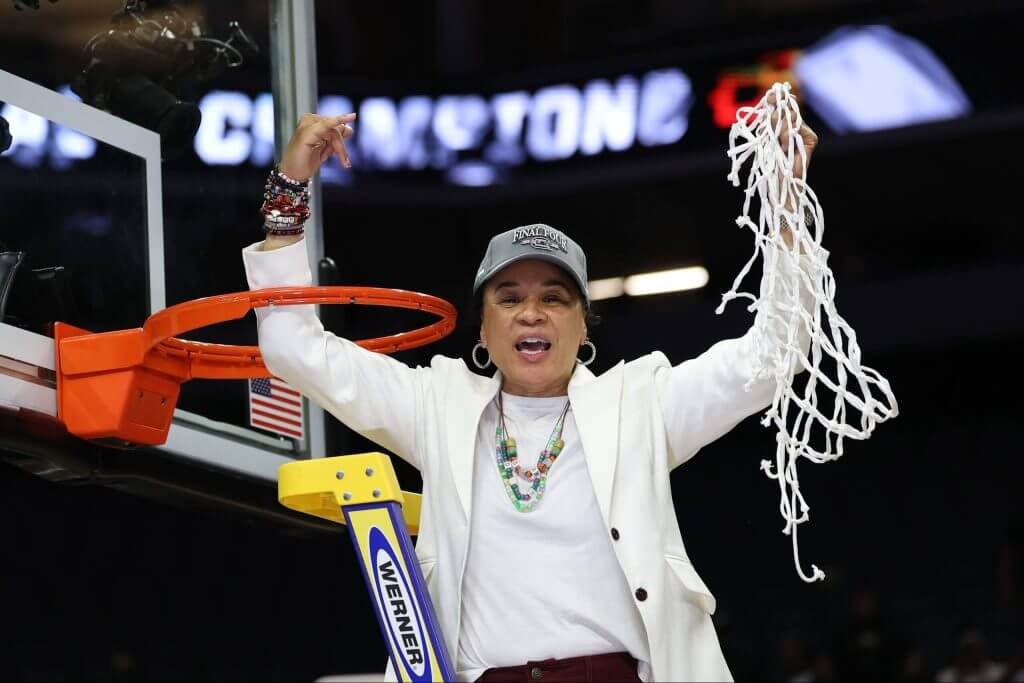
SACRAMENTO, Calif. — Wacky timing forced Dawn Staley to miss the trophy presentation. The South Carolina coach, a main character in this women’s college basketball surge, was occupied with live television interviews. So the players had to accept the Sacramento 4 Regional championship prize without their leader.
Good thing they know the routine.
Advertisement
For the sixth straight NCAA Tournament, the Gamecocks reached the Final Four, with a 78-52 victory over TCU on Monday night. There’s an urge to consider it a ho-hum accomplishment, a procedural step for a program that has won three national titles and spent the past dozen seasons as a top-tier contender. But let’s not get all snooty about South Carolina taking another Elite Eight.
It’s a familiar result, but these are not the same old Gamecocks. Their general style of play hasn’t changed, but they have a little different flavor. In previous seasons, abundance had defined them. Too much depth. Too much experience. Too much size and athleticism and physicality. They dictated everything to opponents. Their pristine culture was understood. Newcomers were incorporated slowly, not thrust into savior roles. Even Joyce Edwards, the All-American sophomore forward, didn’t start as a freshman. But this squad had to find its own path to get to the right place.
Staley integrated five fresh faces into her rotation. One of them, French center Alicia Tournebize, was a midseason addition. Two starters – transfers Ta’Niya Latson and Madina Okot – needed to adjust their approaches to play the South Carolina way, but the coaching staff had to give them freedom, too. And this new energy became even more important because injuries left the Gamecocks thinner in the post than they’ve been in a long time.
“There were just a lot of unknowns,” Staley said. “And you don’t know how they’re going to handle the pressures of playing for us, the pressures of getting back to this point right here.”
On the surface, it was easy. The Gamecocks have a 35-3 record. They haven’t won fewer than 35 games since 2020-21 — and that was a COVID-19-shortened season. But it was a challenge to be so great again. Many wondered whether Latson, a scorer with an unlimited green light at Florida State, could play a more restrained game. Okot had to live up to a WNBA-level standard at center, the most celebrated and critical position in the team’s attack. And the holdovers had something to prove, too.
Advertisement
They all maintained the standard. They did it the South Carolina way. And they added some flair, when appropriate.
“You know, that doesn’t often happen because you’ve got young people who have their own way of doing things,” Staley said. “Ta’Niya had her own way of doing things. Madina, Big Mama, had her own way of doing things. (Agot Makeer) has her own way of doing things. Same with Ayla (McDowell).
“They all could have just tried to do things the way they survive at doing things. And it takes a little bit of courage to let your guard down to be led so you can fulfill your role to the best of your ability.”
At South Carolina, some things cannot change. The team defense has to be extraordinary. Toughness is mandatory. Playing time is never a foregone conclusion. And Staley will build around strong post play. But she doesn’t get enough credit for the small strategic alterations she makes to fit different rosters. This team plays a faster, more perimeter-oriented style. They grind on defense and fly on offense.
Advertisement
Against TCU, the Gamecocks needed to speed up a team that plays at the controlled pace of All-American point guard Olivia Miles. It took three quarters, but they overwhelmed the Horned Frogs.
“Your margin for error against South Carolina, UConn, Texas, UCLA is almost zero,” TCU coach Mark Campbell said. “And with this level — the South Carolinas of the world — a bad shot, a turnover, a missed blockout, it just escalates quickly.”
The score was 49-41 entering the fourth quarter. The next thing you know, it’s showtime. On a play that defines this South Carolina team, a three-on-one fastbreak saw Johnson dish to Makeer, who made a beautiful extra pass to a streaking Edwards for a layup.
The score was 61-41.
Advertisement
“That’s just something that we had to figure out, not just us, but our coaching staff as well,” sophomore guard Maddy McDaniel said of South Carolina’s often-electric style of play. “Just as it was hard on us, it was hard on them as well.”
They’re better for going through the process. Without the subtle changes, the Gamecocks wouldn’t be so dominant.
“We definitely had to get used to each other, because none of us really played with each other,” junior guard Tessa Johnson said. “And I would say, the losses that we had in the season kind of brought us closer together.”
Johnson crossed her fingers as she described the team now: “I feel like we’re pretty like this.”
Advertisement
“We just go with what’s working at the time,” she added. “We do still have great centers. They are very dominant, but we also have guards that can score the ball as well.”
In Edwards, they have a superstar power forward to anchor them. In fifth-year senior Raven Johnson, they have a great point guard to lead them. Everything else has fallen into place, including the postseason emergence of Makeer, a five-star freshman who scored a career-high 18 points and badgered Miles on defense.
It’s a Final Four formula: old reliable program, surprising new vibe.
In Staley’s absence, Johnson and Latson accepted the Sacramento 4 Region trophy. They lifted it high. They beamed with their teammates as multicolored confetti flew over their heads. They partied until she could join them, and then they partied harder.
Advertisement
It was a fitting scene. They don’t need constant direction anymore. They know the way.
This article originally appeared in The Athletic.
South Carolina Gamecocks, Women’s College Basketball, Opinion
2026 The Athletic Media Company

