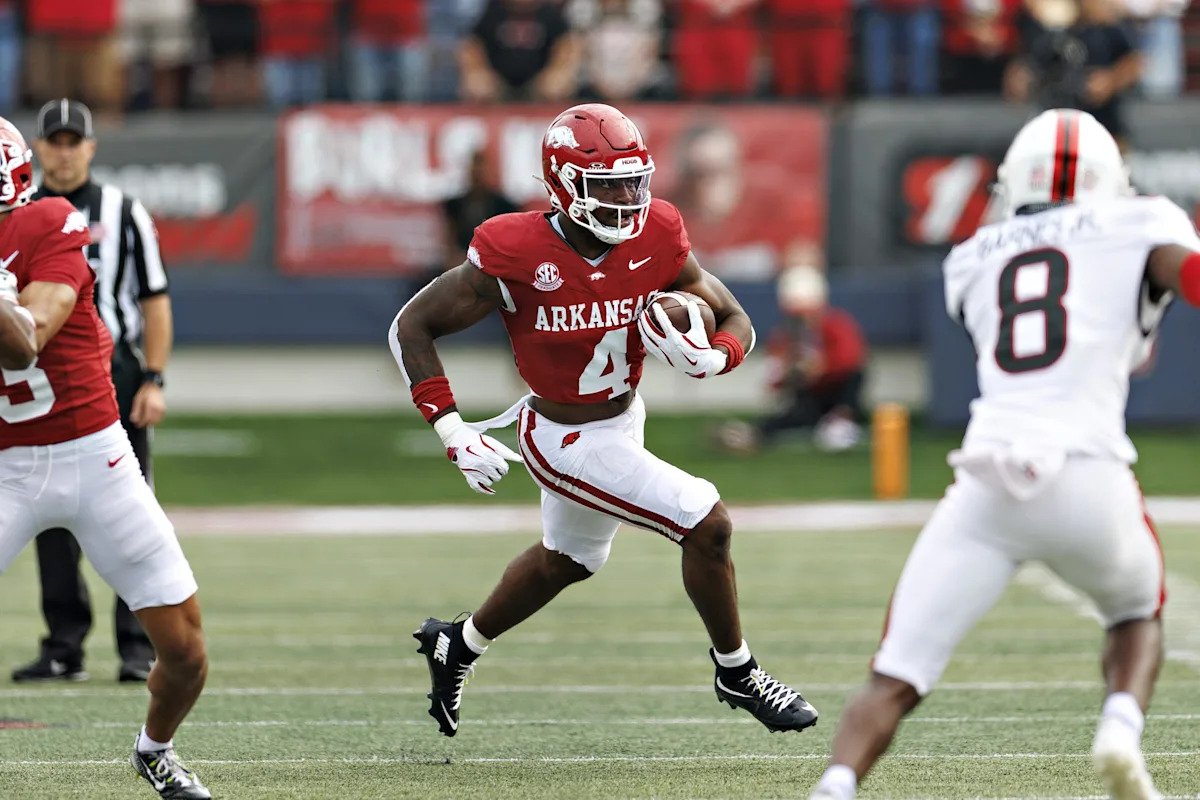
The Las Vegas Raiders have invested a good amount of capital to fill out the depth chart at running back over the last two offseasons, adding Ashton Jeanty to the roster with the sixth overall pick of the 2025 NFL draft and Mike Washington Jr. in the fourth round this past April.
While head coach Klint Kubiak recently said he’d like to maximize Jeanty’s workload, adding Washington to the mix gives the Raiders a strong one-two punch in the backfield. Additionally, Kubiak mentioned that it was important for the second-year pro to have a “wingman” moving forward, and he used a two-back system with the Seattle Seahawks last season.
Advertisement
So, how the touches out of the backfield get divided up is still a question, but Las Vegas does have a pair of running backs who can tote the rock. On that note, how do Jeanty and Washington complement each other?
Scheme Fit
This is an interesting one because both backs are a little better in a gap scheme, while Kubiak is known for having a zone-heavy system. That’s primarily how the two rushers were used during their last seasons in college, with Jeanty recording 193 gap runs to 181 zone runs and Washington’s split was 90 to 72, per Pro Football Focus. Comparatively, the Seahawks’ leading rushers in 2025 (Kenneth Walker and Zach Charbonnet) combined for 242 rushes on zone runs and 150 on gap runs during the regular season.
That being said, some coaches from the Shanahan tree, which Kubiak stems from, have pivoted philosophies to a more balanced rushing attack. For example, the Los Angeles Rams/Sean McVay dialed up 213 gap runs and 194 zone runs for running backs last year. Considering Kubiak is a creative play caller, and people in his network are shifting schemes, there shouldn’t be much concern about fit with the Raiders’ backs.
Advertisement
Plus, Jeanty showed improvement on outside zone concepts during his rookie season and has plenty of one-cut ability. So, that could be part of his role while Washington serves as more of the downhill runner.
Running Style
Building on the last sentence above, the Arkansas product doesn’t have much wiggle to make defenders miss. But he did finish 2025 with the sixth-most missed tackles forced (34) and with the third-highest yards after contact per attempt (3.86) among SEC running backs with at least 71 carries, per PFF. That’s because the 6-foot-1, 223-pound running back is tough to bring down and has 33⅝-inch arms to break tackles with a nasty stiff-arm.
Meanwhile, Jeanty was the best back in the country at breaking tackles in 2024, recording nearly 50 more MTFs than anyone else with 152 and leading the way with 5.25 YCO per attempt. The 5-foot-8, 211-pounder has some power to run defenders over, but he’s a lot more shifty than Washington is to make defenders miss. That creates some thunder and lightning in the Raiders’ backfield.
Advertisement
Big-Play Threat
This is another interesting category because both players showed the ability to hit home runs in college.
Jeanty led all FBS running backs with 36 “breakaway” runs (15 yards or more) and 1,366 yards on breakaways during his last season at Boise State, per PFF. Washington’s numbers aren’t that close in comparison to the 2024 Heisman runner-up’s historic performance. But the Arkansas product fared well in his own right, ranking fourth among SEC running backs in the same categories with 17 breakaway runs and 515 yards on those carries.
To add some more context, Washington played against better competition week in and week out in the SEC, and had a subpar supporting cast on a 2-10 team. Meanwhile, Jeanty dominated Mountain West competition and was on a team good enough to make the College Football Playoffs. That helps account for the difference in the numbers above, and the former Razorback running a 4.33-second 40-yard dash at the NFL Combine should help him become more of a big-play threat in the pros.
Advertisement
Meanwhile, the Boise State product has a track background and is plenty fast, but he didn’t run the 40 and doesn’t have long speed that Washington does. Also, Jeanty is better at getting the tough yards, and the rookie is more of a true home-run hitter who will have a handful of carries where he gets stuffed at the line and then breaks a long run.
Receiving Skills
Both backs had decent production as pass catchers in college. In three years at Boise, Jeanty recorded 80 catches for 862 yards and six touchdowns. The majority of those numbers came in 2024, when he had 43 grabs, 569 yards and five scores. Over the past four years at Buffalo, New Mexico State and Arkansas, Washington logged 73 receptions for 470 yards and three touchdowns, with 28, 226 and one coming this past season.
What’s interesting is that neither back showed a particularly impressive route tree before heading to the NFL. Their previous clubs primarily used the passing game to get them the ball in space as an extension of the rushing attack, having them run swing routes and screens as receivers. So, it’s not as if either Jeanty or Washington has a ton of experience running choice routes or an extensive route tree out of the backfield.
Advertisement
That being said, Washington has better hands with one drop last year compared to Jeanty’s four, per PFF, and the former’s speed can be an asset on wheel routes to potentially develop into the Raiders’ receiving back.
Pass Protection
This is where Las Vegas might be better off going with someone other than the two running backs mentioned. Pass protection was one of the biggest question marks surrounding Jeanty as a draft prospect, and he gave up 12 pressures (three sacks) on 85 opportunities to earn an ugly 34.1 PFF pass-blocking grade as a rookie. Meanwhile, Washington surrendered seven pressures (one sack) on 78 opportunities for a 28.4 grade at Arkansas last season.
So, this could be a situation where it makes more sense to put someone like fullback Connor Heyward next to Fernando Mendoza or Kirk Cousins until Jeanty or Washington proves they can hold up in pass pro.

