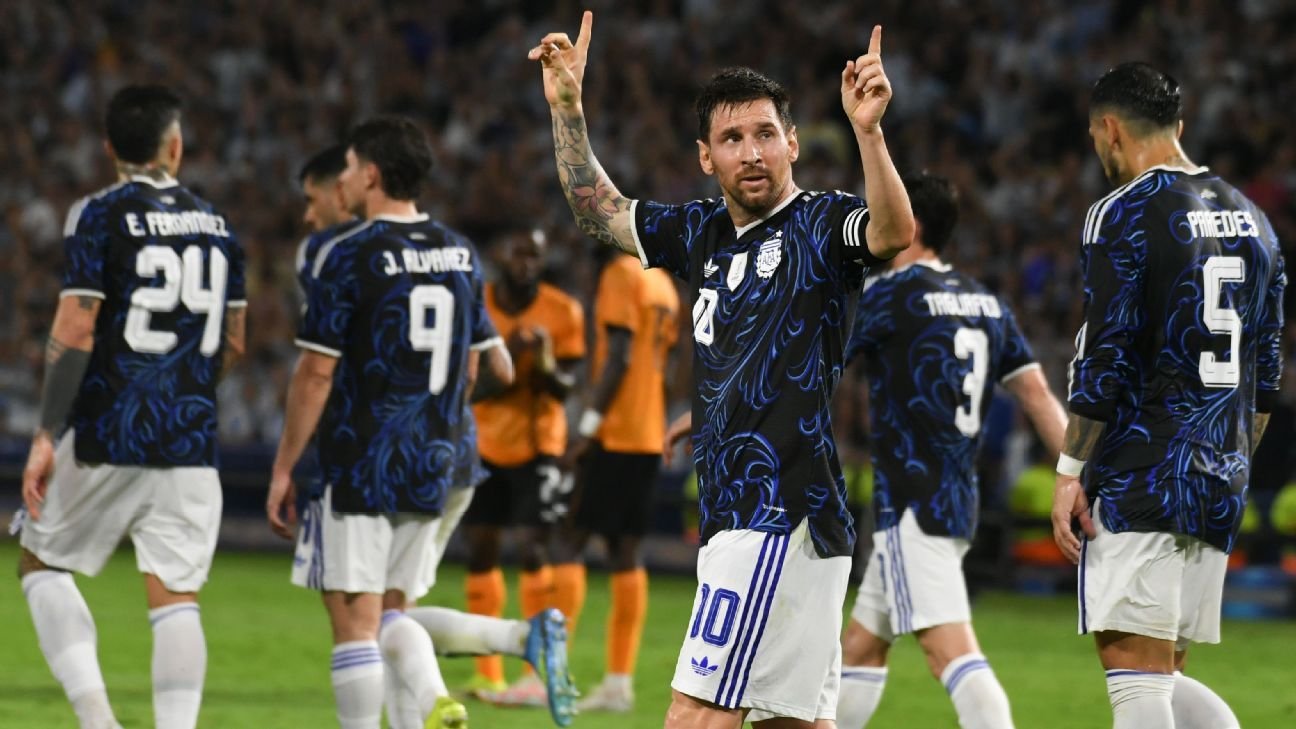
Except for the nations involved in the playoffs, Europe’s teams were finally free to face opposition from other continents on the late March FIFA dates. And so all of the South American sides on their way to the World Cup were at last able to test themselves against the Europeans, with one exception.
Argentina had been fixed up to face Spain in the Finalissima, the meeting of the champions of the Euros and the Copa América, The conflict in the Middle East made Qatar unviable as a venue, and negotiations to find an alternative broke down.
– Ranked: All 48 teams that can win the 2026 World Cup
– One thing to know about each of the 48 World Cup teams
– Does Casemiro have the legs to power Brazil’s two-man midfield?
So, this posed Argentina with a problem. What would they do in the last FIFA date before the World Cup build-up? They elected to bring the players back to Buenos Aires. They could spend time with their families, there would be plenty of training sessions, and a match or two, so the public could give the team a rousing send-off, but also pay their respects to Lionel Messi, in presumably his last dance with the national team on home soil.
But where to play the game, and who to play against?
Argentina’s normal base is River Plate‘s Monumental Stadium. With the biggest capacity in South America, it would be ideal for such a showpiece occasion. But there was a problem. It was already booked for concerts by AC/DC, so Argentina, then, were forced to take the highway — not to hell — but to the much smaller ground of Boca Juniors‘ La Bombonera.
Guatemala were lined up to provide the opposition. But FIFA stepped in, saying that Guatemala were already playing another game in Italy, and regulations prevent sides from appearing on two different continents on the same FIFA date.
The last-minute solution, then, was to bring in Mauritania for a match last Friday, and then Zambia for Tuesday’s send-off.
This is unorthodox preparation. It means that Argentina’s list of opponents since the end of World Cup qualification reads as follows: Venezuela, Puerto Rico, Angola, and now two more African sides who came nowhere near making it to the big party in June and July.
Does it matter? Argentina can argue that things have gone very well since they claimed the crown in Qatar nearly four years ago. They retained the Copa América in 2024 and they topped South America’s World Cup qualification table with ease. Plus, they have found ways of playing where they are not as dependent on Messi. The best night of all, for example, was the easy 4-1 win over Brazil that took place in Messi’s absence.
Even so, the degree of difficulty of the task in front of them needs to be taken into consideration. Italy retained their title in 1938 and Brazil did it in 1962, but no one has ever managed to win a second consecutive World Cup outside their own home continent. Argentina are seeking to make history in June and July, and so a more strenuous stress test of their capabilities might well have been in order.
There would seem to be three pertinent issues. One is Messi himself. There is still no official word on whether he will play the World Cup. Scaloni says that the player alone will make that decision at the appropriate time. He is not what he was and how can he be as he approaches 39 — his birthday is June 24 — when the tournament is underway? There are still flashes of genius, but can he really still tip the balance at the highest level? With Argentina not having faced European opposition since the 2022 World Cup final, it is hard to know.
Last Friday’s 2-1 win against Mauritania made for uncomfortable viewing. Argentina were reasonable in the first half, when Julián Álvarez played and dreadful in the second, when Messi replaced him. Some of this was a collective loss of focus, and an exaggerated desire of his teammates to tee up Messi for some farewell goals.
But there seemed to be a clear conclusion. Álvarez is now Argentina’s most potent weapon, and Messi in the side makes much more sense alongside the stamina, intelligence and talent of Álvarez. This was immediately reinforced in the Zambia match, when the pair combined right at the start to put Argentina ahead, and did it again just before halftime to double the lead.
The second issue regards Messi’s old colleague, Ángel Di María. So skillful, so versatile, so important on the big occasion, Di María has been a vital part of Scaloni’s success. He continues to shine, now back home with Rosario Central, but he is showing no signs of going back on his decision to retire from the national team. How can Argentina replace the irreplaceable?
At the start of this cycle, there were hopes that Alejandro Garnacho might be the man, but his progress has been frustrating. Over the last few days — and in the closing minutes of the Zambia game — there have been hints that some of this responsibility might pass to Valentín Barco, the left-footed winger currently with Ligue 1 club Strasbourg.
As he showed on Tuesday night, he can cause danger from either flank, and he also rounded off the 5-0 win with the last kick of the game. Barco will clearly not be a regular starter for Argentina in the World Cup, but even based on a few minutes against not the strongest opposition, it is possible to imagine that Scaloni is thinking of him for the kind of shock impact role that Di María played so well.
And the third issue is probably the most important. During the course of the Qatar campaign, Argentina’s defensive unit continually collapsed under pressure. It happened against Australia, against the Netherlands, and, very nearly with fatal consequences, against France in the final.
And this, in an extended World Cup, contains an extra knockout round, which offers another chance for defensive chaos to prove the team’s undoing. The problem is that no new defenders have emerged. Argentina are essentially going to North America with the same defensive unit they took to Qatar. There were times in the past few days, especially in the second half against Mauritania, when they looked extraordinarily vulnerable to the opponent’s counterattack. And if that applies in these gentle friendlies, how will they cope in the decisive stages of a World Cup?
At this point, there is no way of knowing. In the last few months, they have not been tested against the caliber of opposition that will be gunning for them in North America. Scaloni, then, is taking pretty much the same team that went to Qatar. It is a well-known side, but nearly four years on, it is about to take a giant step into the unknown.

