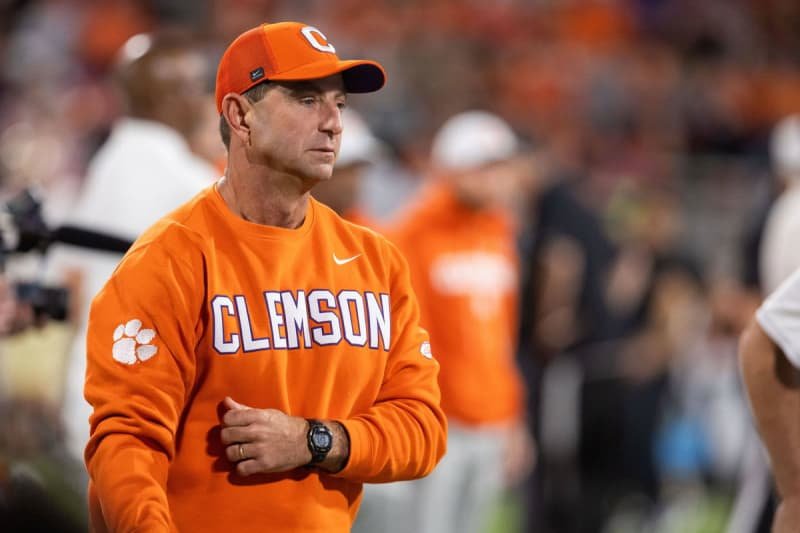
The dream of a Division I scholarship is being weaponized, and for some high school athletes, the price of that fake dream is a mere $30. A high school coach who experienced it describes how high school recruits are feeling the impact of the latest recruitment scam. It paves the way for Dabo Swinney’s calls for stringent tampering rules.
“😳 NO WAY we’re out here paying for fake offers and reposting them,” University High School head coach Dustin Lawless said on X. “What’s worse is the grown man behind the screen and the grown men who know what’s goin on but not calling it out or condoning it… 🧵 ⬇️”
Advertisement
Maryland football’s name has been co-opted in a recruiting scam, especially after several all-state West Virginia high school football players received offers from someone named Andrew Green. This man claims to be a part of Maryland’s coaching team, and many high school players, like Roanoke Catholic High School’s Rahem Lipford, who’s a 2028 recruit playing at the WR/CB position, tagged Green’s Twitter account while posting about their commitment.
The scammer’s reach was wide, duping multiple recruits like David “D1” Robinson Jr. and Pete Carter, both of whom publicly celebrated their fake offers from Maryland on social media, tagging the fraudulent account in their posts.
Dustin Lawless also shared screenshots of Andrew Green’s conversations with the players, asking them for $30 to help them get into Maryland. However, the team’s official account posted a warning on Twitter about the fraud this account/person is committing against the players.
Advertisement
“This user is not a staff member of Maryland football, nor are they affiliated in any way,” Maryland’s social media/content manager Michael Rovetto said on X. “Offers extended by ‘Coach Drew Green’ are not real offers. Please BLOCK and REPORT!”
In recent years, many fake social media accounts have impersonated college coaches and extended offers to high school players. In 2025, a Tennessee coach under the username of @CoachLHughes made fake offers to players and also asked for a $20 payment via check or Cash App. Later, their associate AD, Tom Satkowiak, confirmed the user was a fraud and warned players.
This isn’t the first time Maryland has been involved in such an issue. Back in May 2025, Maryland football faced a major accusation of tampering after landing kicker Sean O’Haire from Richmond. He had no intention of entering the portal until he received an offer from Maryland. And his former head coach, Russ Huesman, didn’t think twice before pointing it out.
“Maryland tampered with our kicker and gave him $50,000,” Huesman said. “They came in; they tampered. The kid had zero interest in transferring; they offered him money. It happens all over the country, and there’s nothing the NCAA’s going to do about it.”
Advertisement
While the Maryland incidents highlight issues from fake offers to alleged tampering, they are part of a larger, nationwide problem that has prompted prominent coaches like Clemson’s Dabo Swinney to demand stricter regulations and enforcement from the NCAA.
Dabo Swinney’s firm stand on tampering
Clemson head coach Dabo Swinney raised serious concerns about the growing issue of portal tampering. He even forced the NCAA to open an investigation against Ole Miss. It all started with Swinney accusing the Rebels of constantly contacting his linebacker Luke Ferrelli. He also claimed the contact was a deliberate attempt to push the linebacker into the portal.
After those comments, the NCAA contacted Dabo Swinney and confirmed that an investigation would proceed. Despite that, Swinney didn’t hold back from discussing the possible threat tampering poses to the teams.
Advertisement
“This is a whole other level of tampering,” Swinney said. “It’s total hypocrisy… This is a really sad state of affairs. We have a broken system, and if there are no consequences for tampering, then we have no rules, and we have no governance.”
The desperation to keep strong players on the team makes sense, especially in this transfer portal era. Ferrelli was reportedly happy at Clemson, but on January 15, he entered the portal with the intent to commit to Ole Miss. Later, Clemson GM Jordan Sorrells informed Swinney about Ole Miss’s aggressive push to recruit him.
Clemson’s requests to cease contact were disregarded, and their suspicions were validated when Ferrelli entered the portal with the evident intention to transfer to Ole Miss.
From high schoolers being duped by $30 scams to top programs accusing each other of tampering, the current landscape lacks clear guardrails. Swinney’s public crusade against Ole Miss may force the NCAA’s hand, but for now, players and programs are navigating a system where the rules are either unclear or unenforced.

