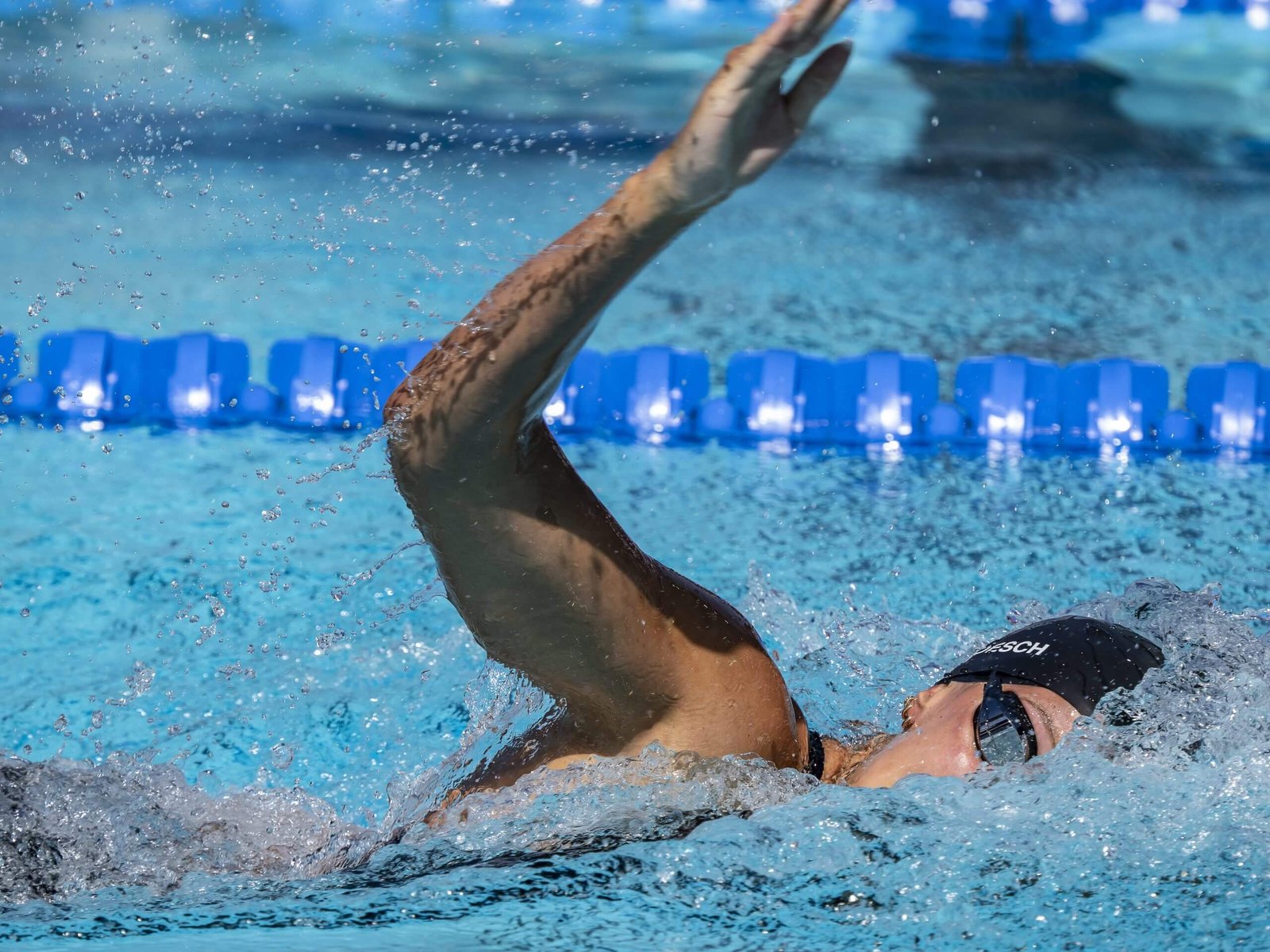
Improved American Freestyle Depth Bodes Well for Relay Prospects
At the past three years of international competitions, the gold-medal podium has been an elusive target for the United States in freestyle relays. The U.S. men dominated the 400 free relay in Paris, and the mixed 400 free relay secured gold in world-record time at last year’s World Championships, but in most other finals, the American quartets have struggled to keep pace with tough competition from Australia and, in the men’s 800 free relay, Great Britain. Illness spreading throughout the team at last year’s Worlds did not help matters.
Perhaps that tide is shifting, though, thanks to much-improved depth in the 100 and 200 freestyle over the past two years. Across the country, swimmers view these events as a greater opportunity to reach major international competitions since USA Swimming selects at least four and up to six competitors for each relay at major competitions. For a variety of reasons, the standard required to reach that barrier has elevated significantly.
That trend showed at last week’s U.S. Nationals, even as the majority of swimmers set to compete at the upcoming Pan Pacific Championships did not compete or swam a limited program of events.
Kate Douglass, Gretchen Walsh & Torri Huske — Photo Courtesy: Peter H. Bick
The U.S. women have the potential to challenge the 400 free relay world record as soon as next year, and the results from Nationals are a big reason why. The race went off without the Torri Huske, Gretchen Walsh, Kate Douglass and Simone Manuel, the top-four swimmers in the event at the last two selection meets and the swimmers who combined to set an American record on the way to silver at the Paris Olympics.
The race still had three swimmers going under 53, with Anna Moesch breaking the American record at 51.88 while Rylee Erisman and Liberty Clark both went 52.9s. That marked just the second occasion three Americans have broken 53 in one race, the first coming in last year’s full-strength National final. That means a whopping seven U.S. swimmers have gone that fast since June 2025; Moesch and Douglass have gone sub-52 while Camille Spink is not far back, having gone 53.19 to finish fourth at Nationals.
Likewise, the 200 free at last year’s Nationals was one of the quickest domestic fields ever: Claire Weinstein won in 1:54.92, followed by Katie Ledecky, Huske, Erin Gemmell and Anna Peplowski all in the 1:55s. That was a significant jump from Olympic Trials one year earlier, when only Ledecky broke 1:56. Weinstein, however, has withdrawn from Pan Pacs due to illness.
The race in Irvine last week, again without the top finishers from the previous year as they get ready for Pan Pacs, had three further women swim 1:55s, led by Moesch with a stellar 1:55.05. Erisman clocked 1:55.86, followed by Madi Mintenko at 1:55.87. Clark went 1:56.55 for fourth, ahead of the fourth-place time from Olympic Trials two years earlier.
Unlike in the shorter relay, the American team does not yet have the top-end speed to match up with the Aussie duo of Mollie O’Callaghan and Lani Pallister, but this is the first time in the 2020s that the U.S. has a major depth advantage in this event.
The men, too, have made significant progress toward restoring their dominance in the 400 free relay and perhaps finally topping Britain in the longer event. For the 100 free, 47s are becoming the norm. Since the start of 2025, no country has had more than three swimmers break the 48-second barrier in the individual event; except for the United States, that is, with 11 men having gone that fast (seven so far this year, with three of the four remaining swimmers set to swim at Pan Pacs).
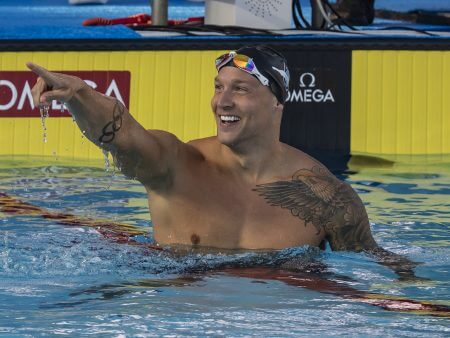
Caeleb Dressel — Photo Courtesy: Peter H. Bick
The final at Nationals saw World Championships silver medalist Jack Alexy struggle as he prepares for Pan Pacs while Chris Guiliano was absent. Still four sub-48, with a resurgent Caeleb Dressel leading the way in 47.70 and 19-year-old Maximus Williamson going that for the first time in his fourth-place effort. It’s worth noting that the American team has never lost the 400 free relay with Dressel on the squad, a run which includes three Olympic gold medals and three world titles.
In the 200, much of the improvement came last year as Luke Hobson reached 1:43s for the first time, Gabriel Jett finished second at Nationals in 1:44.70 and both Rex Maurer and Henry McFadden records efforts in the 1:45-low range. Now, add Ryan Erisman to that mix, the 20-year-old having dropped more than two seconds from his best time this year on the way to winning the national title in 1:45.23.
It is far too early to project which swimmers will race for the United States on the freestyle relays as they search for Olympic gold on home soil two years from now in Los Angeles. In fact, much could change between now and next year’s World Championships in Singapore. But with so many swimmers firing off world-class times across these events, the standard for simply qualifying for these relays is rising, a trend which bodes well for American medal hopes in the years to come.

