The Hockey News has released its archive to all THN subscribers: 76 years of history, stories, and features.
Subscribe now to view the full THN Archives here
Also, go to thn.com/free to subscribe.
Advertisement
THINGS ARE NOT SUPPOSED to be this way. As the domestic auto industry finds itself hanging by its fingernails, the gap between the Detroit Red Wings and the rest of the NHL continues to widen.
When THN conducted its first-ever NHL franchise ranking last season, the Red Wings finished ahead of the pack by a considerable margin, then went out and won the Stanley Cup, then signed the most sought-after free agent of the summer after he pursued them. So much for parity in the new salary-capped NHL.
Last season, the Red Wings’ margin of victory in our overall totals was 14.5 points over the Ottawa Senators, but this season they’ve bulged that lead to 21.5 points, this time over San Jose.
Advertisement
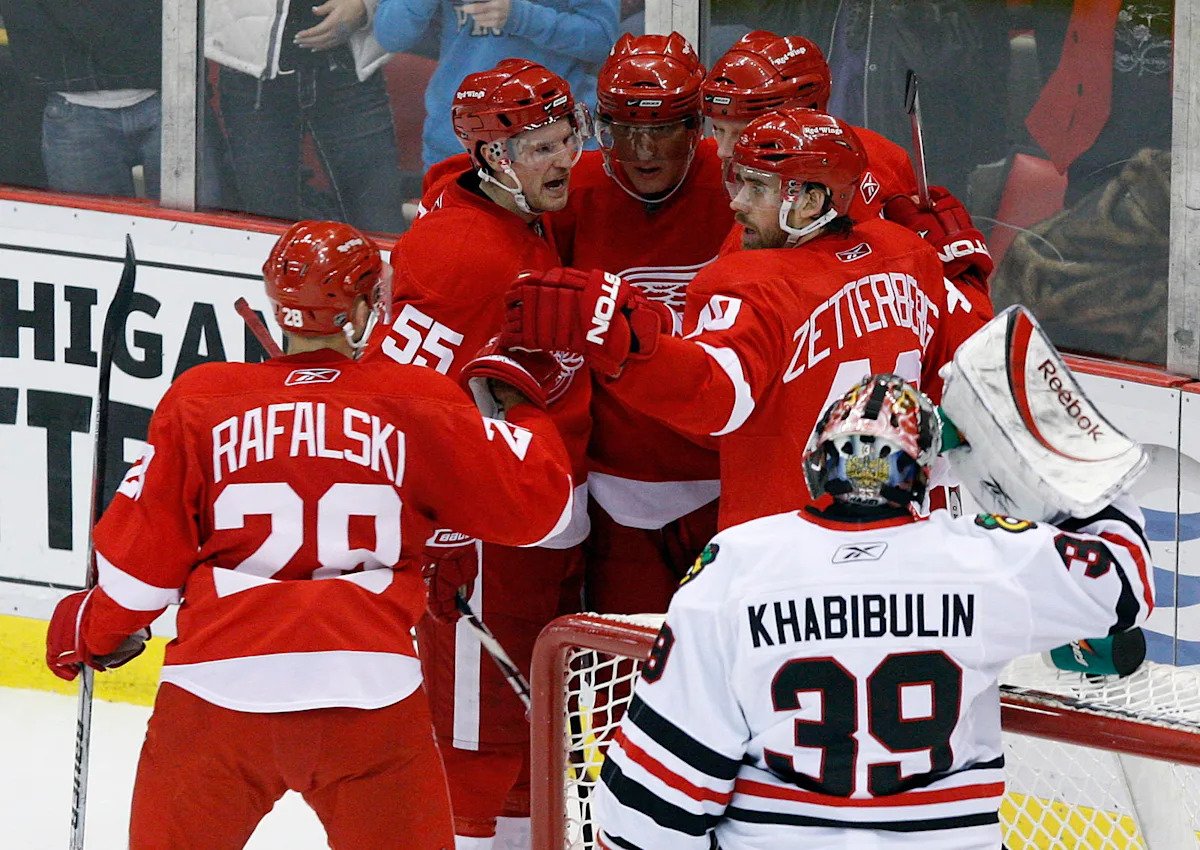
Yup, things are looking absolutely rosy for the Red Wings, that is until you step outside the Joe Louis Arena. If the Big Three in Detroit were near as solid and successful as the Wings’ Big Three of Nicklas Lidstrom, Pavel Datsyuk and Henrik Zetterberg, they wouldn’t be on the verge of bankruptcy and holding out their hands for a government bailout. Detroit relies on the auto industry as much as any city does on its main employer and when the defending Cup champions have to sell tickets for some games for as low as nine bucks and still can’t fill the building for all of them, well, these are very difficult times.
There has been enormous amounts of speculation about what would happen to Detroit if one or more of the Big Three was forced to close its doors. It’s a scenario Red Wings owner Mike Ilitch does not want to contemplate.
“I can’t anticipate the automakers not being a part of the Detroit scene – let alone the U.S. economy – and so I don’t even want to speculate on that,” said Ilitch in an email. “I’m hopeful the president and the others in Washington will work with the auto industry to make sure the U.S. keeps a strong manufacturing base at home.”
There are, oh, about 25 other teams who would be doing cartwheels if they had the Wings’ attendance problems – they couldn’t even sell out the building for a Dec. 18 showdown against the Sharks – but their average numbers through 15 contests were still a robust 19,630 per game.
Advertisement
“I would say that given everything that has gone on to this point, we’re thrilled with our support,” said Red Wings GM Ken Holland. “Do I worry about it? Yeah, because I live it every day. I feel for people when I pick up the paper and see people losing their jobs.”
Holland is quick to point out, however, that if the Red Wings played in an 18,000-seat arena, they’d be selling out every game. The Red Wings play in a market where there are professional baseball, basketball and football (well, sort of) teams and huge athletic program at the University of Michigan. They have 3,600 more seats to sell per game than the Edmonton Oilers, “and they only have one team,” Holland said.
The economy aside, things haven’t looked this good for the Red Wings in some time. Ask any pro scout on the circuit and he’ll tell you the Wings have as many as a half-dozen NHL-caliber players on their minor league roster in Grand Rapids and their stable of young players is solid. They’ve been perennial contenders, dominant in the regular season and very good in the playoffs, have one of the best owners in hockey and the undisputed strongest front office in the game, have drafted and developed players very well and despite the fact they have filled a 20,066-seat rink only eight of 15 games this season, attendance is still a strong point.
Holland attributes some of the Red Wings’ success to luck, but that’s like saying the best poker players in the world somehow get the best cards all the time. The Wings make much of their own luck and their ability to put together a perennial Cup contender is what made Marian Hossa choose them last summer.
Advertisement
The Red Wings rarely sign bad contracts, which gives them flexibility with the salary cap and if they do have to make a trade, it gives them a valuable player and doesn’t force them to trade one headache to acquire another one. At some point in the New Year, Detroit will almost certainly announce it has signed Henrik Zetterberg for the balance of his career.
All of which makes it difficult to believe that the Red Wings will fall from their perch anytime soon. They may not win the Stanley Cup every year, but it’s difficult to believe they’ll fall off the map the way previous finalists such as Carolina, Edmonton, Tampa Bay and Ottawa have.
Every team in our franchise rankings was graded in nine categories and we concentrated primarily on the seasons spanning from 2002-03 through 2007-08. Our categories are: front office continuity; attendance; regular season finish; ranking in last year’s THN Future Watch; playoff performance; entry draft record; how teams are doing this season; franchise values; and, quality of ownership.
1 FRONT OFFICE CONTINUITY
Sure, you can debate this one. After all, the Nashville Predators have had the same GM and the same coach since they were a cuddly little expansion team and they haven’t won squat.
Advertisement
But we still believe there is a lot to be said for front office stability. Teams earn a maximum of 10 in this category and the Predators, Minnesota and Buffalo did that on the strength they’ve had the same GM and coach the past five seasons.
Teams that had three coaches and/or GMs were awarded eight points; four received five points; five got three points; six received one point; and, Chicago, which has had three GMs and four coaches since 2002-03, received a bagel.
Those who filled in for coaches or GMs on an interim basis were not included in the totals.
2 ATTENDANCE
Attendance is a bit of a mug’s game in the NHL because nobody knows what the actual figures are in many American markets. For example, the Canadiens draw 21,273 for each game and every seat is bought and paid for, but a number of southern U.S. teams have thousands of free giveaways, which inflates numbers.
Advertisement
In this category, teams received a maximum of 10 points based on their attendance figures for this season and the past five seasons.
The points were given for attendance with respect to percentage of capacity of the arena rather than straight attendance numbers. The Edmonton Oilers aren’t penalized for playing in a small building, but the Chicago Blackhawks, who tried until last season to fill the cavernous United Center with a bad team, take a hit here.
Teams averaging 100-percent-or-better capacity received 10 points, something all the Canadian teams but Montreal managed to do, along with the Minnesota Wild and New York Rangers. Those drawing between 98.9 to 99.9 capacity received nine; 96-98.8 received eight; 90-95.9 got seven; 97-89.9 earned six; 84-86.9 received five; 80-83.9 earned four; and, 70-79 got three.
3 REGULAR SEASON
Yes, it probably has something to do with the fact that for the past three seasons, the Red Wings have hada pretty steady diet of St. Louis, Chicago and Columbus, but we’re very confident the Wings would pile up points no matter which division they inhabited.
Advertisement
As it is, their regular season success over the past half-decade has been nothing short of astounding. The Wings ran away with this category on the strength of capturing three Presidents’ Trophies the past five years and finishing no worse than third overall in any season since 2002-03. How dominant have the Red Wings been in the regular season? Well, consider that their average of 114 points per season is nine points better than second-place Ottawa and Dallas.
The score in this category was determined by teams’ regular season finish in each of the past five seasons. Clubs were assigned a numerical value based on where they ranked in the league each season, earning 30 points for finishing first overall down to one for the 30th-place team. That total was then divided by five to determine average placing per season since 2002-03.
The Red Wings received 30 points for each of their Presidents’ Trophies in 2003-04, ’05-06 and last season, and they earned 28 points for finishing third overall in ’02-03 and 29 for being second in ’06-07. That gave them a total score of 147, which averages out to 29.4, almost five points ahead of the second-place Senators.
For the second straight year, the Blue Jackets pull up the rear with just 5.2 points.
Advertisement
4 FUTURE WATCH
The Phoenix Coyotes didn’t do a very good job of drafting players in the first half of the decade, but things are undoubtedly looking up on that front.
Here at THN, we take a lot of pride in our annual Future Watch issue, which ranks each NHL organization on the quality of its prospects and NHL roster players under the age of 22.
Teams could earn a maximum of 10 points in this category and the Coyotes, Blackhawks and Penguins did just that by being the top three teams in last season’s edition. Teams ranked 4-6 received nine points; 7-9 got eight; 10-12 was worth seven; 13-15 was worth six; 16-18 received five; 19-21 was worth four; 22-24 received three; 25-27 received two; and, 28-30 one point.
Advertisement
So what do the Penguins, Coyotes and Blackhawks have in common? They’ve all had a bevy of high picks in recent drafts.
Bookmark The Hockey News Detroit Red Wings team site to stay connected to the latest news, game-day coverage, and player features.
5 PLAYOFF PERFORMANCE
You know there’s parity in the NHL when the team that wins this category has won just one Stanley Cup and has fewer than half the available points in the category.
In this portion, we examined each team’s playoff performance from the spring of 2003 through last season. We awarded 12 points for a Cup; eight for a final appearance; six for making it to the conference final; four for getting into the second round and two for qualifying.
Advertisement
The Anaheim Ducks, with their Stanley Cup and appearance in the final in 2003, took this category with 28 of a possible 60 points.
Since they lost the Cup final to the New Jersey Devils in ’03 (eight points), the Ducks missed the playoffs (zero), lost in the Western Conference final (six), won the Stanley Cup (12) and were eliminated in the first round of the playoffs (two). Despite winning the Cup last season (12 points), the Red Wings are two behind the Ducks in this category after losing in the Western Conference final (six), losing in the first round twice (two points each) and losing once in the second round (four).
We would like to take this opportunity to thank the Blackhawks, Blue Jackets, Panthers and Coyotes, who kept us from having to use our fingers, an abacus or any other calculating device by missing the playoffs each of the past five seasons.
6 ENTRY DRAFT SUCCESS
The path to the Stanley Cup starts in June at the draft table. That maxim has been proven time and time again by successful teams. Teams that draft and develop well always have a stable of young players who can push for jobs or be used in trades to fill a hole in the lineup.
Advertisement
Scores in this category were determined by each team’s performance in the five drafts from 2000 through 2004, the logic being the players from those drafts have separated themselves as either full-time NHLers or minor-leaguers by now.
We examined each of those drafts and awarded one point for each player who either is or has been an NHL regular. The team drafting the player receives the credit for the player even if he established himself with another organization.
If a player was drafted twice after re-entering the draft – and he became a regular – both teams that drafted him receive credit for the player.
The Sabres, who have had a remarkable run of success in producing big-league talent, lead the league with 11 NHL players over that period in Paul Gaustad, Jiri Novotny, Derek Roy, Jason Pominville, Keith Ballard, Daniel Paille, Denis Wideman, Thomas Vanek, Jan Hejda, Nathan Paetsch and Drew Stafford.
Advertisement
The Coyotes, who produced just Fredrik Sjostrom and Ben Eager, are last in this category.
7 2008-09
It would be impossible to rank the into account how franchises as of right now if we didn’t take they’re doing this season.
And to the surprise of no one, the record-setting San Jose Sharks are the top team.
In this category, we came up with the score based on where teams stood in the NHL standings as of Dec. 16. Since teams had played a different number of games, we based our rankings on winning percentage and not points accrued.
As was the case with our five-year analysis, we assigned a numerical value based on each team’s position in the standings, with 30 for first place down to one point for last. But since the season was barely one-third complete, we felt giving 2008-09 the same weight as the first two categories would skew the rankings. So, we took the scores and divided them by three, meaning the Sharks received 10 points in this category.
Advertisement
At the time of our ranking, Tampa Bay and the Islanders were tied for last place, so we assigned them two points each for being 29th – just 0.7 points out of 10 when divided by three.
8 FRANCHISE VALUE
Very straightforward. We took the franchise values for this season according to Forbes magazine and teams received one point for each increment of three that they were on the list. This season, the Rangers, Leafs and Habs were the top three teams, so they each got 10.
9 OWNERSHIP
It’s not a coincidence that the teams that make a habit of being successful have strong ownership. When it comes to on-ice success, it truly starts at the top. This category was ranked out of 10 and five teams earned perfect marks.
Advertisement
The Red Wings are owned by Little Caesar’s pizza baron Mike Ilitch and for the past 20 seasons they have set the standard for NHL ownership. Ilitch is involved enough without being a bother to the coach or manager and his commitment to the community will help the Red Wings through what promise to be difficult economic times.
Ilitch and Peter Karmanos were rivals on the Detroit minor hockey scene through the 1980s; as an NHL owner in Carolina, Karmanos has proven to be Ilitch’s equal in virtually every way. Karmanos’ teams have struggled since winning the Stanley Cup in 2006, but he remains committed to a non-traditional hockey market in Raleigh.
In Calgary, the Flames are owned by a group of Calgary oilmen led by former NHL chairman of the board Harley Hotchkiss, a group that has ushered the Flames into an era of unparalleled prosperity.
They proved in Edmonton that ownership by committee could work, then made a seamless and encouraging transition by selling to a local and passionate billionaire in Daryl Katz, whose biggest challenge is finding a way to build an arena with only $100 million of his own money.
Advertisement
A group led by former Rangers executive David Checketts now runs the St. Louis Blues and while the results haven’t come quickly on the ice, the Blues are back to selling out on a regular basis.
Never miss a story by adding us to your Google News favorites!
Image
For action-packed issues, access to the entire magazine archive and a free issue, subscribe to The Hockey News at THN.com/free. Get the latest news and trending stories by subscribing to our newsletter here. And share your thoughts by commenting below the article on THN.com or creating your own post in our community forum.

