One of the things I am always sensitive to is the ratio between positive and negative news. The analysis itself is neutral, but what we choose to analyze is never neutral. We will always come in with preconceived notions about what we are likely to find. So, every once in awhile I want to highlight something we think will be positive to give us that lime wedge after a series of tequila shots.
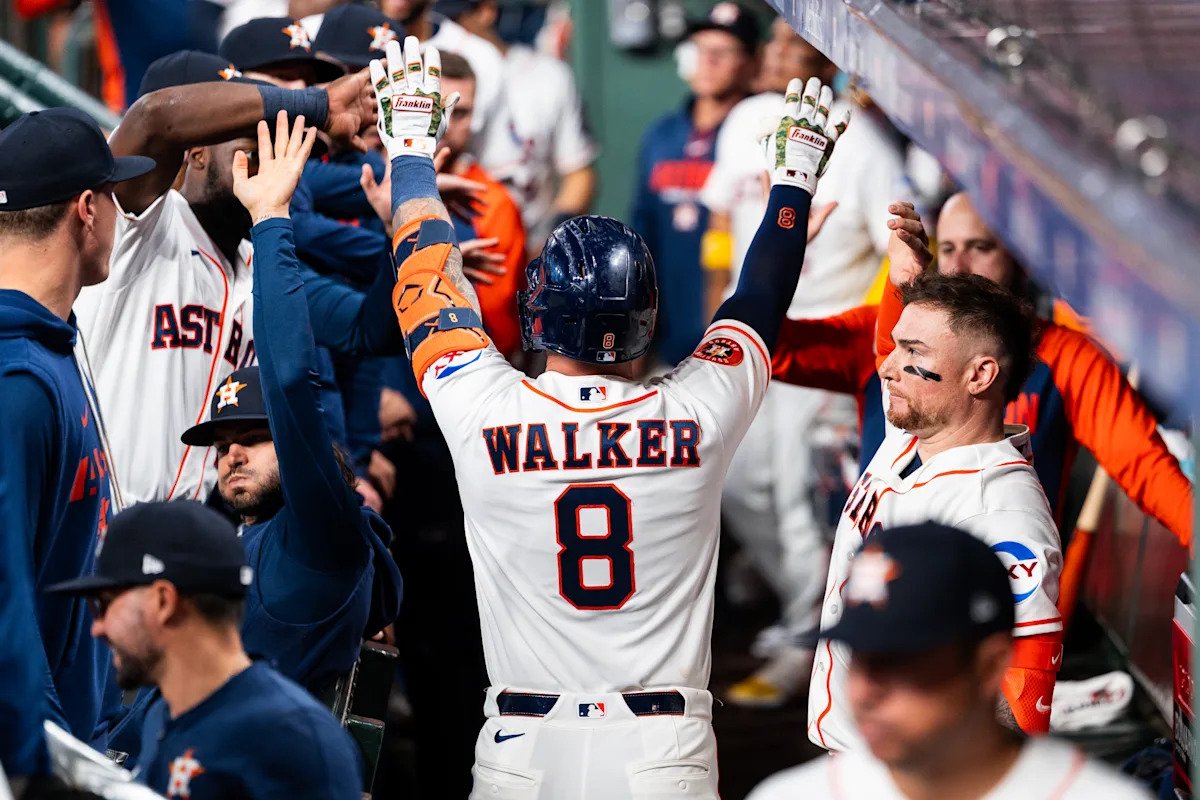
Coming into the season, Christian Walker was predicted to go in one of two directions. He could go the Jose Abreu route and completely fall apart or he could rebound and have a year typical of what he had done in the past. Of course, the basic numbers indicate the latter, but we should dig a little deeper and see how similar these numbers are to his other full seasons. We will look beyond the COVID year and see how similar Walker’s underlying numbers are to those Arizona seasons that influenced the Astros to make the signing in the first place.
Advertisement
Before we jump into the numbers, we should look at some of the numbers we will be including. Obviously, numbers like strikeout rate and walk rate are self-explanatory. We will also look at BABIP (batting average on balls in play), Historically, the league average for that number usually rests around .300, but we sometimes see some minor fluctuations there. We will also look at isolated power and secondary average. Isolated power is a part of secondary average and it usually rests somewhere between .150 and .175 on average. Secondary average mirrors batting average, so a .250 secondary average is usually around the league average.
|
SO% |
BB% |
BABIP |
ISO |
SEC |
|
|
2021 |
23.8 |
8.5 |
.307 |
.137 |
.232 |
|
2022 |
19.6 |
10.3 |
.248 |
.235 |
.353 |
|
2023 |
19.2 |
9.4 |
.272 |
.239 |
.364 |
|
2024 |
24,1 |
10.0 |
.287 |
.217 |
.332 |
|
2025 |
27.7 |
6.3 |
.291 |
.183 |
.253 |
|
2026 |
19.6 |
8.7 |
.271 |
.265 |
.362 |
So, at first blush it doesn’t appear as if 2026 is way better than anything he has done before, but it appears that 2025 was way worse than just about anything he had done before. 2021 would be the only comparison and his strikeout rate was lower and his walk rate was higher that season. His BABIP was also higher that season as well. So, it could easily be said that 2025 was the worst full season of Walker’s career.
When we are looking for real improvement we often look at the statcast numbers. Sometimes a player can be lucky one year and unlucky the next. What we are looking for are reasons for the improvement outside of luck. Obviously, the K rate is the first really positive indicator. He is also walking more often as well. Let’s look at the quality of contact between 2025 and 2026.
|
xBA |
xOBP |
xSLG |
xOPS |
|
|
2025 |
.233 |
.292 |
.435 |
.727 |
|
2026 |
.254 |
.327 |
.469 |
.796 |
What do these numbers mean? They mean what they usually mean. Walker was not as bad as he looked last season and he isn’t quite as good as he has looked so far this season. It is the implications of this that are more important for us to consider. Walker has one more year on his contract. He currently sits at 1.7 FWAR. That followed a 1.1 FWAR count last season for a grand total of 2.8 FWAR for the first year plus of his Astros tenure.
Advertisement
The Fangraphs standard for value is between eight and nine million per win. If we set it at the low end then we would expect Walker to produce five wins in his first two seasons to be worth the 40 million he will be owed over the course of those seasons. That means that he would need to earn 2.2 more FWAR between now and the end of the season to recoup the 40 million spent. Given his current pace that seems doable, but the Statcast above predicts some regression.
The elephant in the room
As many of you know, last week I called for a tear down and Walker was one of the names mentioned. Trading him will be easier said than done. He has a limited no trade clause that lists six teams he cannot be traded to. Who are the teams on that list? We are not sure. Those lists tend to be individual to the player. Sometimes they list teams that are perennially in the cellar. Sometimes they list organizations with players or coaches they don’t like. Sometimes they list cities they wouldn’t want to live in. It is impossible to know where his head is at here and how that would impact his market.
Yet, one cannot deny the desire to cash in on an asset while he is near the peak of what his value is. Walker is on pace to hit 40 home runs this season. He isn’t going to hit 40 home runs in all likelihood, but some rube somewhere in a GM’s chair might believe that he might. If that gamble comes with a good prospect then the prospect plus the financial savings is something to consider.
Advertisement
Of course, the Astros are also coming off of a three game sweep of the Cubs. They are currently 11-11 in May as the pitching has seemingly found some level outside the sewer. They could lean into the current uptick and hope that another rebound is possible. You obviously aren’t getting there without a productive Walker. They also could believe that a Walker is a key part of whatever run they could make in 2027. At any rate, Walker’s performance has been a positive this season and even if the Statcast results predict a regression, it would still be growth from last season. What do you think? Would you hold onto Walker if a team came calling with a good prospect?

