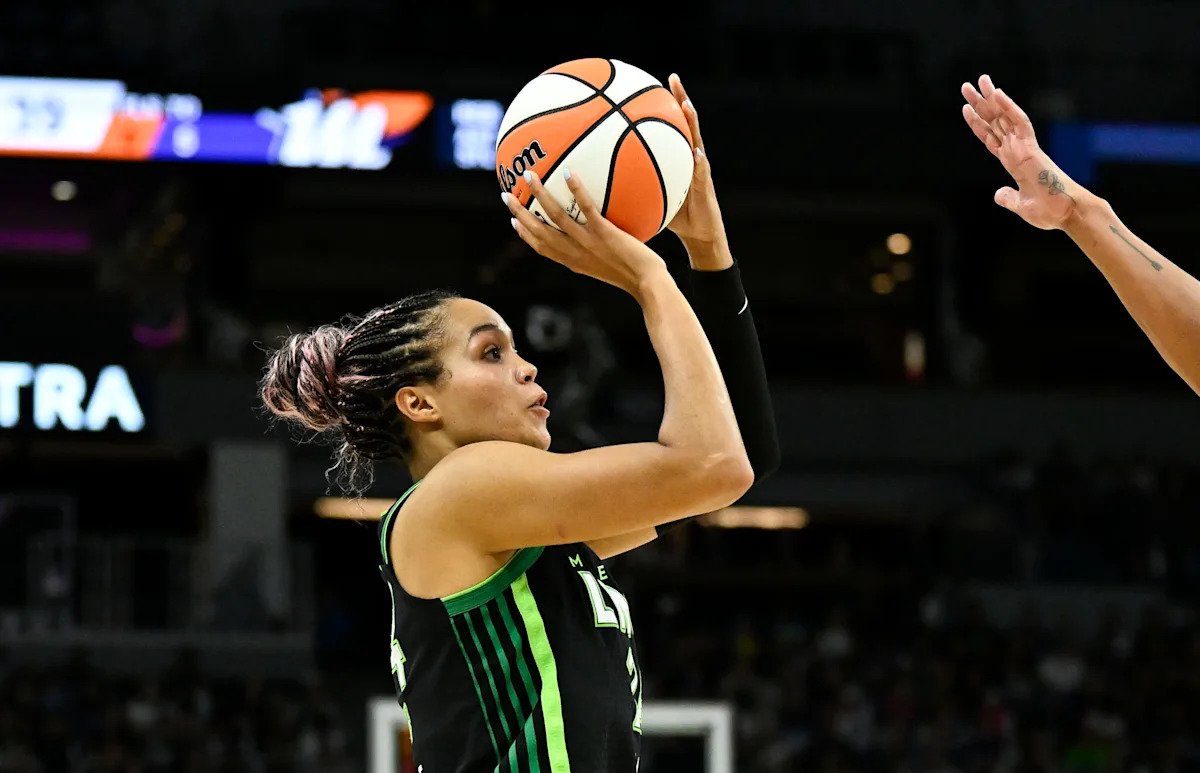
The WNBA finally has a new CBA, but there’s one loud question swirling around the news: Who got the better end of the deal?
On Wednesday, after more than 17 months of talks, the league and the Women’s National Basketball Players Association (WNBPA) agreed in principle to a new collective bargaining agreement. The moment marked a milestone for the league and its players. With the new agreement in place, it’s now an all-out sprint to a May 8 season tipoff.
Advertisement
Just a month before, as WNBA CBA negotiations were grinding along with little movement in either direction, WNBPA vice president Napheesa Collier boldly said eight words about how conversations would eventually end.
“Well, someone’s gonna have to fold, aren’t they?” Collier told USA TODAY exclusively.
Collier didn’t blink or flinch when she said those seemingly prophetic words. She smiled, confident and unwavering in her stance. It was eerily reminiscent of the same conviction the WNBPA vice president displayed five months prior, when she called out the league and WNBA commissioner Cathy Engelbert amidst CBA negotiations. Collier, fed up with what she felt was a lack of accountability by the league, said, “The league has made it clear it isn’t about innovation, it isn’t about collaboration, it’s about control and power.”


Collier’s case was made when, in February, the union became increasingly frustrated by the league’s lack of “urgency” in talks, given that NBA commissioner Adam Silver had recently weighed in about reaching the 11th hour of negotiations without as much movement as there needed to be for the season to start on time.
Advertisement
The players’ union and league had entered into a proverbial tug of war over revenue share. Throughout talks, the WNBA maintained its stance that it would offer more than 70% of league and team net revenue to players. The WNBPA wanted its share of gross revenue. Requests from the union’s side started as high as 40% in the early points of negotiations and eventually landed on 25% of gross revenue in the first year, increasing over the life of the agreement to an average of roughly 26%, just before March. Up until that point, the league was still dedicated to net revenue.
However, something seemed to change when negotiations hit the league’s own March 10 deadline, which it set for the season not to be impacted. As the deadline came and went, the talks dragged on, and nary a peep was leaked on revenue-sharing numbers. USA TODAY learned very few details about what was changing in the multiple proposals exchanged over the course of conversations, save for salary cap movement.
Then, on March 16, WNBPA outside council Deb Willig made a comment that was more revealing than most people likely realized. “This has been an extraordinarily unusual set of labor negotiations, and I’ve been doing this for over 50 years,” Willig said. “The why, frankly, is because the league underestimated, seriously, the resolve of the players and what they sought to achieve.”
A source with knowledge of the 2020 WNBA negotiations alluded to the same, saying that one of the biggest lessons from the 2026 CBA talks is that the league “underestimated” the players’ abilities to understand the negotiations. The source told USA TODAY the players are “sophisticated women who understand their value.”
Advertisement
In the early hours of March 18, with a delayed start to the season hovering in the air, the league and its players agreed to a deal in principle. Details of the agreement, including the number of years, have yet to be finalized. Neither the WNBA or players’ union has commented on specifics of the deal as of this publishing. However, among the details reported by ESPN was what Collier could hypothetically point to as “folding” by the league.
The new salary cap is expected to begin at $7 million, up from $1.5 million in 2025, and the average revenue share for the players would be nearly 20% of gross across the life of the agreement, up from 9.3% under the old deal. Regarding player salaries, according to the report, the supermax would be $1.4 million, average salaries $600,000 and the minimum above $300,000. When talks broke at nearly 3 a.m. ET on Wednesday, Collier’s colleagues on the union executive committee were thrilled.
“The deal is going to be transformational,” Stewart said told ESPN. “It’s going to build and help create a system where everybody is getting exactly what they deserve and more, from on the court and off the court aspects. Just excited that we can tell our fans that we’re going to be back.”
“We’re just really grateful to be able to come to a deal,” Ogwumike said to ESPN. “We’re proud of ourselves. And quite frankly, we always told you all we were going to stand on business, and that’s what this looks like.”
Advertisement
If the reported numbers in the new CBA are as expected, then the players not only largely received what they asked for, but backed up the comments Collier made to USA TODAY. However, it seems she believed in herself and her WNBPA teammates all along.
“We don’t think, obviously, what we’re asking for is unfair, otherwise we wouldn’t be asking for it,” Collier said.
“But we understand it’s a negotiation, and I think we are trending in the right direction. But, we have to be able to stand strong in what we believe in and make sure that we are getting a fair cut in this pie that we are building together as a league and as players.”
This article originally appeared on USA TODAY: In WNBA CBA talks, who got better deal? Napheesa Collier was dead on

