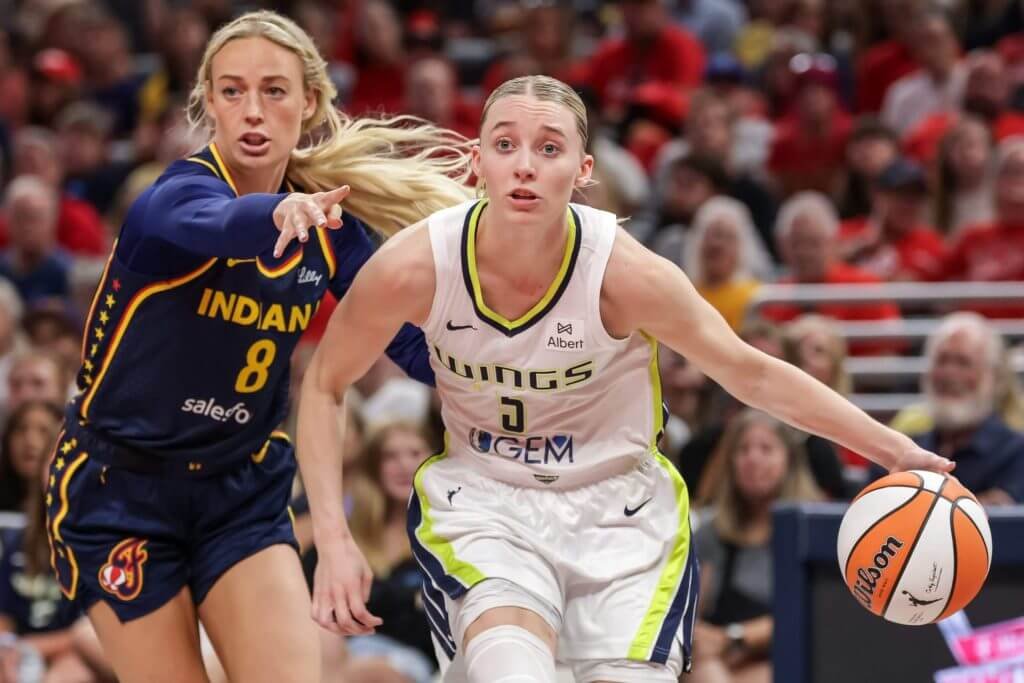
INDIANAPOLIS — Wednesday morning at the Indiana Fever media day, a reporter asked Aliyah Boston to share about her offseason. She did, succinctly and politely, while keeping a lid on the details.
She volunteered how she had gone home and trained five times a week. She touched on her time playing for the Unrivaled league, smiled to herself while briefly reminiscing about a trip to Barbados, and hastened to her conclusion that her break was all a “grind.” Two questions later, someone else inquired where those “home” workouts had taken place. A harmless follow-up, seemingly, but judging by Boston’s reaction, it was as though she had been asked to reveal her Social Security number and bank account PIN.
Advertisement
“Oooo,” Boston purred. “You in my business.”
The tone of her voice suggested exaggeration for comedic effect. Boston, a star in the WNBA, could’ve been kidding. After all, vibes run high during these softball sessions known as media days, as reporters across all sports willingly tee up the friendliest of queries. However, the roll of her eyes and deliberate glance away from that reporter suggested annoyance. Boston reflexively ducked as if this particular line of interrogation had sailed in high and tight.
Quick, someone call the Dallas Wings’ public relations staff. Because if the player with the richest total salary in league history objects to a question like that, then it’s going to be a long season.
Largely thanks to the arrival of transcendent stars Caitlin Clark and Angel Reese, and the expanse of eyeballs that followed them, a record 216 WNBA games will be broadcast this year. ESPN even created Women’s Sports Sundays in response to the league’s rising popularity. And so, the stars of today’s WNBA are brand ambassadors, podcast hosts, social media influencers, marathon collective bargaining negotiators and, freakin’ finally, well-compensated professional athletes. However, they must help themselves by embracing that the bigger the platform, the brighter the spotlight. More attention means more intrusion, and more zeroes on a paycheck give the haters more ammunition.
Advertisement
Fair or not, their private lives are for public consumption. This should be a hard yet accepted truth for professional athletes, from Anthony Edwards to Azzi Fudd and anyone who carries the responsibility of being a No. 1 pick in his or her league. As Fudd — or, truly, the Wings’ staffer who went viral last week — recently learned, there’s no such thing as an out-of-bounds question about your “personal” life when a team drafts you to share a backcourt with the person you publicly announced as your girlfriend.
Even so, when a Dallas reporter raised that question to Fudd during her introductory news conference, Curt Miller, the team’s general manager, gazed toward the staffer and set in motion that scripted and ill-advised interruption. Fudd sat there, silent and stone-faced. How ironic, considering Fudd had just joined a sisterhood known for speaking up on whatever it fancies.
They are outspoken and unafraid, these women. Because throughout their careers, they’ve had to fight against persistent foes — racism, homophobia and misogyny — and those even closer to home, like team owners and even their own commissioner. They’ve lived on the frontlines of player-involved protests more than any other professional league. In 2020, they campaigned to help oust Kelly Loeffler, the former Republican senator and co-owner of the Atlanta Dream. Then, last year, the All-Stars commandeered the conversation by taking their CBA battle to the court and wearing “Pay Us What You Owe Us” T-shirts.
Advertisement
However, that fight is over with the W moving into its money era. A player with at least three years in the league can make a minimum salary of $277,500, versus the $76,535 from only two seasons ago.
No longer can these women be cast merely as social justice warriors in shorts. So, as is the rite of passage for any professional possessing the bag, WNBA players can now be perceived as money-hungry. Sophie Cunningham knows that feeling.
Cunningham, who’s entering her eighth year in the league after coming off an MCL injury, re-signed with the Fever for a one-year deal that was reportedly worth $665,000. On her podcast, Cunningham and her co-host talked about the deal, and when asked whether it was better than she expected, in light of the new CBA, she answered honestly: “Nope.”
Cunningham’s response sparked easy clickbait for content creators across the internet. Though Cunningham has spent time clarifying her comments (she said she was addressing the short term of the deal, not complaining about the money), she’s convinced that the public needs more, not less, candor from athletes in her position.
Advertisement
“Of course, anyone can clip a little something, and then it can just blow up and not be what you meant at all,” Cunningham said Wednesday. “I think as much negativity as I got on that, so many people are like: ‘Hey, we love the authenticity. We love the honesty. We think that more players should speak like that.’”
This spotlight, as much as its beams might burn, isn’t going away. Boston, who was gracious and professional while facing a scrum of reporters, provided just a small example of a star player treating a benign question as an invasion of privacy. However, instead of viewing the added attention as a nuisance, players of the W should take every opportunity to become more entrenched in the mainstream and more fully known by paying customers. Such openness can work in their favor.
While this should be a profound moment in league history, in which the decades of building a foundation have shifted to maintaining and connecting with a larger audience, players must accept that their latest challenge isn’t a fight. It’s a step, albeit an uncomfortable one, toward the forefront.
Advertisement
This article originally appeared in The Athletic.
Indiana Fever, Dallas Wings, WNBA, Sports Business, Opinion, Culture, Indiana Fever
2026 The Athletic Media Company

