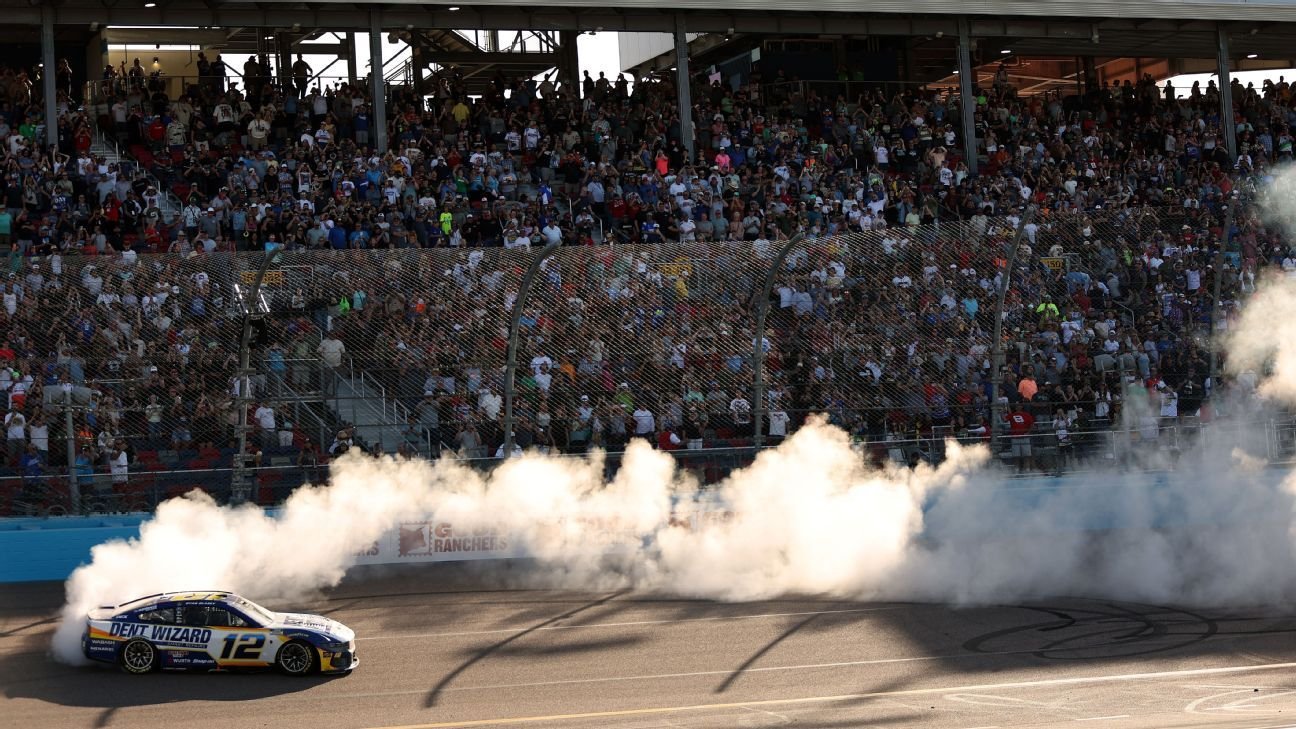
If one were looking for a recent example of the greatness in the motorsports empire Roger Penske has built, look no further than the NASCAR and IndyCar combination weekend at Phoenix Raceway.
NASCAR, the stock car series in American motorsports, and the IndyCar Series, the open-wheel series in American motorsports, are not familiar bedfellows. It’s been less than a dozen times throughout history that the two have shared the same property like they did earlier this month. If theirs was a Facebook relationship, it would be marked as “complicated.”
Penske, however, does not do complicated. He does things at the highest level, so perhaps it was fitting that on that Phoenix weekend, one of the most legendary team owners in American racing left no room for anyone else to enjoy the spoils of victory.
Team Penske swept the weekend. Josef Newgarden won the IndyCar Series race after teammate David Malukas won the pole. Joey Logano won the NASCAR Cup pole, and then teammate Ryan Blaney won the Cup race.
As the organization celebrates its 60th anniversary, that weekend will perhaps be the first and biggest highlight.
“I was fortunate enough to be a part of the 50th anniversary, and it’s just unbelievable to see what he’s done in motorsports for six decades,” Blaney told ESPN. “Not only on the NASCAR side, but obviously, IndyCar and sports car. It’s been neat to add a little to its history. It’s fun to be a part of it.”
Blaney, who has won 17 of his 18 races in a Penske Ford and claimed the 2023 championship for the team, is no different from any driver who dons a Team Penske firesuit — they want to win badly for the boss. As good as their individual success feels, there is no better feeling than knowing it contributes to the Penske legacy.
Logano finds it hard to give a quick answer for what it means to drive for Penske. It’s not hard to understand why, when it comes to the man who gave Logano his second chance in the Cup Series and turned him into a three-time champion. At 22 years old, in 2012, Logano was down on his luck, knowing he was losing his ride with Joe Gibbs Racing, when he was signed by Penske.
In the years since, Logano has won 35 races for Penske. To date, Penske has won 157 races in NASCAR Cup competition, and Logano is second on the team list for those race wins behind Rusty Wallace, who earned 37.
“It’s fun to see [Penske] still get excited about winning,” Logano told ESPN. “It’s been 60 years in motorsports, that’s crazy. The number of championships and race wins and all those things, eventually you could be like, ‘OK, cool. We won another one.’ It’s not like that for Roger. He still gets very excited, still very much a kid in a candy store when you’re able to win.”
Penske’s win on a shared IndyCar and NASCAR weekend is fitting for his story. IndyCar is likely what some associate him with most, or what he might be best known for, considering the dynasty he built. After all, it was open-wheel and sports cars where his motorsports story and success began, with NASCAR stock cars coming later.
Penske first entered NASCAR events in 1972 and did so through 1977. Mark Donohue and Bobby Allison won a combined five races for him in that period. After a brief break, the team reemerged in 1980 with Wallace for two races.
Then came a 10-year hiatus from the sport.
“We exited that and Formula 1 around the same time,” Walt Czarnecki, who has been an executive for Penske for more than 50 years, told ESPN. “Mark [Donohue] was fatally injured in the [1975] Austrian Grand Prix and we stayed in Formula 1 for one more year, but then decided to focus strictly on IndyCar. We were running all these programs out of a small shop in Reading, Penn.; we had a small shop over in the UK for Formula 1, and it made more sense just to focus on one enterprise, and that was IndyCar.”
It wasn’t until 1991 that Penske returned to NASCAR. Don Miller, another longtime Penske employee, and Wallace made it happen. And in bringing Miller Brewing Company on board, they formed what is now one of the most recognizable partnerships in the sport.
“I think we had 15 original people in a small shop in Mooresville, [N.C.], a 10,000-square-foot shop,” Czarnecki recalled. “And that was the beginning of it all. We had an association with Pontiac. Rusty and Don were able to secure that, and we got off to a flying start.”
Wallace put Penske on the NASCAR map. He won 35 races between 1991 and 2000 before the organization began expanding with additional cars and drivers. Ryan Newman, Jeremy Mayfield and Kurt Busch all drove and won for Penske.
By the time that Brad Keselowski came along in the late 2010s, Penske had won more than 50 races. It made them one of the top organizations in the sport — with one thing missing, however.
Keselowski delivered Penske his first Cup Series championship in 2012. It wouldn’t be until Logano came along and claimed the 2018 title that Penske returned to the top of the mountain. Over the past five years, though, Penske has solidified its status as a NASCAR dynasty by trading titles with Hendrick Motorsports (three to Hendrick’s two).
“To be put in the same category as Rick Hendrick and Hendrick Motorsports is something,” Czarnecki said. “The real change in our program came in 2010 or 2011. We, like most businesses at the time, had a manufacturing side and an engineering side, and the two sometimes didn’t communicate as well as we would have liked. So, we made a move by taking one of our engineers, Travis Geisler, to become the liaison between the engineering and manufacturing, and both sides knew what the other was talking about. Of course, the race team on the weekends had to execute the final product, but that change was very, very important.”
It is a tale that shows how Penske is a man who not only believes in hiring the right people, but in making sure they are put in the right places to succeed. There has also been little turnover over the years. Today, more than 40 members of Team Penske have been with the organization for more than 20 years.
The home base has grown, too, and plays a part in the team’s success. Penske acquired its current Mooresville, N.C. building in the summer of 2004 and was fully housed there by 2005. It didn’t stay a NASCAR home for long. The sports car program moved there from Pennsylvania by the end of 2005. The IndyCar Series operation was moved there in late 2006.
All of Team Penske’s brainpower under one roof. Such a collection of knowledge and talent has fueled a competitive nature, pushing each other — or, like in Phoenix, making sure they don’t fall victim to endless needling and bragging rights.
“No, I don’t think it’s surprising, just because that’s the type of human that he is,” Blaney said of Penske finding the same success in NASCAR as he has elsewhere. “He’s a very competitive person. He always talks about people; people make what you’re doing, and he’s always made it a huge point to have the right people around and make sure he appreciates all the people who have a part in everything. Not only his race teams, but also his business.
“It’s amazing, he can walk into any dealership or truck rental place, and he’ll know everyone’s names and how long they’ve been there. I don’t have that. I don’t have that type of gene in me. So, it’s neat to be around a person like that and learn from and try to mold yourself after, and I’ve been very lucky to have been with him for a long time. It’s a special guy to be around.”
“The Captain,” as he’s affectionately known by those closest to him, is in many ways the gold standard in American motorsports — regardless of whether the conversation is centered around stock cars, open-wheel racing or sports cars.

