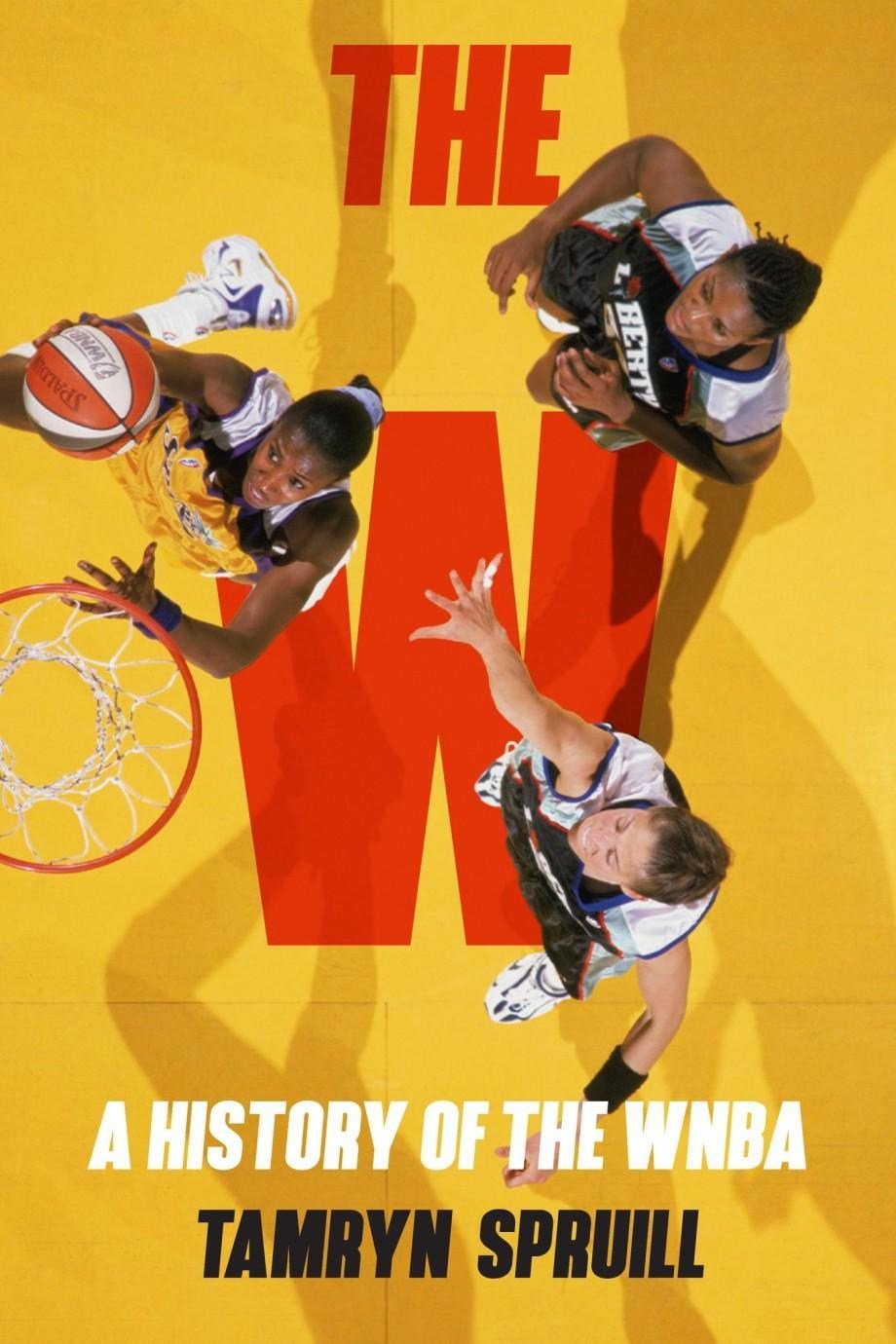
Swish Appeal is thrilled to celebrate the forthcoming book by former editor-in-chief Tamryn Spruill. The W: A History of the WNBA will be published on September 22, 2026.
And its already been identified by the New York Times as one of the most-anticipated nonfiction books of 2026. Congrats, Tamryn!
Before the book comes out, Tamryn took the time to catch up with Swish Appeal and provide insight into everything that went into this labor of love, from the challenges of the book writing process to the changes the book underwent along the way to how researching and writing about the history of the WNBA has influenced her understanding of what’s happening in the league today.
Tamryn, you served as the editor-in-chief of Swish Appeal for three years (possibly, three of the most uncertain and chaotic years in women’s basketball history, considering the COVID-19 pandemic, and all the sociopolitical reckonings it provoked, popped up in the middle of your tenure), stepped down in 2021 with the intent of completing your book, which was originally scheduled for a 2022 release, and now, here in 2026, that book is finally coming to fruition.
Can you explain where you’ve been, why the book has been delayed and anything else you’d like to share with curious Swish Appeal readers, from those who remember you and are thrilled to see your name again to those who might have become women’s basketball consumers since your depature?
It is surreal to be reemerging and reengaging after years with my nose to the grindstone. All the factors you mentioned contributed to the delay. Add in the work I was doing with Change.org in 2022: On March 5th of that year, the New York Times was first to report on Brittney Griner’s detention in Russia. After Angel McCoughtry informed us via social media that her “homie” had already spent weeks behind bars at that point, I started the Change.org/FreeBG petition, advocating for her release.
Advertisement
Two months later, in May, Dani, my partner, and I made an abrupt move into her childhood home to help her mother, Susan, with daily living. Susan had been battling an aggressive form of brain cancer that was quickly taking away her vision. Not long after that, someone visiting her brought COVID-19 into the home. We all got really sick, but Susan’s immune system was compromised from chemotherapy and radiation. Before COVID-19, she was counting down the days toward a promising clinical trial she’d been enrolled in; her participation had to be postponed, though, pending her recovery from COVID-19 and a host of secondary infections.
At the start of July, Dani and I became in-home hospice caregivers to Susan, who didn’t live to see August.
I dedicated the book to Susan, whom I called Susu. She badly wanted to read the book. Even on her worst days, she’d return from treatment and immediately ask: “Did you finish your chapter? Have you heard any news about BG? Did you get feedback from your editor?” She was just a fiercely supportive, caring, and generous person.
The book is also dedicated to Nikki McCray-Penson, who I didn’t know personally, but who believed in me as an author, and in this project enough to advocate for it in my book proposal, which helped me to get a book deal. Nikki lost her long battle with breast cancer a year after Susu’s passing—almost to the day.
Advertisement
I am incredibly proud that this book exists and is finally making its way into the world. That Nikki and Susu aren’t here to see it is definitely bittersweet.
And obstacles weren’t finished with us yet! In October of 2022, my editor announced that she was moving to a different publishing house. Another editor got up to speed with my project and I embarked upon a total rewrite—because the book itself is the biggest reason that it took four additional years for The W to be finished.
There is no way to quickly do a book of this magnitude. For starters, no other comprehensive history of the WNBA exists. This being the first book of its kind left us with the prevailing goal of getting it right: turning a 30-year history into a well-paced narrative, allowing space for the players’ voices to resonate throughout, examining complex sociopolitical and cultural issues, grounding the work in archival and scholarly research, and balancing weighty discussions with the exciting, inspiring history being made on the courts. Getting it right, to me, meant naming as many contributors to the league as I could: every first-round draft pick, every award-winner, every milestone-maker, every player picked in second and lower rounds that went on to make a big name for themselves in the WNBA. This was necessary for a league that had, for at least two decades, been starved of coverage.
Originally, your book was to be titled ‘COURT QUEENS: The WNBA’s Story of Power, Passion, and Perseverance On and Off the Court.’ It will now hit the shelves as ‘The W: A History of the WNBA.’ What explains the change?
Yeah, I’d been using that title publicly, and one variation, since late-2020, when the book deal was first announced. Titles are not copyrightable, though, and another author and publisher took the title and got their book to print before we did. After pouring everything into this book for six solid years, the pilfering of my title was naturally gutting. But what seemed like a major setback turned into a ripe opportunity.
Advertisement
I have to admit, knowing your priorities as editor-in-chief of Swish Appeal, the original title, especially the original subtitle, seems more reflective of your work. Was this a marketing decision, by you, the publisher and/or both parties in collaboration? Did the content of the book change over time, requiring a title change?
Thank you for recognizing the prior title as an extension of my editorial priorities at Swish Appeal. I am so proud of the work we did during that time, and the impact it had in growing the game. After learning that I’d need to replace the title, I took some time for introspection. I gardened, went on runs, hit the hiking trail, stepped away from my computer. I wanted to see what message I was meant to learn from all this and open myself to the possibility of a silver lining.
The opportunity to change the title, even though it wasn’t my choice, turned out to be a blessing in disguise. I picked the new title, The W, because it simply, but potently, reflects themes that run through the book. The W is a title more befitting of the league’s players, which I explain in the book’s early pages, in the author’s note.
Speaking of change over time, A LOT has changed in the WNBA since your book’s original publication target date in 2022. At the beginning of 2022, A’ja Wilson was a one-time MVP and the Las Vegas Aces had yet to win a championship. Breanna Stewart still played for the Seattle Storm. Sue Bird, Diana Taurasi, Sylvia Fowles, Candace Parker and Liz Cambage were still impactful players in the league. The Indiana Fever seemed fated to forever be a small-market and overlooked team.
In addition to the on-court changes, there’s the off-the-court acceleration of the league, where the rising interest in women’s basketball at the collegiate and professional levels has vaulted the WNBA from the outer fringes of the American sports cultural landscape to a spot much closer to the center. On top of all that, you had the knowledge that a new CBA (or lockout/strike) would be coming after the conclusion of the 2025 WNBA season. How did you navigate ALL that as you were writing the book?
The hardest part of incorporating the rapid developments of recent WNBA history was keeping up with them! I have my beautiful wife to thank for helping me do that—informing me of each new development, emailing articles to me like crazy. By the time a new publication date was given to me, September 22, it was just about continuing to tell the exhilarating story of the WNBA for as long as we could—before the publisher needed to start the presses!
Advertisement
The upside of the book taking longer than planned is that I got to add some of the WNBA’s most important history to it. So, all the setbacks and delays ultimately ended up being a major blessing for the book—for the mission of doing justice to the league’s history.
Take your pick among the quotations that capture the relationship between the past and present: ”History does not repeat itself, but it does rhyme,” attributed to Mark Twain; “So we beat on, boats against the current, borne back ceaselessly into the past,” F. Scott Fitzgerald; “The past is never dead. It’s not even past,” William Faulker.
As someone who has just completed a historical account of the WNBA at a moment where it seems that WNBA is constantly breaking new historical ground—the TV viewership records, the never-been-done-before statlines, the first-ever or youngest-ever or fastest-ever to do this or that, the contract valuations, the endorsement opportunities—do you think any of those quotations apply to the WNBA?
How much does the league’s past still influence the present? Do any present-day developments rhyme with historical happenings? Can the past experiences of the league provide an understanding of where the league and the sport might be going next?
It’s interesting that you present a quote about history. My introduction to The W includes one, from a poem by Maya Angelou: “History, despite its wrenching pain / Cannot be unlived, but if faced / With courage, need not be lived again.” These lines are from “On the Pulse of Morning,” and I like the way they acknowledge the harms of history and the inability to turn the clock back. But in the last line, Angelou leaves us with a powerful, implied call to action. History needs not repeat, she is telling us, if we muster the strength and energy to do the work. As this pertains to the WNBA, the 2020 CBA and season of social justice exemplify the players’ courage.
Advertisement
Some of the provisions that they won in the 2026 CBA acknowledge and seek to repair that which “cannot be unlived.” What comes to mind here is honorary payments to former players who, during their time on the court, never earned their worth. Now, the players and their union, the WNBPA, must ensure that the hardships of WNBA past “need not be lived again.”
That means maintaining an awareness of the US’s backlash problem: that progress is typically followed by attempts to roll back gains. The players will need to be vigilant defenders of their CBA wins, even as they pursue bigger ones. Anything taken for granted can be taken away: We need look no further than US democracy.
Finally, where are YOU going next? Is another book already in the works? Do you foresee yourself re-entering the women’s basketball space through other mediums? What else can we look forward to from Tamryn involving the WNBA and women’s basketball?
At the moment, I am working with the publicity team as they schedule events and promotions for The W. I am also really enjoying watching WNBA games—and NWSL matches and the FIFA Men’s World Cup, for that matter—without a laptop in my face! It’s a treat to be able to enjoy a game with a glass of red and my feet up. I don’t know what’s next for me in women’s basketball, but I am working on another book—the details of which I’m keeping under wraps for now.
Advertisement
Now, lets’ dive a bit deeper into the content of the book, giving Swish Appeal readers some insight into what they can expect to discover when they pick up their copy of ‘The W.’
So, as the WNBA celebrates 30 years, what do you consider the most significant development in the league’s history, and why?
Without a doubt, the greatest narrative-changer in the WNBA’s history was the rise of new technologies—social media, in particular.
For the first time, the players no longer needed to wait for a gatekeeper from the league, or an individual team, to promote them. They could begin building a fan base in college and carry it with them to the W. Skylar Diggins is an early example of a player who leveraged social media to build an enthusiastic fan base, which led to a deal with Roc Nation and enough in endorsement dollars that she didn’t need to play overseas in the WNBA offseason like so many of her contemporaries. There are complicated layers to this discussion, though, which I examine in the book—because not every player was able to do what Diggins did in 2013.
Advertisement
In addition to using social media to develop individual brands, players could for the first time voice their complaints to the world. They could show the world the previously hidden realities of their work lives, everything from disastrous commercial travel experiences to unsafe arenas. Social media also allowed journalists who’d grown tired of being passed over for prime jobs to take matters into their own hands. No longer would they wait for someone to hire them or accept a pitch; they’d create a platform, curate their own coverage, and build a following. All of those factors generated momentum.
For much of its history, the WNBA was defined by its precarity or instability. There was fear, or even expectation, that the league would not, or could not, survive. How did that sensibility shape the trajectory of the league?
My answer is twofold. First, the women in the WNBA’s early years were determined to defy the odds. All prior attempts at a professional women’s basketball league in the US had failed, and everyone from lay sports fans to national broadcasters spoke in terms of “if” or “whether” the WNBA can succeed. As competitors, it’s hard not to have that chip on one’s shoulder—that grit to take down naysayers.
But at the same time, the narratives around the league’s instability—often from the NBA and WNBA front offices—stymied the league’s development. With the word on the street perpetually being about red ink and struggle, often said without evidence showing the players’ union actual numbers, the players were stripped of any leverage to fight for improvements. They had to take what they could get and not complain too much, for fear that the little they had could be taken away. The dynamic of precarity for years kept the league stuck.
Advertisement
As someone who has been following the WNBA for all of its 30 years, did you come across anything in your research that you were unfamiliar with, had forgotten and/or were surprised by?
Well, I was stoked to see Deanna Nolan involved in this year’s All-Star events because she’s too often overlooked in discussions of the league’s former champions.
And outside of Houston and Louisiana, where Kim Perrot was from, I don’t think people know just how harrowing the 1999 season was for the Comets. To begin the playoffs just days after burying your starting point guard, and to go on to win a third-straight championship despite that heartbreak and grief? The Comets’s 1999 season is one of the most riveting stories of triumph over tragedy in sports history, but it hasn’t been treated as such in the cultural zeitgeist. As a 5-foot-5 sparkplug of a playmaker, Perrot helped the Comets win the first two WNBA championships after entering the WNBA as a 30-year-old rookie—undrafted, through a local tryout. Perrot’s bigger legacy, though, was how she lived her life in service to others, even during illness and amid a fight to stay alive.
Perrot’s impact in Houston wasn’t fully on my radar; at the time she was playing, I was living in the Southeast and going to Charlotte Sting games. In this era before the internet really took off, news didn’t exactly travel fast.
Advertisement
There was so much underreporting on the WNBA for so long that a lot of information may have been known in a local market but not nationally. In my research, and through copious interviews, I was able to gather so many details that really illustrated what people were coping with behind the scenes. Business decisions impact individual lives, and I am honored that so many amazing people were willing to share their experiences in their own words.
Can you be more specific about what those stories are?
I don’t think my publisher would want me to (laughs), but so much comes up in The W—from cold showers, slip-and-fall accidents, and blatant homophobia, to lawsuits, houselessness, substance abuse and suicide. There’s a pretty long list of celebrities who appear in the pages … for various reasons.
Relatedly, is there a development, event or individual that mostly had been “forgotten” by the women’s basketball community that deserves more credit for influencing the trajectory of the league?
We take streaming for granted now that it is everywhere, but it wasn’t so long ago that the WNBA started streaming games on Twitter, and that suggestion came from Jewell Loyd during Lisa Borders’s run as president of the league. Streaming has enabled so many more people to watch WNBA games and related programming.
Advertisement
I want people to remember that the idea came from a player, a former No. 1 pick, and multi-time champion.
Of the anecdotes included and/or interviews conducted for the book, which one was your favorite, and why? Additionally, was there an anecdote that did not make the final book that you’d like to share?
So much did not make the book! It was really hard, too, to let certain content go, such as some of my reporting on the broader cultural context surrounding the league at various points in its existence. As a research nerd and professor, I went really deep with some topics, that could seed a paper or another book!
I started a file called “Outtakes,” where I dumped all this cut material, which I may start publishing at thehardscreen.net.
Advertisement
You’ve been deep in the WNBA’s past. With that experience and the expertise you’ve gained from it, is there anything you’d like to share about the league’s present? These days, there’s always A LOT going on, both on and off the court. Your perspective on whatever has preoccupied you of late would be appreciated.
The “Sunset” season has been really sad to watch because the team has meant so much to communities, not just in Connecticut but all across New England. Girls’ basketball programs in various states had collaborations with the Sun that fostered the next generation of hoop stars.
The blasé attitude of the WNBA leadership in the handling of this decision reminds me of the old days, when teams were folding year after year or “unceremoniously mov[ing] cities,” as one reviewer of The W put it. Despite the success of the Sun in selling out TD Garden two years in a row, Cathy Engelbert was unwilling to support a sale to a Celtics minority owner, which would’ve kept the team in the region. Engelbert stated that fans in New England “won’t go away,” but some vocal fans online—now feeling used, disrespected, and taken for granted by the WNBA—have quipped: “Oh, really?”
The bigger area of concern, though, is the impact of national politics on the league, the backlash to social justice efforts that we see playing out every day, the sale of the Sun franchise to a Trump-supported ambassador (to Italy) just six years after the players campaigned for Kelly Loeffler’s rival in the Georgia senate race, caused her to lose her seat, and forced her out as owner of the Atlanta Dream. Loeffler is now working in the Trump Administration as the head of the Small Business Association. So, the backlash blues that Nina Simone sang about have always been real and we are living through one now. Sticking it to Boston certainly tracks with trends in national politics as well.

