SYDNEY — One of the Iranian soccer squad members granted asylum in Australia has changed her mind about seeking refuge, prompting the remaining six to be moved to another location.
The player had been granted a humanitarian visa on Tuesday night local time, along with a support worker, bringing the Iranian cohort seeking refuge in Australia to seven. But she changed her mind on Wednesday morning and contacted the Iranian embassy, Home Affairs Minister Tony Burke said.
“In Australia, people are able to change their mind, people are able to travel,” he told parliament. “We respect the context in which she has made that decision.”
The remaining six women who stayed in Australia had to be moved to a safer location, he said, because the player gave away their location when contacting the embassy.
“Unfortunately, in making that decision, she had been advised by her teammates and coach to contact the Iranian embassy and get collected,” he said.
Mr Burke earlier said government officials did not rush or pressure the women into making a decision on whether to accept a humanitarian visa following the team’s exit from the Women’s Asian Cup.
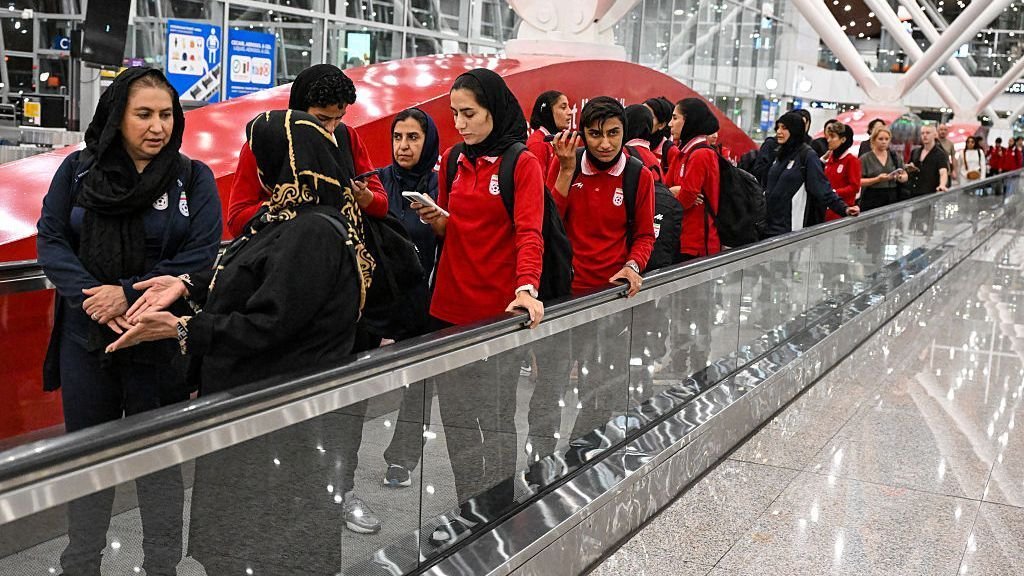
The rest of the team’s departure from Sydney, Australia, to return to Iran late Tuesday local time happened during fraught and outraged protest at the team’s hotel and at the airport. Iranian Australians sought to prevent the women from leaving the country, citing fears for the team’s safety on their return to Iran after they were labeled “wartime traitors” by Iranian state media for refusing to sing the national anthem before their opening match.
Their flight departed late Tuesday.
Burke said that as the women passed through security at Australia’s border, they were each taken aside individually by Australian officials and interpreters, without minders present, and were made offers of asylum.
“They were given a choice,” he said. “In that situation what we made sure of was that there was no rushing, there was no pressure.”
Some called their families in Iran to discuss the offer, Burke added, but no further members of the delegation decided to remain in Australia.
“Everything was about ensuring the dignity for those individuals to make a choice,” he said. “We couldn’t take away the pressure of the context for these individuals, of what might have been said to them beforehand, what pressures they might have felt there were on other family members.”
Those who have sought asylum received temporary humanitarian visas, which have a pathway to permanent residency in Australia, Burke said.
The team members previously confirmed to be staying in Australia were captain Zahra Ghanbari and players Fatemeh Pasandideh, Zahra Sarbali, Atefeh Ramezanizadeh and Mona Hamoudi.
Iranian refugee advocate Ara Rasuli, who was involved with the asylum process, said the Australian government had “opened every avenue for the girls to stay here and to be protected.”
The players who returned to Iran possibly faced execution, and their families faced retaliation from the regime, she said.
“They are in a lot of danger,” Ms. Rasuli said. “There are all sorts of different threats, such as taking the families into custody, taking over their assets … and that’s why most of the girls are choosing to go back home, because the threats are a big issue in this matter.”
The Iranian team arrived in Australia for the Women’s Asian Cup last month, before the Iran war began on Feb. 28. The team was knocked out of the tournament over the weekend and faced the prospect of returning to a country under bombardment.
It was not clear exactly how many people were in the delegation, but an official squad list named 26 players, plus coaching and other staff. Burke rejected suggestions that Australian officials should have done more to stop the women’s departure.
“Australia’s objective here was not to force people to make a particular decision,” he said. “We’re not that sort of nation.”
The minister said he had viewed widely-published footage that appeared to show a woman being led by the hand by her teammates from the team’s hotel on Queensland’s Gold Coast to their bus. Whether that constituted coercion was a matter for local Australian police, Burke said.
The Iranian team became popular figures in Australia during the tournament. Brisbane Roar, the premier football club in the city of Brisbane — the nearest major city to where the women were based — posted to social media Tuesday inviting the women remaining in Australian to train with their club.
The team’s fate drew international attention, including from U.S. President Donald Trump, who decried the Australian government Monday for not offering the women asylum. It emerged Tuesday that discussions between Australian officials and some of the women had already been unfolding privately and Trump later praised Australia’s Prime Minister Anthony Albanese after the two leaders discussed the matter by phone.
Iranian state TV on Tuesday said the country’s football federation had asked international soccer bodies to review what it called Trump’s “direct political interference in football,” warning such remarks could disrupt the 2026 World Cup.
Information from AAP and The Associated Press was used in this story.

