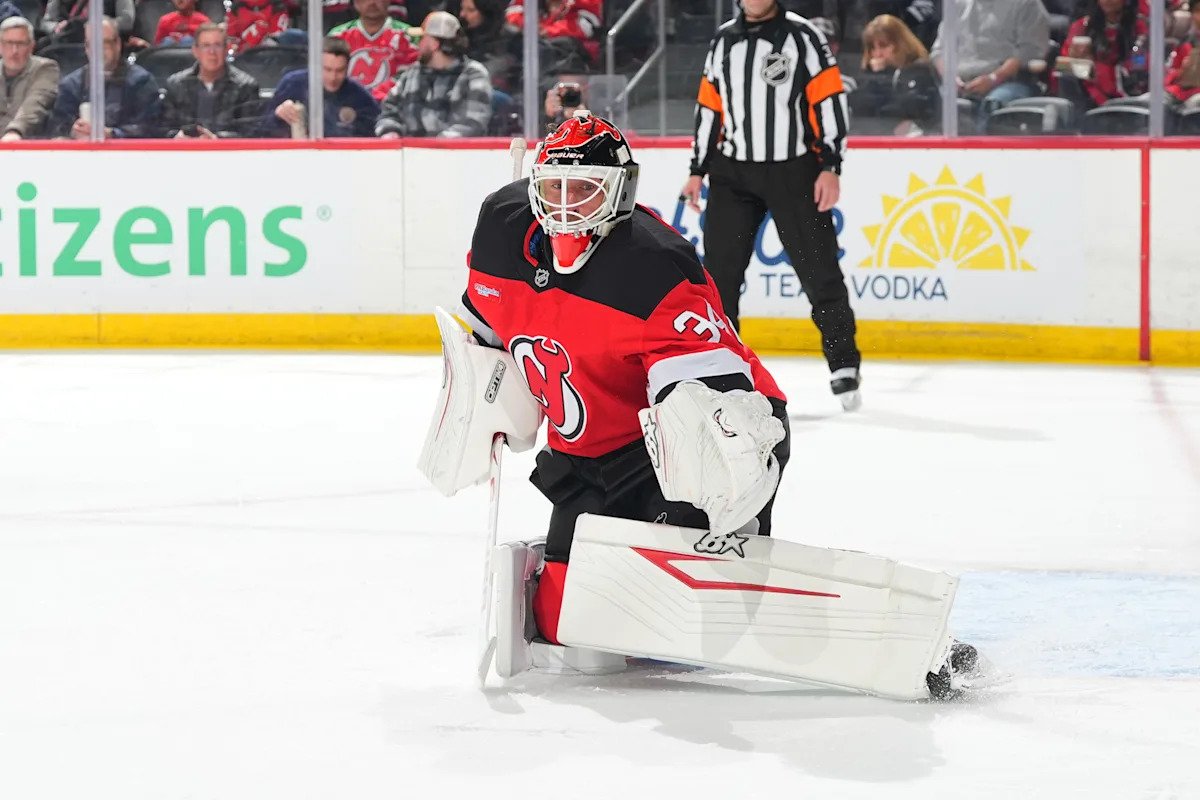
The goaltending for the New Jersey Devils has been an often touched upon issue this season. With Jacob Markstrom looking to be declining, and Jake Allen being used exclusively as a backup despite having better stats, the team has struggled to pick up wins with regularity. While the rest of the team is far from perfect, and there have been defensive lapses more times than any fan or pundit could probably count after 74 games, at some point your last line of defense needs to make a save. The Devils just aren’t getting those saves on most given nights.
But is it JUST the Devils having those issues?
Advertisement
Looking at NHL statistics from this season compared to previous ones has been an eye-opener. Jake Allen right now for example sits tied for 16th in the league in save percentage and his .906 is just .01 away from league leader Scott Wedgewood’s .916! Even last season when the top four tenders in the league all had percentages above .920, Jake’s .908 in 2024-25 was still good enough to be tied for 14th. Allen is still falling right in the “league average” in terms of this category, but the Devils are still faltering as a whole. Part of that is certainly on Markstrom, whose last two seasons have seen him rank tied for 29th (2024-25) and now tied for 49th in the entire league. 2024-25 was essentially backup numbers from him while this season is basically “not an NHL goalie anymore” numbers…and Tom Fitzgerald gave him a two year extension…
In viewing the league’s data as a whole though, it had me wondering if save percentage is still an effective way of determining if a goalie is any good or not. Wedgewood’s .916 this season is .01 worse than Anthony Stolarz’s league leading percentage from last season. The NHL also currently has only 10 goalies with save percentages at .910 or above. In seasons past, it was seemingly agreed upon that teams would want their starters shooting to have a .915 in order for their team to be successful. Now we live in an NHL where a .916 leads the league and has helped that player’s team to a league best 108 points at the time of writing. Go back even a couple seasons further, and it gives a better idea of how goalie numbers have continued to trend downward.
It’s not a secret that the NHL wants higher scoring games; more goals equals more excitement equals more happy fans unless the goals are being scored against the team they’re rooting for. The game has been trending in this direction for a bit and with more teams trying to be fast-paced, high scoring clubs, it leads to more situations where there’s an odd man rush, or a defender out of position. With fewer goalies posting “elite” numbers in the NHL now as well, you have to think that those players just aren’t making the saves that tenders of the past would. Maybe it is just a skills thing; after all, I’ve never seen a goaltender as big as Markstrom play as small as he does.
Maybe breaking down some more advanced stats would be a better way now to judge individual goalie performances. After all, if a team has two goalies with roughly similar stats, it’s hard to say if the problem lies with them or with the team in front of them. With the Devils and one goalie having quite a bit better of stats than the other, I think a conclusion can be drawn that one goalie just isn’t very good anymore. High danger chances versus medium danger versus low danger is also worth looking into, because if any goalie is letting in a lot of shots deemed medium or low danger, they’re probably not NHL caliber.
Advertisement
There’s more to this discussion than just one writer’s opinion, but I think it is worth at least questioning if we need to change how goaltender effectiveness and quality is determined. Save percentage used to be a quick, easy way to assess this. With league-wide numbers going down, however, maybe there needs to be a new way, or at the very least, a different percentage number that’s seen as a bar for the minimum required of a starting goalie. And maybe it needs to be the Devils who within their own organization set a number that their goalies need to strive to achieve. If not that, then at least a way of assessing ability so that a certain GM doesn’t give out another junk contract to visibly and statistically declining players.
What are your thoughts on save percentage being down around the league; do you think it winds up being just this season where the numbers are this low? Do you agree that this is just the way the game is trending? What save percentage number do you think starting goalies should be looking to achieve in today’s NHL? Are you more of the opinion that there are better metrics to measure this than save percentage nowadays? Leave any and all comments down below and thanks as always for reading!

