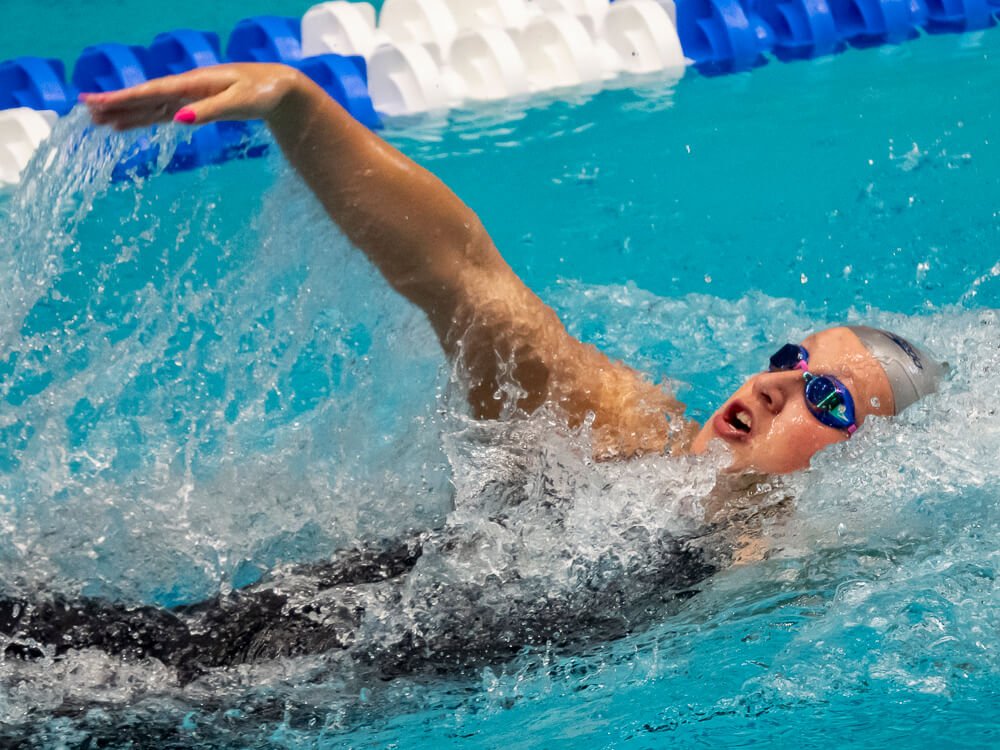
Isabelle Stadden Joins U.S. Women’s Backstroke Mix With Breakout Westmont Performance
For the last seven years, Isabelle Stadden has been nestled into the lower portion of the U.S. women’s backstroke hierarchy, good enough to make a Nationals final and earn top-three finishes at the NCAA Championships but little more. That’s hardly a knock on Stadden but rather a reflection of the American women’s supreme depth in the event. In this decade, Regan Smith, Claire Curzan and Katharine Berkoff have all won world titles in backstroke while Phoebe Bacon and Rhyan White have been medalists at the global meet.
All the sudden, Stadden might be setting herself up to join that most elite group thanks to a brilliant weekend of racing at the Westmont Pro Series. Competing against national foes for the first time since a relatively disappointing U.S. Nationals last year, where Stadden took fifth in the 50 back but missed the final in the 100 and 200-meter races, the 23-year-old smashed her lifetime bests and climbed the all-time rankings over all three backstroke distances.
In the 200 back on the first night of competition, Smith swam the fastest time in the world this year at 2:04.90 while Stadden finished only one second back in 2:05.91. That was her first time breaking 2:07, let alone 2:06, and she was faster than the time of 2:06.04 that Curzan swam for bronze at last year’s World Championships. Stadden is now the 13th-fastest swimmer in history, with only Smith, Missy Franklin, Bacon, Curzan and White having ever been quicker among Americans.
The 50 back a day later brought Stadden head-to-head with Berkoff, the reigning world champion. She came in only five hundredths back, 27.24 to 27.29. The result was 21st-best in history and once again, quicker than the bronze-medal time from Worlds.
The last two days of racing brought three rounds of the 100 back, where Stadden made quick work of her best time of 58.99, which had lasted for almost five years since the Olympic Trials for the Tokyo Games. Her times were 58.68 in prelims, 58.26 in the semifinals and 58.84 in the final, enough to take down Berkoff by almost three tenths. When the dust settled, Stadden found herself at No. 11 in history in the race, three hundredths outside the top-10, and the lone Americans to surpass her best time are Smith, Berkoff and Kathleen Baker. This one would not have been enough for a medal in Singapore, however, with Berkoff claiming bronze in 58.15.
Stadden achieved these results after moving her training base from Berkeley, Calif., where she represented the Golden Bears during her college days, to the group at the University of Virginia that includes elite backstrokers like Curzan and Gretchen Walsh. Her performances at this in-season competition instantly validated her decision while sending a scare into the many other women fighting for spots on U.S. teams in the backstroke races.
Of course, that group remains absolutely stacked. Between Smith, Berkoff and Curzan, the American women won the maximum six backstroke medals at last year’s Worlds, with only Australian legend Kaylee McKeown standing in their way. Rising stars like Leah Shackley and Charlotte Crush have positioned themselves for runs at major teams in the coming years. And the roster for this year’s Pan Pacific Championships is already set based on results from last summer.
But Stadden is now squarely in the mix, her career revitalized. Even if she is not racing for international medals this year, her competitors will be monitoring her times at competitions leading up to and including U.S. Nationals. If Stadden can continue to take steps and challenge the top times in the world, she will position herself for a long-awaited international breakthrough in 2027.

