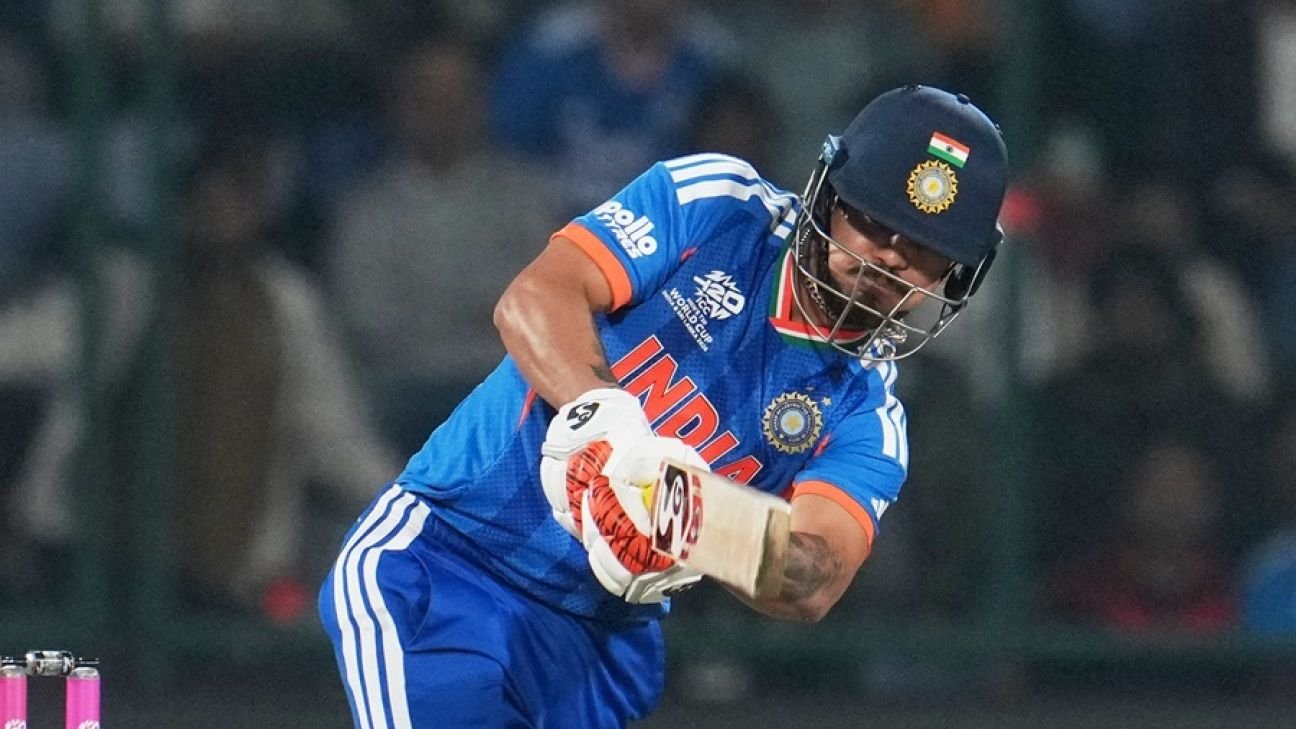
By the time Sanju Samson flicked half-heartedly into the hands of deep midwicket, having hit the previous three deliveries of the second over of the match, from Ben Shingoko, for consecutive sixes and a four, his opening partner Ishan Kishan had made just two off four balls. India were 25 for 1.
After finding themselves at 77 for 6 against USA in their opening match the 2026 T20 World Cup, India admitted that wildly swinging the bat at every ball was self-harming and they would need to revise the strategy and play the situation. Since his return to the Indian team, tough, Kishan has batted by his own rules: hit, hit, hit endlessly. It is a method that catapulted him from nowhere into starting as opener at this World Cup.
Against Namibia, he started quietly for the first few overs, but by the end of powerplay India were eyeing a total far north of 200 considering the depth in their batting. Despite the heavy roller in use over the last two days, the Delhi pitch had not flattened to the extent India desired. The very first ball Kishan faced from Namibia left-arm fast bowler Ruben Trumpelmann surprised him as the ball kicked off the surface and hit the shoulder of his bat.
But the moment JJ Smit was introduced midway into the powerplay, Kishan’s eyes lit up. Smith’s average speed range is in the late 70s mph (125-128kph), and was never going to be bother Kishan, who only last week was charging the extreme pace of Anrich Nortje and walloping him for boundaries for fun in a warm-up match. Though it was just a warm-up, Kishan’s intense hitting even overshadowed Abhishek Sharma, who has become the most fearsome top-order batter in the last two years. Against South Africa, India were 83 for 1 in the powerplay after Kishan retired and crossed the 100-mark in the eighth over, which allowed them to raise a commanding 240 total.
Kishan brought that same clarity, the same tempo and mindset to this batting to Delhi, where India were put into bat. While the final over of powerplay started with a dot ball, Kishan ransacked 28 runs off Smit including four consecutive sixes. India finished the powerplay 86 for 1, which is third-highest for India in T20Is in the first six-overs phase, with all three coming since the start of 2025.
The top-two Powerplay totals for India are: 95 for 1, against England in Mumbai last February; followed by 94 for 2 against New Zealand in Guwahati last month. These scores are part of an evolving trend in the two years after India won the 2024 T20 World Cup, as they have scored at a scary pace, crossing the 200-mark more than any other team and falling short by three runs of breaching the 300-run mark, 18 months ago in Hyderabad against Bangladesh.
When it comes to powerplay, since the 2025 Asia Cup last September, with a cut-off of five innings, Indian batters, in 16 innings, have scored the most runs (960) at the highest strike rate (162.93), and hit the most boundaries – 106 fours and 48 sixes. New Zealand, who come close in terms of innings played in the same period, have, in 15 innings, scored 826 runs at a strike rate of 149.33, hitting 93 fours and 37 sixes. Pakistan, who will play India in Colombo on Sunday, have scored 767 runs in 15 innings at a strike rate of 136.34 with 86 fours and 33 sixes. India are the only team whose collective batting strike rate is over 150 in powerplay in this period.
While record powerplay scores have become part of the zeitgeist in the IPL, which is played on flat pitches in the peak summer along with the cushion of an impact player, in marquee tournaments such as the World Cup, the variance in pitches, higher-quality international bowlers and the high stakes combine to mount pressure on the batters. In Delhi, immediately after Kishan got out the runs dried up drastically: in 30 balls, India lost three wickets, scoring just 20 runs. That India still ended with a 200-pus total was owing to Hardik Pandya bookending their innings with an impactful half-century. However, without that dominant powerplay, India would’ve more likely finished under the 200-mark.
Now, then, the powerplay is not just setting the tone but for the big hitters in the middle and lower order. Dominating the first six overs is also helping India to offset any collapse or slowing down in the middle overs or even at death, as was the case in Delhi where they lost four wickets and scored 25 runs in the final four overs.
In Abhishek and Kishan, India have two opening batters who can strike at over 200 consistently. And that gives them the liberty to go bonkers against any opposition. While the India middle order has batters with high-quality skillsets there are weak points, like Tilak Verma and Suryakumar Yadav against left-arm spin or Shivam Dube against the short delivery on a tacky pitch, Rinku Singh against spin. These are not glaring weakness, mind you, but areas that an opponent would have knowledge about. It becomes important then for the openers to get an above-par total in powerplay.
Kishan, whose 24-ball 61 included six fours and five sixes, agreed that attack was the default ploy in the powerplay, but not to every ball and bowler. “We all are in good touch and we are all looking to use the powerplay as much as we can and we are selecting the bowlers,” Kishan said after the win. “If you see in the first over, Trumpelmann, he bowled few balls pretty well. So we did not take charge because we knew later on once the ball stops swinging, maybe we can go for extra 10 runs in the over instead of scoring 15 we can go for 24 or something. So that was the plan.”
“Game by game, situations will be different. Today it was different. Tomorrow [sic] when we play against Pakistan it might be different. So we need to assess as soon as possible know about the wicket more, know about their bowling strength, who’s going to bowl when, and who we can take on. If it’s required for me to take single and give the strike to someone else, I’ll do that as well.
“It’s important to be aware of the game situation. One batter can always go for sixes at any point of time. But top three, one batter is supposed to bat for long and we have been doing it pretty consistently. It’s now just time for us being in a good headspace and being calm in the situation, even if the over did not go our way, we just try and look at the situation, look at the bowler, who we can charge and who we can just try and rotate strike on.”

