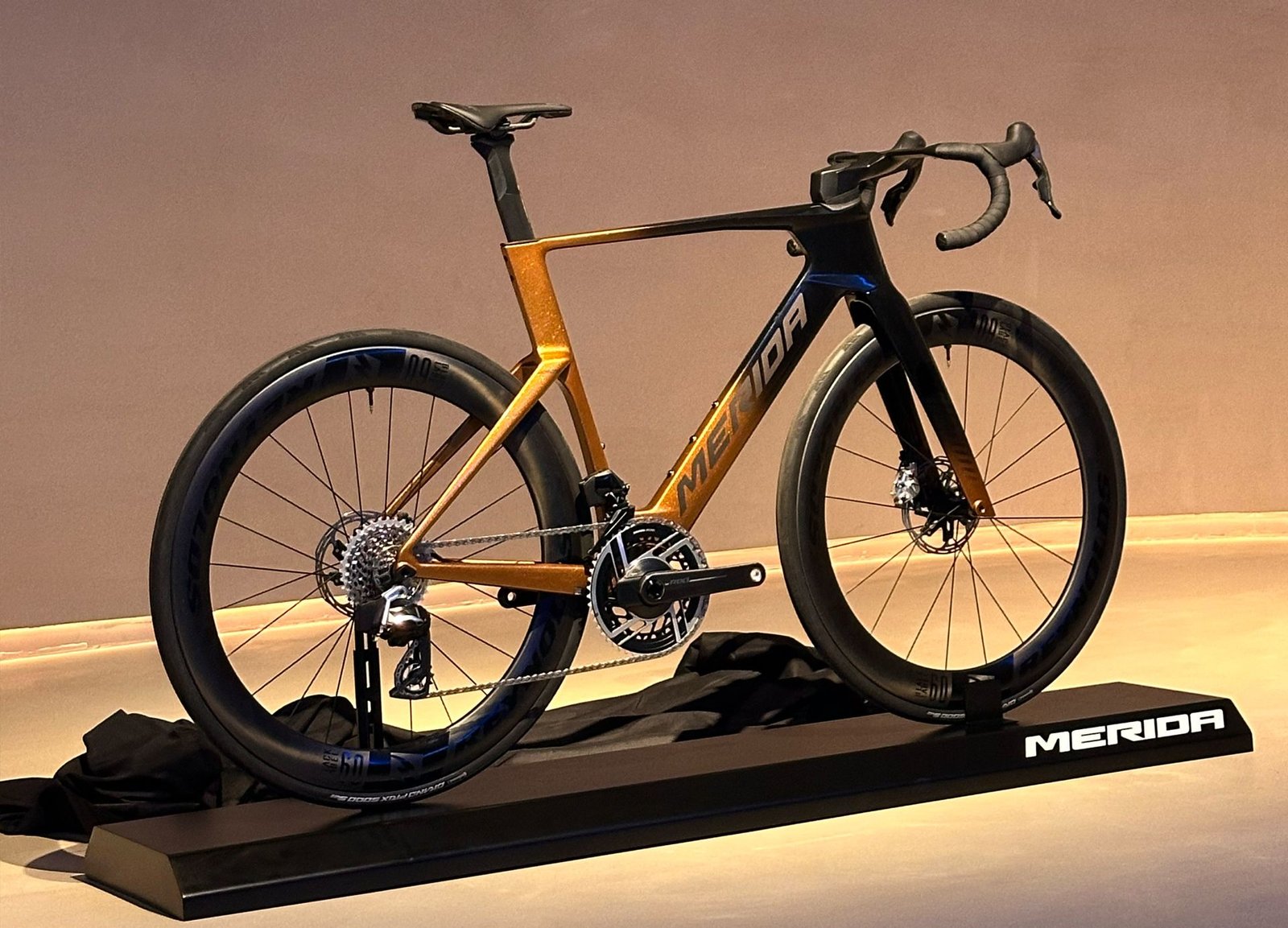
It’s been six years since Merida unveiled the fourth-generation Reacto, and despite mounting peer pressure to chop weight and make the platform even more aero than ever, it’s managed to stay relevant and competitive. Merida, however, was secretly working on a successor behind the scenes, and Bahrain Victorious rider Matej Mohoric even went as far as to test a new Reacto prototype in the open at last year’s Tour de France.
Merida and Bahrain Victorious, unfortunately, parted ways at the end of 2025 after a nine-year partnership, and now finds itself without a WorldTour team for 2026 – an unfortunate outcome given the work put into the new Reacto platform. The word on the street, however, suggests Merida will be back in the WorldTour in 2027 but that’s a story for another day…
Author Aaron Borrill took the Reacto up ridiculously steep 10km Puerto de El Bartolo climb that will feature in this year’s stage 6 of the Vuelta a España – look at that view
(Image credit: Aaron Borrill)
I’ve always been a fan of the Reacto and its all-round nature, having tested the outgoing model in various states of tune over the past six years. Even in top-spec trim, the Reacto has always represented value over its aero road bike rivals, coming in notably cheaper. While the outgoing bike wasn’t what I’d call a heifer (the Reacto Team-E version I tested in 2020, tipped the scales at 7.4kg in medium), one area that needed addressing when comparing it to the current crop of lightweight aero road bikes was the total system weight.
Back in 2019, I recall chatting with the late Director of Products and General Manager of Merida Bikes, Jürgen Falke, at the Bahrain McLaren team kit and equipment reveal at the McLaren Technology Centre in Woking. There, he told me an easy way for the team to reduce the weight of an aero bike (up to 300g) was to use tubular tyres. Fast forward to 2026, tubular tyres are all but gone, forcing Merida to look for other ways to reduce mass, such as refining the frame architecture and system hardware
While Merida has managed to bring the total system weight to segment parity, there’s more to the new Reacto than merely weight savings, and the company has carried out a full-scale redesign of the entire platform, focusing on aerodynamics and ergonomics. There’s also a wide range of builds to suit all requirements and budgets.

The Reacto 10K in size medium, tips the scales at 7.2kg
(Image credit: Aaron Borrill)
Design, aerodynamics and tyre clearance
While the new Reacto retains the design DNA of the outgoing model, closer inspection shows a modified silhouette, which Merida says will “distinguish it from its rivals and give it a more unique profile compared to the outgoing Reacto.” The biggest change comes from the omission of the “compensation triangle” at the top/seat tube junction; this has been smoothed off as the seatpost clamp has been relocated behind the seat tube. Merida also says the triangle provided no aero benefit.
There’s also a seat tube cutout that is more open and doesn’t run as close to the wheel as before. Merida made this change to reduce weight and says it has no significant impact on aerodynamics, citing just a 0.6W penalty. The new cutout also creates a unique facade that the Taiwanese brand reckons will help it stand out from its rivals.
Another notable change is the deeper headtube and chuniker fork, developed at yaw angles ranging from -10 to 10 degrees. Despite the swage line that runs into the upper fork, for the first time since the original Reacto, the fork doesn’t cut into the downtube. Those with an eagle eye will also notice the new Reacto wordmark, featuring a bolder look with more precise and hard lines – echoing the step up in the bike’s design.
Other changes include the new s-flex seatpost, which is now notably thinner and 100g lighter than before, thanks to the relocation of the Di2 battery to the bottom of the frame. The new seatpost is a defining feature of the bike and is responsible for much of the compliance at the rear; the top section of the post provides some flex in terms of vertical deflection under load. For now, it’s available in zero offset, with an offset option available later. Two seatpost lengths are available: 330- and 380mm. The bike still uses a press-fit bottom bracket.
Image 1 of 3


To test the bike’s aerodynamics, Merida worked closely with Reynolds Cycling, leveraging the American brand’s vast knowledge to help develop and benchmark the characteristics of the new tube shapes. Reynolds supported the development of Merida’s internal CFD modelling, which helped accelerate the project and development of the new bike.
The initial wind-tunnel testing was carried out using a modular bike rig with interchangeable tube sections to identify the optimal shape combinations and verify the CFD results. Multiple iterations were trialled, including several one-piece handlebar setups and a proprietary aero bottle assembly that is claimed to save 3.4W over a standard round bottle. The new cage system plays nicely with both Merida’s aero bottle and regular round designs.
All these tweas have resulted in a bike that is roughlyb5% faster than its predecessor.

Dropped seatstay design remains. New Reacto wordmark logo takes pride of place just below the flange
(Image credit: Aaron Borrill)
During the testing phase, riders did blind testing on steep climbs and fast downhills to sample the balance and flex in different layups. While Merida could have gone with a 50g lighter frame in CF5 trim, the company decided to absorb the 50g weight penalty for better ride feel in dynamic situations, owing to its predictability and accurate cornering.
According to Merida, the outgoing Reacto used at last year’s Paris-Roubaix and Flanders was outfitted with 35mm tyres. Clearance, however, was super tight and subsequently wrecked a few frames, so introducing wider tolerances was a focus for the new platform. Like most manufacturers, Merida has taken a conservative approach to quoting maximum tyre clearance here. Clearances on the new bike have been boosted from 30mm to 32mm (with 5mm clearance on each side), meaning it should safely accommodate rubber as wide as 35mm.
All these changes have had little effect on the geometry, which remains largely the same as before. As such, a size medium still has a stack and reach value of 557 and 395mm, and a parallel head and seat tube angle of 73.5 degrees. Even the head tube and fork length remain as is. The only discernible changes pertain to the wheelbase (up marginally on most sizes) and chainstays, which have grown 2mm to 410mm across all sizes.

New Team CW 1P cockpit weighs roughly 320g
(Image credit: Aaron Borrill)
New cockpit
The new Reacto was designed around a fully integrated handlebar configuration, dubbed the Team CW 1P cockpit. Developed together with Vision, it adopts a unique gullwing shape with ergonomic touchpoints for improved comfort across multiple hand positions. It’s available in progressive sizes and flare, ranging from super-narrow widths to UCI-compliant sizing.
According to Merida, the cockpit played a massive role in the new bike’s overall aerodynamics, accounting for 50 per cent of the aero improvement. Constructed from lightweight carbon fibre, it weighs roughly 320g (length and width dependent), boasting high vertical and lateral stiffness that, from my own testing, over some 300km at the launch event, helps transmit feedback and feel in spades.
The Team CW 1P cockpit is available on selected CF5-frame models but can be retrofitted to all Reacto models.

The deeper head tube follows the modern aero road bike design blueprint
(Image credit: Aaron Borrill)
The goal of reaching the 6.8kg UCI limit
The goal for the new Reacto was to get the weight as close to the UCI limit of 6.8kg as possible, and depending on the build and spec, the company reckons it has achieved it. At the launch event, we were shown a size small Merida Reacto Team fitted with 45mm Vision wheels, Continental GP5000 TT tyres, and 160/140mm rotors, and it weighed 6.75kg on the scale without pedals. In medium trim, the weight is said to jump by 30g to 7.05kg. Sure, not many WorldTour professionals will ride it in this specification, but looking at bikes such as Tadej Pogacar’s stripped-back Colnago Y1Rs from stage 13 of last year’s Tour de France mountain time trial, the new Reacto can easily meet the UCI weight limit.
Merida has optimised the frameset in two versions: CF5 and CF3; the latter allows for a more affordable option. Both carbon-fibre grades share the same geometry and aero properties, with the lightest complete build, the Reacto Team, weighing a claimed 7.1kg. The entry-level 4000 weighs 2kg more, at 9.1kg, but utilises less fancy equipment.
The total weight savings of the frame, fork and hardware over the outgoing model come to 108.3g (1,724.5g vs 1,616.2g) in CF5 guise.

The new bike climbs as well as any modern aero bike…
(Image credit: Merida)
Merida Reacto 10K – First ride impressions
There was plenty of time to ride the new Reacto at the global press camp in Spain. With incredible mountain roads and weather, I used the four days to spend as much time on the bike as possible – covering over 300km and 5,000m of climbing. As a result of the comprehensive time spent in the saddle, I’ll be publishing my full review rather than first ride impression next week on Cycling Weekly, but to give readers an idea of how it performs, I’ll share some of my impressions below.
As an aero bike, the new Reacto does what it says on the tin – it’s rapid and accelerates with ease. Having recently revisited the outgoing Reacto platform, the difference in urgency is chalk and cheese. The new bike is super refined, delivering a relatively smooth ride quality even with inner tubes and 28mm tyres fitted. The riding position is long and low, and aggressive, so you’ll need to experiment with what works for you, but this is a race bike after all, and there are certain compromises that come with the territory. Despite the racy angles and position, I found it fairly comfortable for an aero road bike.
The new Team CW 1P gullwing cockpit is lovely. It’s as aggressive as it is ergonomic and allows for a super-aero position depending on the width – my Reacto 10K was specced in a full SRAM Red AXS groupset with UCI-illegal 360mm handlebar, something I found amusing given Merida’s absence from the WorldTour for 2026, but the handlebar is also available in UCI legal widths, too. The narrow bar felt a bit twitchy at first, delivering very fast steering that’s only noticeable when climbing out of the saddle with gusto.

…regardless of whether you’re in or out of the saddle
(Image credit: Merida)
Even during seated manoeuvres, the bike climbs with ease – and dare I say, could potentially nullify the need for a dedicated climbing bike. At 7.2kg for a medium in 10K spec, I couldn’t find fault with its climbing abilities. I even pedalled it up the ridiculously steep 10km Puerto de El Bartolo climb that will feature in this year’s stage 6 of the Vuelta a España (more on how it fared on the 28 per cent pitches can be read in my detailed review next week).
For me, the biggest improvements to Reacto have come in the way it descends. While the geometry is largely unchanged from the outgoing model, the slammed front end, slightly longer wheelbase and chainstays make it very predictable and stable, instilling huge trust in cornering situations. Grip is abundant, and this ensures the Reacto corners like it’s on rails. Even descending on the opposite side of the road to what I’m used to, I felt in control and never out of my depth.
While the roads were notably smooth and a lot different from what we’d experience here in the UK, I did sample the bike across some choppier sections of tarmac where the ride quality was notably firmer and abrasive, but this could have stemmed from the 28mm tyres with tubes. Wider tyres and lower pressures will solve this, but it’s worth noting that, as far as aero road bikes go, the Reacto feels like it could have one of the best ride qualities in the category.

The Reacto 4000 is the value proposition in the range coming in at an impressive £2,400/€2,800
(Image credit: Aaron Borrill)
Range pricing overview
The Reacto has always represented the value option among the best aero road bikes, and Merida wanted to ensure the new platform stayed true to its ethos of affordable performance. While pricing has inched up over its forebear, the range is notably cheaper than its rivals when comparing specifications.
The range is available in 10 builds and is spearheaded by three premium offerings – the Reacto One, Team and 10K – which differ in weight and rider intent. First up is the 7.4kg Reacto One, which will set you back £10,000 / €11,500. It’s a full-on aero build, so weight is not its focus, but it features a 1x Rotor drivetrain, a Classified rear hub assembly, and 65mm DT Swiss ARC 1100 DiCut wheels wrapped in Continental Aero 111/GP5000S TR tyres.
At £9,500 / €11,000, the 7.1kg Team is the lightest build in the range, outfitted with Shimano Dura-Ace Di2, Vision Metron 60 RS i23 wheels, and Continental GP5000S TR tyres.
Coming in at the same price point as the Team is the 10K, which offers the most balanced build in the range. It’s built around a SRAM Red AXS groupset and Reynolds BL 60 Pro wheels, boasting a total system weight of 7.2kg in size medium.

(Image credit: Aaron Borrill)
The Reacto Pro comes in at an impressive £7,500 / €8,750 price point. It gets the same CF5 frame grade and Shimano Dura-Ace Di2 groupset as the Team but ditches Vision wheels for DT Swiss ARC 1600 Spine hoops.
The Reacto 9000 (£6,250 / €7,250) and 8000 (£5,000 / €5,750)differ in carbon grade, with the latter ditching CF5 for CF3. Both bikes are built around a Shimano Ultegra Di2 groupset and 60mm Reynolds wheels that differ somewhat in specification and weight, with the 9000 weighing 7.8kg and the 8000 coming in at 8kg.
Further down the range is the Reacto 7000, complete with SRAM Rival AXS build kit and Vision SC 60 i23 wheels. Weighing 8.4kg, it will set you back £4,750/€5,500.
Shimano 105 Di2 builds are available on the £3,800/€4,400 Reacto 6000 and £3,000/€3,500 Reacto 5000 models. System weight jumps considerably to 8.5kg for the 6000 with Vision SC 60 i23 wheels and 9kg for the 5000 with super-shallow Vision Team 35 wheels.
Of all the models, the Reacto 4000 is the rough diamond in the range, coming in at an impressive £2,400/€2,800. It’s the only model in the range with a mechanical groupset, in this case Shimano 105, and it weighs 9.1kg. The shallow, heavy Merida Expert SL wheels can easily be upgraded to 60mm carbon hoops, unlocking the bike’s full potential.

