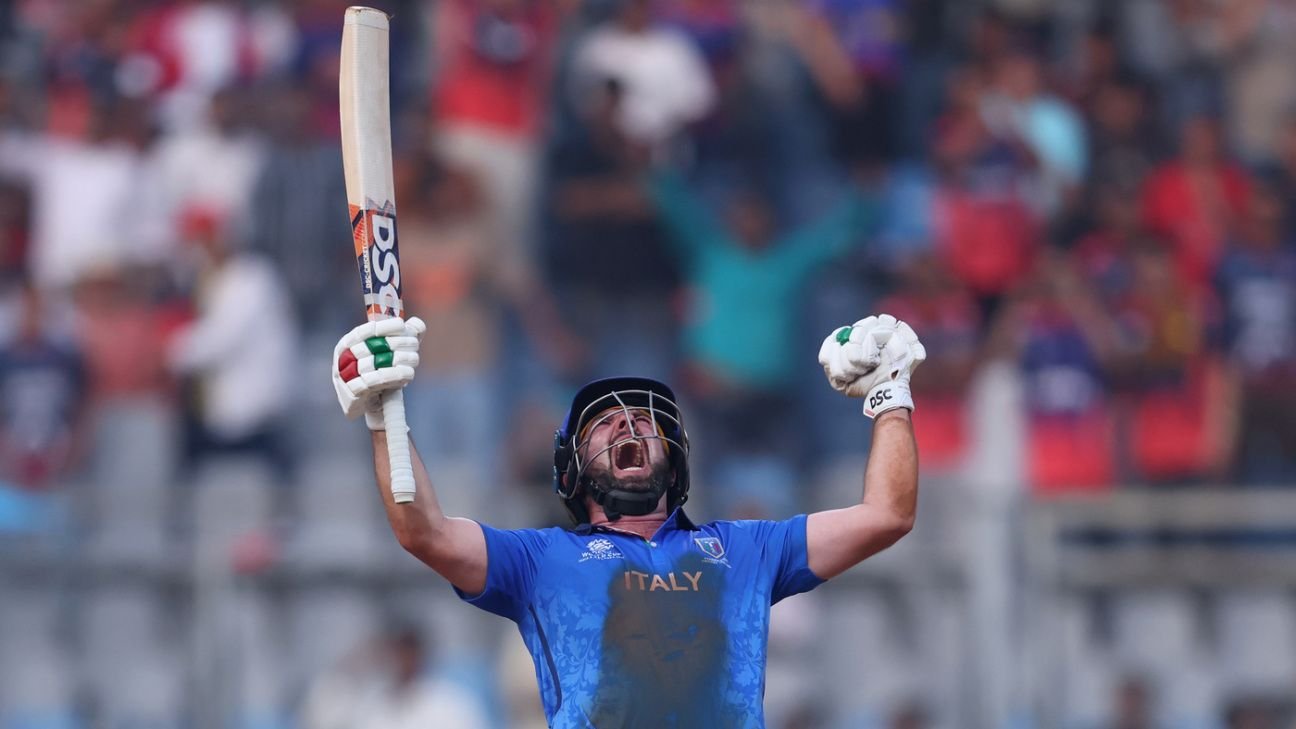
“Un momento storico per l’Italia” (a historic moment for Italy).
When Italy scored their winning runs to seal their first win at a T20 World Cup, silence engulfed the Wankhede Stadium. Not that it was entirely unexpected. Not because it was supposed to be a dot and came off a misfield. But the manner of the win and the authority of it stunned thousands of Nepal fans who had packed the ground in blue and red. At the heart of that hush were the Mosca brothers. They had not merely won Italy the game, they had done so in a way that left a massive crowd shellshocked.
Justin Mosca and Anthony Mosca flung their arms up, running towards each other and locking into an embrace. Team-mates ran in from the dugout to join the celebration. One planted a kiss on Anthony’s head. Anthony, his jersey smeared with dirt from an earlier dive, kissed the Italy logo on it and then turned to shake hands with Nepal’s glum-faced players.
The brothers had just torn through a target of 124 in under 13 overs all by themselves. In a game that looked like it took place in Kathmandu, not at the Wankhede Stadium in Mumbai.
As they walked back towards the pavilion, Anthony draped his arm around his younger brother, and gently nudged him ahead. It was a snapshot of what this Italy side has come to represent. This was not merely a lower-ranked team toppling a higher-ranked opponent. It was also a meeting of two distinct cricketing identities – Nepal, powered largely by homegrown talent, and Italy, shaped by multicultural threads.
“The fact that we’ve got two sets of brothers brings the group together,” stand-in captain Harry Manenti said after the win. “We are willing to bring a group of people who do come from across the world, to bring them in, and welcome them. They enjoy spending time with us, and I think that’s a pretty special thing to be able to bring a group of people from all over the world and have a real connection.
“All 15 of us could be in Italy, we could be in India, we could be anywhere in the world and we know where we come from. We have strong connections to Italy. We’ll continue to drive that through the competition.
“Every team is the same, they’ve got an element to it. We’ve got brothers in our side, and I’d say that we’ve got 15 of them.”
The Manenti brothers and the Mosca brothers, all born and raised in Australia, have Italian heritage, as do team-mates Grant Stewart, Thomas Draca and Marcus Campopiano. JJ Smuts qualified for his passport through marriage, while the likes of Crishan Kalugamage and Jaspreet Singh emigrated from the subcontinent at a young age and built their cricketing journeys in Italy. Harry’s principle is simple: anyone who commits is made to “feel Italian”. It is a multicultural dressing room but they all have a shared identity and a single goal: to grow the game in Italy.
Kalugamage – Italy’s first Player of the Match at the T20 World Cup – addressed those watching back home in Italian, urging them to take up the sport so that one day they might stand where he stood. Earlier in the day, he had been instrumental in dismantling Nepal – who had entered the contest as favourites – for a modest total.
From the first over, Italy made their intentions clear. Without their regular captain Wayne Madsen, leadership duties fell on Harry, whose opening move was bold but calculated: he handed the ball to offspinner Ben Manenti, his brother. Having studied the surface the previous evening during the England vs West Indies game, he sensed assistance for spin and chose not to wait. And that turned out to be a successful move: a turning point in this win.
If that was what it took to earn space in Italy’s sports pages, why not? Football may dominate the landscape, but could cricket dare to dream, perhaps even edge past the Winter Olympics, at least for a day?
“This [the win] will be front page news in a lot of countries and a lot of publications in Italy I would imagine…I’m hoping,” Italy coach John Davison said after the match.
“For us to get that sort of exposure and maybe knock off the Winter Olympics off to the back page of the sport would be unbelievable for cricket in the country and just bring some attention to it.”
On the eve of the game, Madsen had spoken of embracing the anticipated wave of Nepal support rather than shrinking from it. That support was evident long before the toss. Fans lined up at Marine Drive outside the Wankhede Stadium, chanting “Jai Nepal”, flags aloft, filling almost every visible space by the end of the first innings. Italian shirts were scattered, sparsely enough to count.
So when Ben Manenti conceded just one run in the opening over, an odd silence settled over a near-full house. Kushal Bhurtel’s boundary in the second over brought the noise roaring back, only for him to slice the very next ball straight into Anthony’s hands, which hushed the crowd again.
The match unfolded in that rhythm: cheers and silences. Rohit Paudel’s massive sixes sparked the former. Kalugamage’s dismissal of him summoned the latter. There were shots that seemed destined for the boundary. But when they were cut off by sharp fielding from Italy, the applause came to an immediate halt.
Even moments of artistry – Kalugamage’s back-of-the-hand googly that drifted in and clipped Dipendra Singh Airee’s off stump – were met with stunned stillness. But it barely seemed to bother Italy or Kalugamage, who celebrated it in the style of his favourite footballer, Lautaro Martinez, just as he had said he would ahead of this game.
So, it was little surprise that silence returned when Italy completed their historic win. In tribute to the handful of their supporters, which was mostly family and friends, Italy players gathered and walked towards the Sachin Tendulkar Stand, waving and bowing to them in unison.
The brotherhood, for this side, extends beyond the boundary rope. They enjoy each other’s company off the field and make it a point to sit together for dinner every night. There are no doubts they will celebrate this win for a long time, but Harry has an idea of how he expects it to go – no doubt the Italian way.
“It’ll probably start in the changing rooms and on the bus ride home,” he said. “I remember when our first original qualifiers in Rome, we finished the tournament at the top, we had a long drive home where we sat there, and we drank Peronis, we had a good laugh and we sang some songs.
“That’ll probably stay the same. We might just be in the hotel tonight and spend some time with each other and really try and soak up what we just did, because it can easily get past you, and you don’t realise quite what we’ve just done in the game.”
And perhaps that is what made the silence at the end feel so profound, on a night when the Azzurri blue shone through the sea of Nepal’s red and blue. “Un momento storico,” as Kalugamage put it after the match, indeed.

