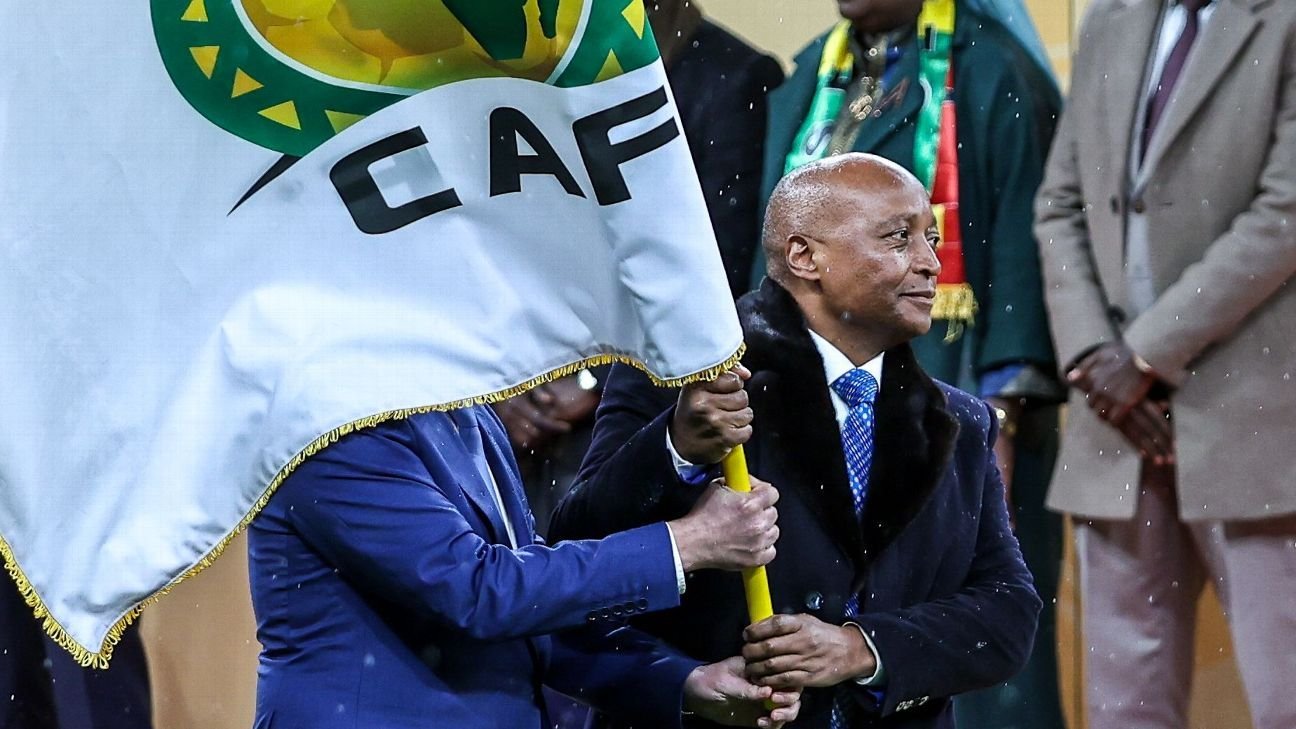
On Thursday, the Confederation of African Football confirmed the rumours that the 2026 Women’s Africa Cup of Nations would not take place in Morocco as planned on March 17.
Instead it had been pushed further down the calendar, exiled to the latter half of the year, taking place after the men’s FIFA World Cup in late July.
The announcement answered the most pressing question about the competition: Will it be played in March? Answer: Nope.
That’s particularly relevant to the players and coaches currently in pre-tournament camps, not to mention supporters, media, officials, sponsors, broadcasters and other stakeholders — although it left many others unanswered.
Not for the first time, as a CAF proclamation extinguished one fire, it ignited a dozen others.
WAFCON 2026: What’s been confirmed?
Instead of taking place between March 17 and April 3, the tournament has now been moved back by over four months, and will be played between July 25 and August 16, like a train shunted into a more distant siding while more important traffic comes down the tracks.
This is a year and a month after last year’s tournament, which was played in a northern summer slot, and kicks off only six days after the men’s World Cup is set to conclude.
This puts the players and coaches who had been training and preparing for the tournament out of their misery, less than two weeks before the event was meant to begin, and also — for now at least — assuages concerns that the competition will be cancelled altogether.
At least a slot has been found, and the teams have a date to prepare for, while the reprogramming also eases fears that qualification for next year’s World Cup in Brazil will be compromised, with the tournament doubling up as CAF’s route to that tournament for the four semifinalists.
In this era of African football, where certainty is rarely found easily, these small measures count.
What’s still uncertain?
CAF’s three-paragraph statement — sparse and cautious — may have sketched out the changed scheduling for the event, but much of the canvas remains blank.
While the confederation announced a change of date, they neither confirmed nor denied that Morocco would still be hosting the event… which must raise serious doubts about where the 16 teams will be gathering four and a half months from now.
On one hand, Morocco remains the favourite. The kingdom have the glistening facilities, they have the infrastructure, the burgeoning local passion, the administrative machinery and it would be one less late reshuffle on CAF’s books.
If the plan was to move the tournament away from Morocco, then South Africa — still clearly waiting in the wings — could have been awarded hosting rights in early February when Peace Mabe, Member of the South African Assembly, announced that her country was stepping in to take responsibility for the competition.
CAF did not act then — by replacing Morocco with South Africa and maintaining the original March-April scheduling — and we still don’t know why.
So Morocco are the favourites, but ZA can’t be ruled out, particularly after Minister of Sports, Arts & Culture Gayton McKenzie’s fighting talk on Wednesday.
“If Morocco is ready to host the WAFCON because they had a brilliant AFCON, they should do so,” McKenzie said at a press conference, “but if they are not ready, we want to tell them we are not a country with no stadiums or infrastructure. We will never be held hostage by countries that have less than what we have.
“I’m not scared to say it,” he added. “If Morocco is not going to host it, South Africa is standing ready, but [Dr Patrice Motsepe] didn’t say this, so don’t attribute it to him.”
Still to be cleared up, as well, is why and how exactly we got to this situation.
CAF’s statement referenced “unforeseen circumstances” but offered no further illumination, declining to publicly assign responsibility, while Morocco have pointed to a congested domestic and international calendar.
Superficially, the explanation is plausible. Their stadiums face heavy demand following the rearrangement of the 2025 calendar, squeezed between the Club World Cup, Arab Cup, Africa Cup of Nations, and a series of international friendlies scheduled across the kingdom in March.
The result, according to officials, is a logistical bottleneck; too many teams, too few days, too many pitches already spoken for.
Does the story stand up to scrutiny?
As CAF stated in Thursday’s statement, the tournament was awarded to Morocco in October 2024, they’ve had plenty of time to flag scheduling concerns and raise any objections before the clock ticked down to these final weeks.
Why were these logistical issues not flagged earlier, when the Botola fixture backlog has been visible for months?
Why have Morocco agreed to allow reportedly almost a dozen men’s national teams to train and/or play on their territory later this month, a generous act of hospitality which has ultimately (inadvertently?) come at the expense of the WAFCON?
Even if Morocco only signalled their difficulties as late as February, was there still not enough time to move the tournament to South Africa and preserve the original dates?
The arithmetic feels incomplete, and here, suspicion can be seen creeping into the vacuum left by silence. Some could be forgiven for quietly wondering whether the tensions of the men’s AFCON, and the punishments meted out to Senegal, perhaps not as harsh as Morocco might have expected for the Teranga Lions’ heist, have coloured their relationship with CAF.
If any such speculation were to be unfounded, CAF have done little to extinguish it, although it doesn’t change the sense that the Atlas Lionesses can be perceived as collateral damage in a murky administrative drama.
What’s the fallout?
Across Africa and beyond, national teams had already assembled for their pre-tournament preparations. Training camps buzzed with enthusiasm, even poor Ghana, who find themselves training amidst missile strikes in the United Arab Emirates.
Now, those camps must be dissolved; players will be released back to their clubs and coaches must pack away their tactical plans for another day.
Federations may well be counting the cost of organising camps for a March tournament that will no longer be taking place.
Even before Thursday’s announcement, frustration had begun to simmer across the African football community, ire focused at delayed communication, prolonged silence, broken vows.
“If someone [from CAF] is listening, can they just give us a ‘yes’ or a ‘no’ [about whether the competition will take place in March],” an exasperated South Africa head coach Desiree Ellis appealed earlier this week.
“Some players haven’t even flown to their countries because of the uncertainty, and it’s not really fair.
“I’ll raise one question,” she added. “Would this happen in the men’s game?”
Since Thursday’s announcement, the criticism has sharpened.
“It’s actually embarrassing at this point,” Nigeria and Roma forward Rinsola Babajide wrote on her X handle after the statement, while here sentiment was echoed by Super Falcons captain Rasheedat Ajibade.
“African women[‘s] football deserves better,” the Paris Saint-Germain forward posted on her social media handles later in the day.
African women football deserves better. 😡#CAF #WAFCON2026
— Rasheedat Ajibade OON, OLY (@Rasheedat08) March 5, 2026
Expect more to follow, and while everyone involved in and backing the women’s game will hope that there are no more changes to the script, it’s clear that damage has been done.
How can people believe CAF and their repeated pledged commitment to the women’s game after this debacle? Motsepe had identified the women’s game as one of the key focuses of his administration’s reshaping of the continent’s favourite sport, but here, actions have spoken far louder than words.
Communication has faltered, leadership has felt distant, and Motsepe’s repeated insistence that African football must be “as good as the best in the world” become harder to reconcile with the evidence.
Ellis asked whether such chaos would befall the men’s AFCON, and another pertinent contrast could be drawn with the Women’s Euros. Ahead of the last WAFCON, there were tentative questions about whether the tournament was beginning to rival the Euros… those comparisons appear painfully optimistic now.
Beyond the immediate disruption likes a broader concern; how much damage has this saga inflicted on the WAFCON?
With African football still recovering from the violent scenes that overshadowed January’s AFCON final, another controversy risks eroding confidence among sponsors, broadcasters and investors.
If the continent’s own governing body cannot prioritise the women’s game enough to avoid leaving the teams, players, coaches feeling let down and humiliated, why should external stakeholders care? Why should they invest?
The new calendar presents fresh challenges; staging the WAFCON immediately after the World Cup and alongside the Commonwealth Games risks pushing the tournament into the shadows of the global sporting calendar, further reducing its commercial value.
It’s not doomed, the talent and the storylines are there for the tournament to build on the successes of recent editions, but increasingly, it feels as though any success would come not because of the clarity and organisation of the game’s custodians, but in spite of them.

