Jacob Misiorowski has vaulted himself into the Cy Young conversation by allowing one run in five May starts combined. He leads the league in strikeouts, strikeouts per nine, and hits per nine. He’s also throwing harder than literally any starter we’ve ever seen. (Probably.)
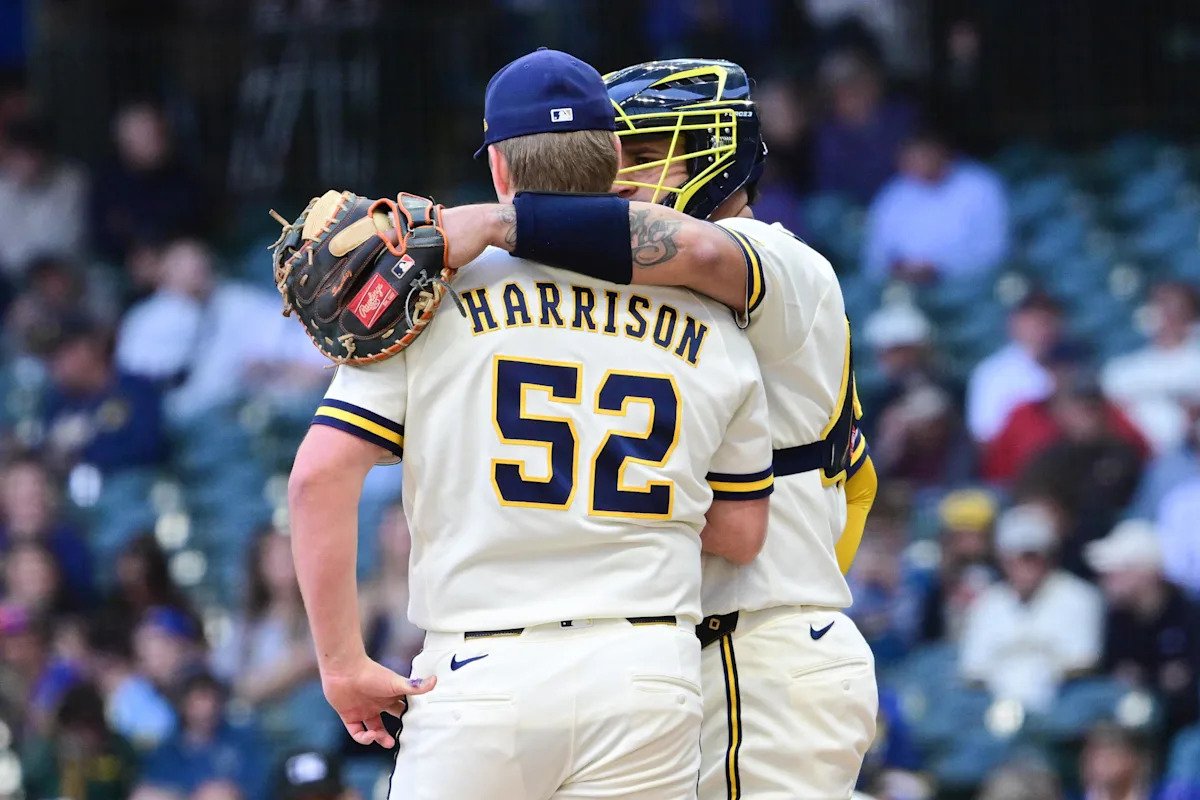
And yet, despite Misiorowski’s unhittable stuff and 1.83 ERA (220 ERA+)*, his teammate, Kyle Harrison, actually has a lower ERA. After six scoreless innings against the Cardinals on Tuesday, Harrison’s ERA dropped to 1.57 (256 ERA+). While Harrison’s peripheral numbers aren’t quite at Misiorowski’s level, they’re still good, and the results are obviously there.
Advertisement
* A quick reminder on ERA+: it’s a way of measuring ERA while accounting for the league environment of the time, with 100 as average, 110 as ten percent above average, 90 as 10 percent below average, etc.
Misiorowski and Harrison are both really good. There are plenty of pieces out there breaking down why. My purpose here today isn’t to analyze their play as much as it is to do what I love doing: look back at history.
I do not expect Misiorowski and Harrison to maintain ERA+ numbers of 220 or higher for the entire season. To say that would be unprecedented would be an understatement: in full-length AL/NL seasons since 1900, only 16 qualified starters total have had an ERA+ of 220 or higher. Still, I was curious about historic pitching partnerships. What are the best single-season teammate pitching duos in baseball history? Who might we say Misiorowski and Harrison are “chasing?”
To create my long list of candidates, I looked for “qualified” starters who finished in the top five in the league in ERA+ and also had a teammate in the top 10. (Right now, Misiorowski ranks fourth in the league; Harrison, who is a couple innings short of qualifying, would be third.) I came up with a little formula—nothing fancy, but a way of ranking these duos to see who came out on top. (I assigned points based on average ERA+, average bWAR, and ERA+ rank in the given season.) I was pleased with the results, and I’m going to share the top seven-ish duos here, then add a couple others that stood out.
Advertisement
The 2010s were a weird time for the Astros. They’d tanked as hard as anyone has ever tanked in the first half of the decade—three consecutive seasons with at least 106 losses between 2011 and 2013—but that tank job actually bore fruit, and by 2015 they were back in the playoffs. They won the World Series in 2017, which also started a more-or-less unprecedented run of seven straight years in which they made it to at least the ALCS. They were back in the World Series in 2019, a series which they lost in seven games to the Nationals… and then shortly after the season, news of the sign-stealing scandal that benefitted them in the 2017 and 2018 seasons rocked the baseball world.
Amidst it all, the 2019 Astros had one of the best rotations of all time. Cole and Verlander finished first and second in all of baseball with a 185 and 179 ERA+, respectively. In bWAR, Verlander was third and Cole fifth, while in fWAR, Cole was first and Verlander fifth. Verlander just edged Cole in Cy Young voting; he got 17 of 30 first-place votes, and Cole got the other 13. They won a combined 41 games and struck out a combined 626 batters, and neither had a WHIP over 0.895.
If that wasn’t enough, Zack Greinke was on that team, too. He finished ninth in the league with a 154 ERA+.
Advertisement
Neither Cole nor Verlander was great in the World Series, though. Cole went 1-1 with a 3.86 ERA, but Verlander really struggled: he went 0-2 with a 5.73 ERA in two starts and had nine strikeouts to six walks in 11 innings.
6. Dolf Luque and Eppa Rixey, 1923 Reds
I promise I won’t get super deep into old dudes you’ve never heard of, but I’m just spitting out what the formula gave me.
This is an unbalanced duo: Luque had an all-time good season, while Rixey was run-of-the-mill good. But it was a down year for pitchers, so even though there’s a 62-point split between them in ERA+ (Luque at 201, Rixey at 139), Rixey still finished third in the league, so that’s kind of weighing heavily on this rating.
Advertisement
Luque was just mowing everyone down. In one of the major outlier seasons in baseball history, he went 27-8 with a 1.93 ERA (201 ERA+) and led the majors in both bWAR and fWAR, wins, ERA, ERA+, and shutouts, and led the NL in FIP, hits per nine, and homers per nine. He had one other good season in 1925 (though not nearly on this level), and several others I’d call “solid,” but he was really only a superstar in 1923. The Reds were good at 91-63, but finished second to the Giants in the NL.
Rixey made the Hall of Fame in 1963. He’s what I’d call a “dubious selection,” but he won 266 games in a 21-year career, and that didn’t include a peak season lost to World War I.
5. Hal Newhouser and Dizzy Trout, 1946 (and sort of 1944) Tigers
I swear this is true: I ranked 127 different duos with my formula, and the 1944 and 1946 seasons of Newhouser and Trout came out right next to each other, at 5th and 4th, respectively. I’m going to essentially ignore the 1944 season; most of the league’s stars were in the military, but Newhouser was deemed unfit due to a congenital heart defect. He was probably the best player left in the league during the time, and won back-to-back MVPs in 1944 and 1945. Detroit won the World Series in ‘45.
Advertisement
Luckily for Newhouser’s Hall of Fame case, he was just as good in 1946, when the stars returned. In 1946, Newhouser went 26-9 with an AL-leading 1.94 ERA (190 ERA+) and 8.5 K/9, an astronomical number for the era. He earned 9.7 bWAR, and led the AL in FIP, WHIP, and H/9. Only Ted Williams’ brilliant return season kept Newhouser from winning a third straight MVP.
Trout also didn’t fight in the war. He was just as good as Newhouser in 1944 but not nearly as good in 1945. In 1946, Trout went 17-13 with a 2.34 ERA (157 ERA+) and 7.6 bWAR, an excellent season, but really his only year that I’d call “good” that occurred outside of the war years.
Detroit finished second in the AL in 1946, 12 games back of Williams’ 104-50 Red Sox.
4. Mordecai “Three-Finger” Brown and Orval Overall, 1909 Cubs
I’m happy to talk about this one just because Orval Overall is one of the great baseball names.
Advertisement
The Cubs had a dynasty in the second half of the 19-aughts. They won three consecutive pennants from 1906-08, and the World Series in ’07 and ‘08. This is the “Tinkers-Evers-Chance” team, and while a casual glance suggests they just had a ton of really good pitchers, it seems more likely that they had a historically good defense that was particularly well-suited to the baseball of the time. To illustrate the point: the 1907 Cubs had five of the top seven players in all of baseball in ERA+. That seems to me to be far more a reflection of their defensive prowess than the talent of guys like Overall, Carl Lundgren, Jack Pfiester, and Ed Reulbach.
Still, we need to acknowledge the numbers these guys put up, and the season that grades out best is 1909. Mordecai “Three-Finger” Brown, so called because of a farming accident in his youth, is one of the great Deadball pitchers and a solid Hall of Famer. He peaked from 1906-1909; in ’09, he led the majors in innings pitched and wins (27) and had a 1.31 ERA (193 ERA+). Overall was almost as good that year, and went 20-11 with a 1.42 ERA (179 ERA+) and led the majors with 205 strikeouts and 6.5 K/9. He was a very solid pitcher from 1907-09 but was essentially out of the league after the 1910 season despite being only 29 years old.
But the 1909 Cubs, though they went 104-49, failed to win the pennant for the first time in four years. The winners that year are among the best teams of all time: the 1909 Pirates, led by the great Honus Wagner, went 110-42 (.724, the third-best winning percentage ever).
A brief historical curiosity: the team that actually had the two starters with the best combined ERA+ in the history of baseball is the 1907 Cubs. The aforementioned Pfiester and Lundgren had ERA+ numbers of 214 and 211 that year. But sometimes bWAR doesn’t make any sense to me, so let’s play “which one of these players is worth 5.7 WAR and which is worth 1.7?”
Advertisement
-
Lundgren: 207 IP, 1.17 ERA, 211 ERA+, 2.73 FIP, 1.072 WHIP
-
Pfiester: 195 IP, 1.15 ERA, 214 ERA+, 2.14 FIP, 0.979 WHIP
By the way I’ve framed the question, you can probably guess that Pfiester, who has better numbers, is the one with 1.7 WAR.
I don’t get it, but that’s the number one season of all time for combined ERA+ of the top two qualified starters on a team. In addition to the 1909 duo discussed above which has the second-best combined ERA+ ever, the 1906 Cubs duo of Brown and Pfiester is also seventh. I think the lesson here is that Tinker, Evers, Chance, catcher Johnny Kling, and third baseman Harry Steinfeldt were all quite good with the glove.
3. Roger Clemens and Andy Pettitte, 2005 Astros
I don’t know about you, but I just don’t like these guys. I became a baseball fan in the late ‘90s and turned 17 in 2005 and Clemens and Pettitte mean two things to me: Yankee dynasties and PEDs. I don’t like either.
Advertisement
Clemens was 42 in 2005, so you’ll understand why I think about this season much like I think about Barry Bonds’ seasons of a similar vintage. Old Man Clemens started 32 games, threw 211 innings, and led baseball with a 1.87 ERA, 226 ERA+, 6.4 hits per nine, and 7.8 bWAR. He also led the NL with a 2.87 FIP.
Pettitte was 33 in 2005 and coming off an injury-plagued season. He hadn’t had an ERA+ over 135 since 1997, but in ’05 he went 17-9 with a 2.39 ERA (177 ERA+) and earned 6.8 bWAR.
What’s a little funny about this is that both Clemens and Pettitte were outpaced in fWAR by their teammate, Roy Oswalt. He won 20 games, so he finished higher than Pettitte in Cy Young voting (Clemens, Oswalt, and Pettitte finished 3-4-5). It was quite a trio. The Astros, as a Wild Card team, beat the Braves in the NLDS and the Cardinals in the NLCS but were swept by the White Sox in the World Series.
People might quibble with the way I’ve put this together because I exclusively used ERA and not anything more advanced than that (and thus bWAR instead of fWAR). That matters quite a bit for a season like 2015, because there is a huge discrepancy in bWAR and fWAR for Greinke that year. By the runs-allowed-based bWAR, Greinke, who went 19-3 with a 1.66 ERA and 222 ERA+, led all pitchers with 8.9 WAR. But he had a FIP that was more than a run higher than his ERA, so by the measure of fWAR, he had only 5.3 WAR, eighth in the league.
Advertisement
Of course, if you use fWAR instead of bWAR, Kershaw moves from third (7.2) to first (8.6), so there’s some balance achieved. Kershaw in 2015 was on one of the great heaters in pitching history: from 2011-17, he finished first, second, first, first, third, fifth, and second in Cy Young voting. He won ERA titles in five of those seven years, and in ’15 he was coming off an MVP award.
Those Dodgers had holes, though. They still won the NL West, but with just 92 wins, and they lost in the NLDS to the Mets. Kershaw and Greinke both pitched well in that series.
Kershaw will certainly be a first-ballot Hall of Famer, and Greinke should be.
1. Randy Johnson and Curt Schilling, 2001 Diamondbacks
When I started this exercise, the first duo that came to mind was Johnson and Schilling. I suspect that many of you went there first, too. Without having to tweak anything, they came out on top of my automated rankings.
Advertisement
That’s mostly due to Johnson, who was just absurdly good in 2001. That was the third of four straight years in which he won the NL Cy Young, and it was probably his best season: he was 21-6 and led the majors with a 2.49 ERA, 188 ERA+, 2.13 FIP, 1.009 WHIP, 6.5 H/9, 13.4 K/9, and an incredible 372 strikeouts. That’s the most strikeouts in a season in the last 53 years, but when Nolan Ryan struck out 383 batters in 1973, he did it in 326 innings. Johnson did it in 249 2/3.
(Only one other player has struck out that many batters in a post-1900 season: Sandy Koufax, in 1965, had 382 Ks in 335 2/3 innings.)
By the measure of fWAR, Johnson’s 2001 season is the sixth-best ever by a pitcher.
Schilling wasn’t as good as Johnson in 2001, but he was still pretty darn good. He was traded to Arizona halfway through the 2000 season, and while he’d been a very good pitcher with the Phillies in the ‘90s (he’d led the league in strikeouts twice), he ascended to another level in Arizona. It was Schilling who led the league in wins in ’01 with 22, and his 157 ERA+ was, to that point, the best of his career. (He’d surpass that, barely, two years later.) By bWAR, 2001 is Schilling’s best season at 8.8.
Advertisement
This duo is not remembered for what they did in the regular season, though. Their performances in that year’s Fall Classic are truly the stuff of legend. Here’s what they did in the first six games of the series:
-
Schilling, g1: 7 IP, 1 R, 3 H, 1 BB, 8 K (ARI wins 9-1)
-
Johnson, g2: CG, 0 R, 3 H, 1 BB, 11 K (ARI wins 4-0)
-
Schilling, g4: 7 IP, 1 R, 3 H, 1 BB, 9 K (ARI loses 4-3 in extras)
-
Johnson, g6: 7 IP, 6 H, 2 R, 2 BB, 7 K (ARI wins 15-2, series tied at 3)
Schilling started game seven and went 7 1/3 innings, struck out nine, didn’t walk any, and gave up two runs. Miguel Batista got the second out in the eighth before handing a 2-2 game over to Johnson, the day after he’d thrown 104 pitches in game six. He got four outs without allowing a baserunner, and the Diamondbacks walked off Mariano Rivera in the bottom of the ninth to win a classic.
This feels right. Johnson is a top ten pitcher of all time, and Schilling is probably in the top 20. They were both at or near their best in 2001, and they have the World Series to add to the legend.
Others of note
The first cut is from the 2002 Red Sox. That’s mostly because of Pedro Martínez, who I think was, between 1997 and 2003, the greatest starting pitcher of all time. But look at Derek Lowe, who was 21-8 with a 2.58 ERA (177 ERA+) in ’02, fresh off three years closing games for Boston.
Advertisement
In the Year of the Pitcher in 1968, Bob Gibson didn’t have a teammate worthy of duo status. But in the AL, the two best pitchers were on the same team: Luis Tiant and Sam McDowell, who both pitched for Cleveland, finished second and third in the league in ERA+.
I thought Koufax and Don Drysdale might be near the top, but their best seasons didn’t quite align. The closest they came was in 1964, but Koufax missed some time that season so his bWAR was a little lower than his other best years, and the formula had them at number 26.
There are two particularly balanced examples from recent history. One is Roy Halladay and Cliff Lee of the 2013 Phillies. They finished with 8.8 and 8.5 bWAR and ERA+ numbers of 163 and 160. The other is the 2017 Nationals, who had Max Scherzer and Stephen Strasburg with identical 178 ERA+ numbers (Scherzer had a 2.51 ERA, Strasburg 2.52). Scherzer led the NL in both versions of WAR that year and won his third Cy Young. Strasburg was just as good, but in 25 fewer innings.
Of note to Brewers fans is, of course, 2021, when Corbin Burnes and Brandon Woodruff peaked at the same time. Because their bWAR numbers aren’t all that high (they each had 5.3), the formula doesn’t love that season (it’s ranked 48th). But Burnes and Woodruff were second and fourth in the league in ERA+, by far the best showing for any Brewers duo.
Advertisement
Misiorowski and Harrison probably won’t add their names to this list this season (a likely limit on both pitchers’ innings being a major obstacle), but who knows!

